
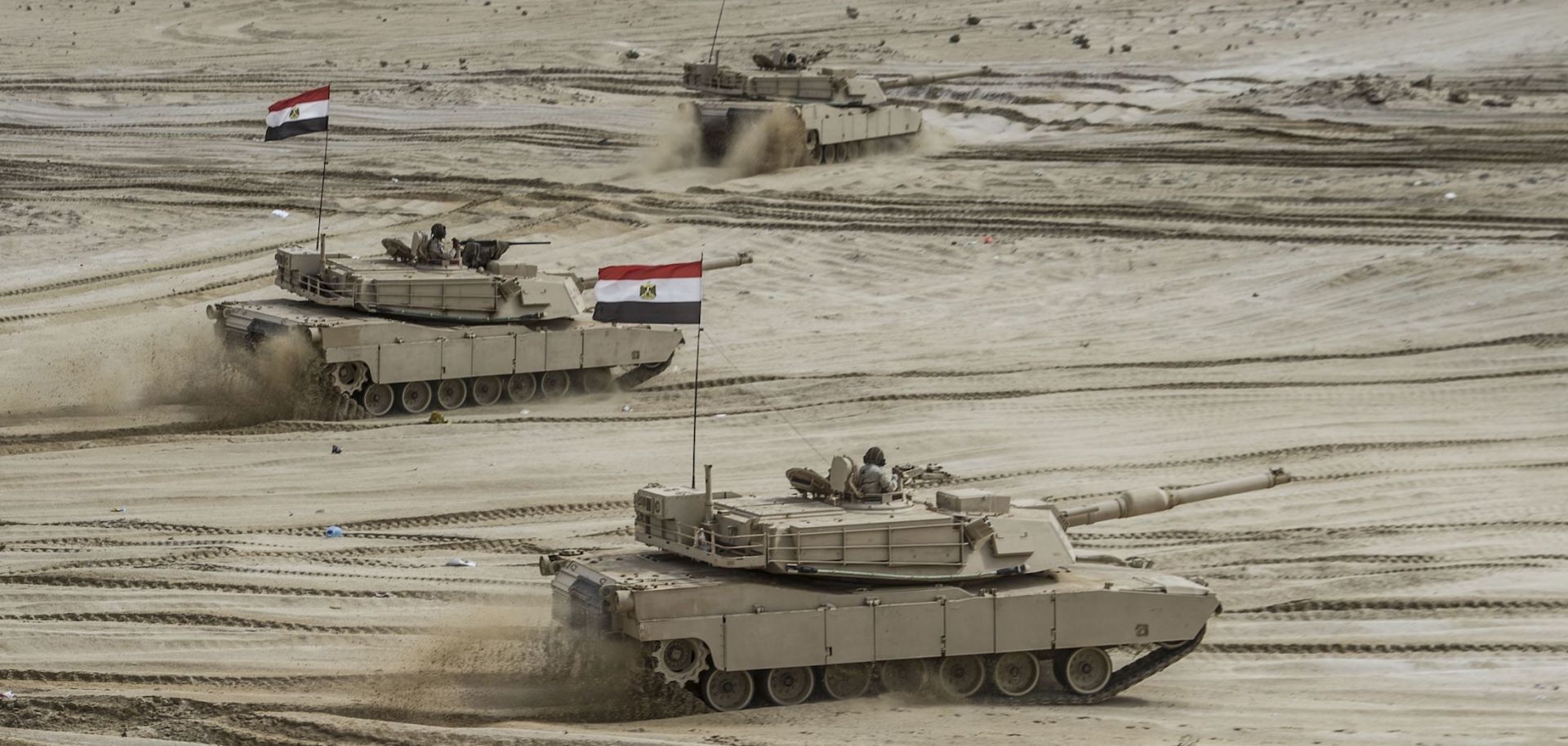
Egyptian tanks take part in joint military exercises at a base near the Mediterranean coast, located northwest of the capital of Cairo, on Nov. 15, 2018.
The U.S.-Egypt accord, one of the cornerstone bilateral relationships shaping stability in the Middle East and North Africa, will come under pressure as the Biden administration enters the White House promising greater scrutiny of Egyptian actions and as Egypt prioritizes regional stability in areas of less U.S. interest. Congress and the incoming Biden administration have already threatened the government of Egyptian President Abdel Fattah al-Sisi with sanctions and conditions on economic aid tied to human rights concerns. On top of this, Cairo is already reconsidering whether it needs to maintain its historic economic, security and diplomatic reliance on Washington at the same level. Even so, the United States is unlikely to terminate its substantial arms sales and aid to Egypt.
Domestically, Egypt's focus on political and economic stability at the cost of personal freedoms will clash with the Biden administration's renewed focus on human rights. This increases the risk of U.S. sanctions and stipulations related to economic aid, which could disrupt Egyptian economic stability. Under the al-Sisi administration, disappearances and arrests of nongovernmental organization workers, journalists and human rights campaigners have reached their peak in modern Egyptian history. The trend has been part of the government's effort to maintain political stability by sharply managing dissent. The instability following the Arab Spring and the resurgence of jihadist violence in the Sinai and Western desert have also focused the al-Sisi administration's attention on eliminating the Muslim Brotherhood and related groups, often leading Cairo to categorize any dissent as Brotherhood-linked. Such actions increasingly concern Western partners of Egypt, and the Biden administration has promised to review relations with Cairo with an emphasis on policing human rights violations.
- According to organizations like the Project on Middle East Democracy, repression in Egypt reached high levels in 2020 under al-Sisi.
- U.S. President-elect Joe Biden tweeted during the campaign in July 2020 that there would be "no more blank checks for Trump's favorite dictator" in reference to al-Sisi and the increasing number of forced disappearances and arrests of human rights campaigners in Egypt.
- Al-Sisi did enjoy good ties with U.S. President Donald Trump, who indeed referred to the Egyptian leader as his "favorite dictator" and said in al-Sisi's presence in May 2017 that the United States seeks "partners, not perfection." Congressional Democrats has already made clear, most recently via a letter to the al-Sisi government in October 2020, that Egypt's behavior is under increasing scrutiny and that arms sales and economic aid will be evaluated with Egypt's actions in mind. The Trump administration, which had little tolerance for political Islamist movements and took its partners' concerns at face value, embraced Cairo's campaign against the Muslim Brotherhood in a way the Biden administration might not.
Meanwhile, Egypt's increasing focus on ensuring stability in its immediate neighborhood does not match the top U.S. priorities in the Middle East, lessening opportunities for coordination and collaboration between the two over mediating regional conflict. As Egypt has emerged from a post-Arab Spring period of severe instability, it has shifted its mediation efforts toward issues abroad that directly impact Egyptian stability. This includes Eastern Mediterranean energy competition; ensuring stability in the Nile River Valley; border security with Libya and Sudan; and containing state supporters of the Muslim Brotherhood, like Turkey. Cairo is not convinced that these priorities align with U.S. priorities, which remain intensely focused on containing Iran and countering terrorist groups in Iraq and Syria.
- Egypt has engaged in a series of unusual military drills in recent months with regional partners, indicating a desire to display its independence.
- Egypt traditionally has not deployed its military forces abroad to places like Iraq and Syria per its domestic military doctrine, reducing opportunities for direct coordination with the U.S. military.
While Egypt will remain a key U.S. partner and recipient of aid, it will also seek closer relations with partners like Russia, which does not pressure Egypt over human rights abuses, and France, which has promised not to condition arms sales on human rights and is more active in the theaters in which Egypt is keenly interested. As Biden's Middle East policies take shape once he takes office, the future of Egypt as a key partner in regional counterterrorism and intelligence operations will become clearer. The Biden administration will not want to lose Egypt's valuable counterterrorism cooperation. Egypt meanwhile is likely to continue in 2021 to experience greater macroeconomic stability than most other countries in the region, which will boost support for government and domestic stability — as well as Cairo's willingness to challenge pressure by foreign governments like the United States over its politics.
- So far, Egypt is the only Middle Eastern country expected by the IMF and World Bank to experience economic growth in 2020, giving it a substantial head start in 2021, a time when most countries worldwide will still be grappling with COVID-19 related contractions.
- Egypt is the third-largest military arms importer in the world; Russia and France are major suppliers, increasingly so in recent years.
- French President Emmanuel Macron told al-Sisi in December 2020 that French arms sales to Egypt would not be conditioned on human rights abuses, a reflection of the economic importance of this relationship to France.
