
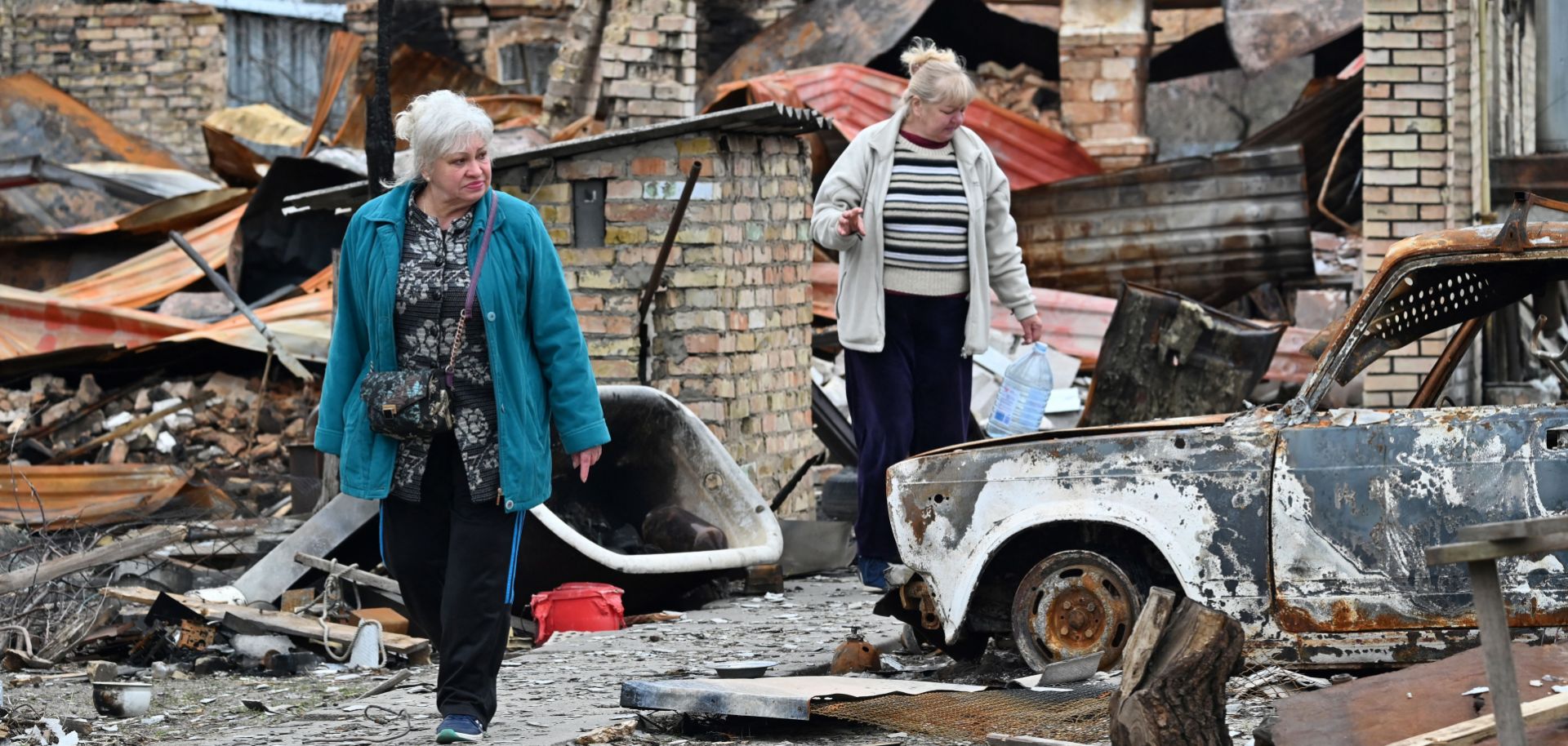
Two women survey their destroyed houses in the Ukrainian village of Moshchun, northwest of Kyiv, on April 20, 2022.
Russia's war against Ukraine entered a new phase at the beginning of April following its withdrawal of forces from northern Ukraine and the repositioning of units to the southeast for a renewed offensive in the country's eastern Donbas region. Moscow has put peace talks with Kyiv on ice, claiming Ukrainian and Russian negotiators had come to an impasse after allegedly hashing out the rough contours of a cease-fire agreement in Istanbul on March 29. The future of negotiations or any diplomatic settlement will largely depend on what happens on the battlefield in the coming weeks, as Russia seeks to seize or encircle the portion of the Donbas still under the Ukrainian government's control and neutralize as many Ukrainian forces as possible.
While negotiations between Russia and Ukraine will likely continue regardless, against this backdrop, the success of such talks and the near-term outlook of the conflict will hinge on the following developments:
1) Russia's military offensive in eastern Ukraine
By far the biggest factor weighing on negotiations is the evolution of Russia's renewed general offensive in eastern Ukraine, which commenced on April 18. Russian forces will likely attempt to seize the administrative borders still under Ukrainian government control of the Donetsk and Luhansk regions, collectively known as the Donbas, by threatening the region with encirclement. Russia's military will likely maintain a defensive posture in the Kherson region, conducting sporadic attacks to maintain the threat of an offensive there and spoil Ukrainian attempts to retake the western bank of the Dnieper River. Russia's recapture of the Donbas would enable the Kremlin to claim victory in completing its minimalist war aims of ''liberating'' and ''protecting'' the Russian-occupied separatist regions, which would then free Russia to move its troops to the defensive until Ukraine accepts this reality. The most likely scenario is that Moscow will expend significant resources to rapidly achieve these goals before unilaterally declaring a cease-fire and insisting that it wants a negotiated settlement. This could push Ukraine to conduct dangerous counter-offensives against increasingly dug-in Russian forces. If Russia fails to achieve its minimalist objectives and Ukrainian forces hold their positions for several more weeks, Russia would likely be pushed to eventually rebrand its so-called ''special operation'' as war to justify additional mobilization measures amid the certainty of prolonged conflict.
2) Russia's fungible war aims
While Russia will tailor its near-term war aims to the state of affairs on the battlefield, the Kremlin's long-term goal will remain pervasive influence over as much of Ukraine as possible. Russia maintains options for tuning and justifying its war aims based on how the situation on the battlefield unfolds. Should Russia recapture the Donbas, it will maintain its reduced war aims and claim that the ''denazification'' and ''demilitarization'' of Ukraine has largely been completed, insisting that negotiations revolve around a new Russian-Ukrainian border and the status of territories seized by Russia. In this scenario, there are two ways Russia could approach peace talks with Ukraine: Moscow could either return to negotiations in good faith and seek a comprehensive deal with Kyiv (which is unlikely but theoretically possible), or it could use the talks and a cease-fire to instead buy time for another large-scale offensive to take more territory. Substantial Russian success on the battlefield would raise the likelihood of the Kremlin choosing the latter of these two options by increasing its incentive to return to its maximalist war aims. If Russian troops are able to significantly degrade Ukrainian forces and capture large new pieces of territory to threaten cities such as Dnipro and Kharkiv, Moscow will be more likely to declare extensive mobilization to continue the war and secure more of Ukraine as quickly as possible. Moscow's ''demilitarization and denazification'' goals are by design highly fungible, allowing for a face-saving minimalist interpretation while also serving as a justification for further offensives against Ukraine.
3) Russia's occupation of southern territories
The viability of occupying additional Ukrainian territories, most notably the Kherson and Zaporizhzhya regions, will heavily factor into Russia's decision of whether to continue the war and go further in eastern Ukraine. There are already signs that Moscow intends to conduct a prolonged occupation of the Kherson and Zaporizhzhya regions and establish pro-Russian collaborationist governments there modeled off the self-proclaimed Luhansk and Donetsk republics in Donbas, which would all but end the possibility of a peace deal. Most notably, Ukrainian sources claim that the pro-Russian occupation authorities are working on referendums in the regions — which could take place as soon as the first week of May — on their independence or annexation by Russia. Should these referendums take place, as appears likely, Moscow will probably be compelled to occupy Ukraine's Kherson and Zaporizhzhya regions. Alternatively, should Russia opt to maintain its minimalist war aims, it could still occupy these areas to later exchange them with Ukraine for recognition of the Donbas and Crimea. However, this appears unlikely, as it would involve giving up on pro-Russian collaborators and could be considered an unnecessary disgrace by Russian nationalists, particularly as Moscow has used the rhetoric of not abandoning the Russians of the Donbas to justify this military action. Furthermore, as Russia considers renewed future offensives against Ukraine, it would have little incentive to withdraw from these areas now only to have to retake them in the future. Russia has little interest or need to withdraw from Kherson and Zaporizhzhya, and the longer Russia occupies them, the more the local population and the Russian elite and popular opinion will acquiesce around the idea of their annexation, which would severely reduce the possibility of a peace deal.
4) Ukraine's negotiating position and internal political constraints
The Ukrainian delegation has already shown flexibility in its negotiating position, putting the status of Crimea and the Donbas on the table for discussion in a proposed meeting between Ukrainian President Volodymyr Zelensky and his Russian counterpart Vladimir Putin, and having allegedly neared agreement regarding Russia's other demands. But even in the currently unlikely event that a Putin-Zelensky meeting does materialize, Putin will likely demand the full and immediate recognition of Russia's sovereignty over Crimea and the independence of the Donbas, which would subsequently be annexed by Russia, while Zelensky will not accept anything less than the immediate departure of Russian forces from Kherson, Zaporizhzhya and any other Russian occupied areas outside the Donbas. Furthermore, Zelensky probably fears that Russia could conduct the negotiations in bad faith, appearing close to or even striking a comprehensive deal only to renege on it and renew its invasion. In addition, many Ukrainian soldiers are unlikely to accept a peace deal, even one relatively favorable to Ukraine, and could attempt to continue fighting or protest the move. Kyiv will resist agreeing to any deal that risks granting Ukraine the worst of both worlds by leaving the door open for continued war and creating a highly destabilized political environment at home that would endanger the country's current unity (which is extremely important amid the prospect of prolonged war). Thus, while Ukraine and Russia may reach a narrow cease-fire in the coming weeks and months, a comprehensive peace deal remains highly unlikely to be struck, let alone last.
