
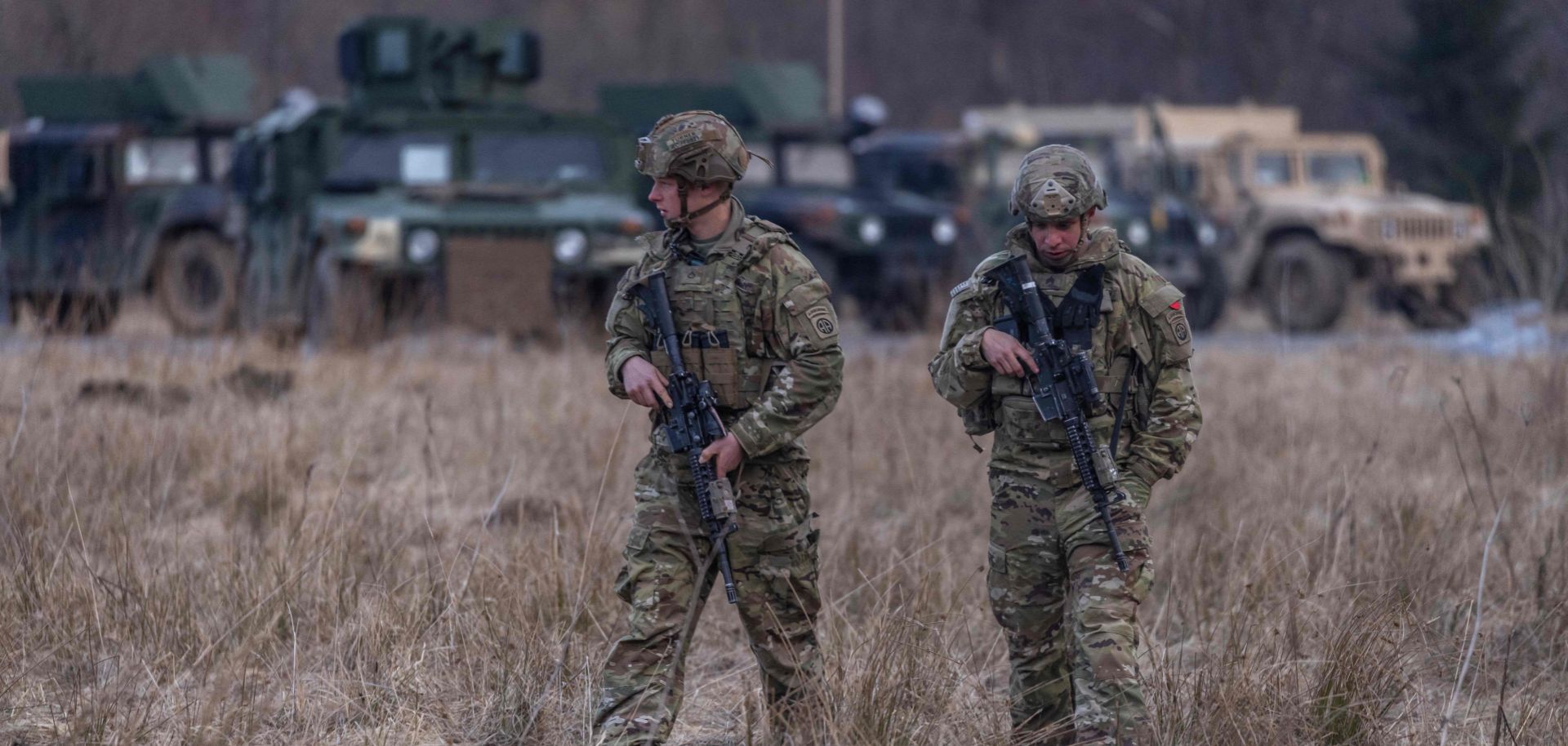
U.S. soldiers are seen in southeastern Poland, near the border with Ukraine, on March 3, 2022.
Russia’s military goals in the current conflict appear limited to Ukraine, but the possibility for battlefield miscalculation or a deliberate escalation in tit-for-tat moves with NATO and EU states presents an unlikely but underlying risk of triggering a wider conflict. Russia seems primarily focused on curtailing Ukraine’s military capacity, enlarging the buffer territory around separatist republics in eastern Ukraine’s Donbas region, and forcing Ukraine to give up hopes of joining NATO and the European Union through regime change and/or significant and lasting Russian influence. These goals, while expansive, are contained to Ukraine for now. However, the longer the war drags on and the more Western states provide military support, the greater the risk of an accident or calculated move widening the conflict to other nearby states, particularly as Moscow seeks to portray the West as the aggressor.
Western countries’ increasing military support for Ukraine opens multiple avenues for potential escalation if Russia interprets such moves as tantamount to NATO involvement. The introduction of large numbers of well-equipped and trained volunteers from NATO countries (which Ukrainian officials have called for and some Western officials have tacitly, and in some cases explicitly, blessed) could provoke Russian retaliation, as could sharing targeting intelligence with Ukrainian forces in real-time (which the United States on March 3 confirmed was already taking place). Moscow may also see supplying Ukraine with certain sophisticated anti-tank or anti-air systems as justifying a response by undercutting Russia’s strategic battlefield advantage. In retaliation, Russia could try to physically block arms shipments through the Polish-Ukrainian border, as well as virtually block the provision of intelligence by conducting cyberattacks — raising the risk of a direct conflict with NATO states or a series of tit-for-tat escalatory moves that result in such. This development becomes more likely the longer the war goes on and the more the West supports the Ukrainian military’s need for additional manpower, equipment and strategic support to maintain the fight against Russia.
- Aside from Ukraine, Belarus and its own territory, Russia’s European enclave of Kaliningrad offers another location from which Russia could conduct various forms of aggression.
- In this scenario, the potential Russian capture and/or use of foreign citizens (particularly European or North American ones) as human shields and/or propaganda could also trigger an intervention by Western powers, as could Russia’s killing of a Westerner on the battlefield — especially if seen as deliberate.
There are also a number of scenarios involving either accidental or deliberate activities along Ukraine’s borders or in nearby areas that could lead the conflict to expand beyond Ukraine. Most immediately, potential Russian military activity along Ukraine’s western borders could create a flashpoint, such as an errant Russian missile, artillery or other strike that lands in the territory of a NATO member state, or a Russian warplane that strays into NATO territory near Ukraine. Even if there are no casualties, the current climate of high tensions could see all sides assume the worst and quickly spiral out of hand. So far, Russian forces have not been operating in western Ukraine but this development cannot be ruled out, especially if the war drags on and Russian troops seek to curtail an insurgency.
- A flashpoint between a non-NATO state and Russia could also provoke escalation as the West would almost certainly back the non-NATO state, even if not required by the terms of NATO collective self-defense. On March 2, Sweden accused four Russian jets of briefly entering its territory over the Baltic Sea, illustrating how such a situation could emerge.
- Intentional damage or destruction of ships in the Black Sea by Russian forces could also lead to increased calls for an active response from NATO member states. On March 3, an Estonian-owned cargo ship sank off the Black Sea after an unknown explosion. All six crew members were rescued and so far Russia has not been directly implicated. But in the current environment of distrust, even an accident could trigger calls for NATO intervention, especially if there are casualties from a NATO member state like Estonia (although the crew members from the sunken ship were reportedly from Ukraine, Russia and Belarus).
Russia could also seek to exert coercive pressure against the West in nearby countries, which in turn could raise the risk of NATO involvement. As it has repeatedly done, Russia could seek to use asymmetric means to retaliate against Western sanctions and military support for Ukraine by leveraging pro-Russian elements in European countries. For instance, it could mobilize Russian ethnic minorities in Baltic states (which are NATO members) to try to stir unrest and weaken those countries’ pro-Western governments. Similar to what happened in eastern Ukraine’s Donbas region, an extreme scenario could see those minorities proclaim separatist republics and then have Russia justify supporting them with weapons and possibly even soldiers, triggering NATO’s collective self-defense mechanism. In Moldova (which is not a NATO member), Russian troops already stationed in the pro-Russian separatist region of Transnistria could also support Russian minorities elsewhere in the country. This would generate serious concern in neighboring Romania, which could then ask its NATO allies to respond to Moscow’s attempts to destabilize the region — potentially leading to direct military confrontation with Russian forces.
- In addition, Russia could try to seed pro-Russian elements into the outflow of people from Ukraine into neighboring states. This would be similar to the crisis this past fall, when EU states bordering Belarus accused Minsk and Moscow of not only deliberately facilitating migrant flows from Middle Eastern countries, but also of infiltrating them with intelligence officers and saboteurs. In an escalatory scenario, Russia (perhaps via proxies) could even arm supposed “migrants,” who could then seek to carry out attacks along the border with Poland, which has received by far the most migrants. This could force a Polish and, in turn, NATO military reaction.
Western actions to protect other nearby states and punish Russia for its invasion offer further potential avenues that could expand the war beyond Ukraine. Even if less likely, there are now high-level conversations about the European Union potentially fast-tracking and overlooking some of the constraints on admitting Ukraine to the bloc, along with Georgia (another country where Russia intervened in 2008 to prevent its tilt towards the West). Finland and/or Sweden, meanwhile, could rapidly move toward joining NATO. Moscow would view either of these developments as highly threatening and could feel justified in using force to prevent or reverse such steps.
- There is also the possibility, which grows the longer the war continues and the likelihood that Russian abuses come to light, that the West will impose the harshest possible sanctions that lead to a Russian economic collapse. These include directly sanctioning Russian energy exports and fully cutting off all Russian banks from the SWIFT payment system. Moscow would likely portray such moves as tantamount to war — something then Prime Minister Dmitry Medvedev explicitly said regarding Russia’s potential SWIFT removal in December 2019 — and could use them to justify using military force against the West, possibly as a way to force peace talks that see the removal of sanctions in exchange.
Finally, there are a few wildcard scenarios that could result in broader conflict between NATO and Russia.
- Major cyberattacks: Although Russia has so far not engaged in destructive cyberattacks since invading Ukraine on Feb. 24, non-state or para-state cyber threat actors could move beyond the constraints of government and attack critical infrastructure in the West or Russia. Should such attacks lead to a loss of life, they would likely provoke escalatory cyber and eventually kinetic responses. While it is possible that pro-Ukrainian cyber actors could engage in such activities, they would more likely come from Russian cyber actors, which have shown a willingness and capability to target critical infrastructure. An attack in which there is a lethal outcome would also most likely be a “red line” for either a kinetic Western response, or a proportional cyberattack that also has a kinetic impact, leading down a path to potential physical confrontation.
- Clashes in other conflict zones: It is also possible that Russian and NATO forces clash elsewhere in the world, in a confrontation that then catalyzes escalation in or near Ukraine. The most likely location for this to occur would be in Syria, where both U.S. and Turkish forces also operate and have previously clashed with Russian troops. However, other locations where Russian troops (or mercenaries) and NATO forces operate near each other, such as in parts of the Sahel region of sub-Saharan Africa, could also serve as flashpoints.
- Significant Russian escalation: In the least likely but most impactful scenario, Russian President Vladimir Putin’s implicit threat to use tactical nuclear weapons would almost certainly cause the West to increase lethal military and other forms of assistance to Ukrainian forces, which could, in turn, provoke further Russian retaliation that escalates to direct conflict. Russian use of chemical weapons and/or use of force that results in widespread Ukrainian civilian casualties could also lead to a similar outcome.
