
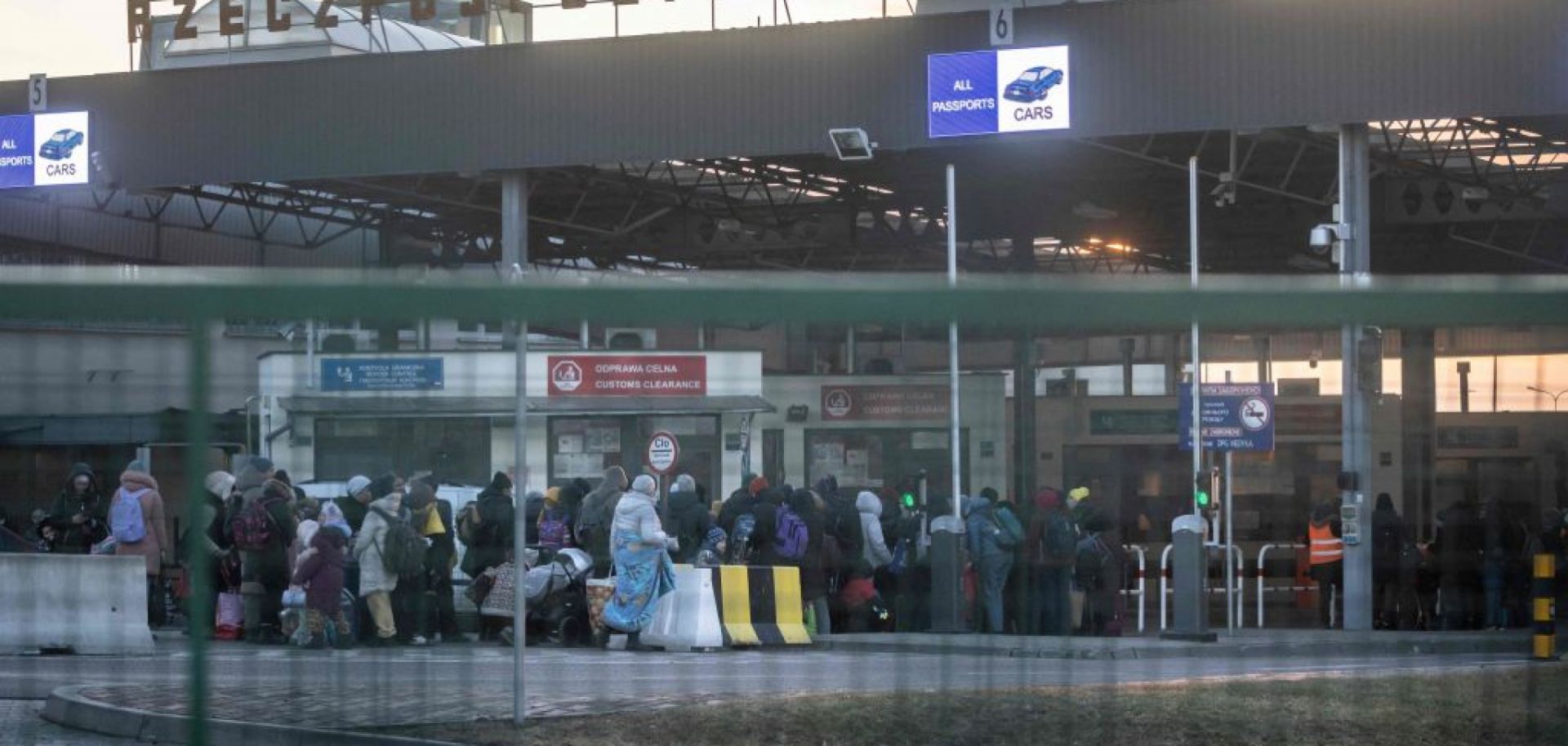
Refugees from Ukraine line up to enter Poland on Feb. 28 at the border crossing in Medyka, Poland.
While Poland faces no immediate threat of Russian military aggression, it is exposed to unconventional attacks from Moscow that will keep tensions high in the coming weeks. The events in Ukraine could also negatively impact the Polish economy, while the influx of migrants from Ukraine could produce a nationalist backlash. Poland's primary geopolitical concern is a potential Russian attack, which explains why it is one of the most hawkish EU and NATO member states when it comes to calling for sanctions against Russia. But Poland faces no immediate threat of Russian invasion because it is covered by NATO's collective defense framework, and Russia is not interested in going to war with the alliance. Russia's response to EU sanctions, however, will likely include unconventional aggressions such as cyberattacks against governments and businesses and disinformation campaigns. So while Poland faces no direct military threat from Russia, the risk of other forms of warfare will remain high for several weeks.
- Russia's actions in Ukraine are likely to cause Poland to increase its military spending. The country already is one of the few NATO member states that meets the alliance's target of spending at least 2% of its gross domestic product on defense spending. Russia's invasion of Ukraine will make it easier for Poland's military establishment to convince politicians to increase defense spending, and will also motivate the government to spend more on cybersecurity.
In the short term, the events in Ukraine will reduce tensions between Poland and the European Commission and pause threats from Brussels to cut Warsaw's funding. For years, Brussels has accused Warsaw of increasing political control of the judiciary and pressuring independent media, while Warsaw has accused Brussels of interfering in Polish domestic affairs. This is a risky confrontation for Warsaw, because the commission has threatened to suspend EU funding, of which Poland is a net receiver. The need to show a united front against Russia and Poland's exposure to events in Ukraine, however, will likely result in a truce between Brussels and Warsaw that will reduce the risk of cutting much-needed EU funding for Poland, at least temporarily.
- In mid-February, the European Court of Justice ruled that a mechanism to link the disbursement of EU funds to respecting the bloc's values and norms is legal. This gives the European Commission leverage in its dealings with member states that refuse to comply with the bloc's rules.
Despite a temporary truce with Brussels, EU sanctions against Russia and the probable collapse of the Ukrainian economy will negatively impact Poland. Trade between Russia and Poland is not particularly strong, but Poland imports goods such as fertilizers and chemicals from Russia and exports agricultural products to Russia, all of which could be affected by the combination of trade sanctions and the negative economic impact of war on the Russian economy. In recent years Poland has reduced its reliance on Russian natural gas by increasing its liquefied natural gas imports, which means that it is in a relatively good position to withstand eventual reductions in Russian exports to Europe. But if the Ukraine crisis continues to result in higher oil prices around the world, it could have an inflationary impact on Poland. In the meantime, trade between Poland and Ukraine is relatively small, with only about 2% of Poland's exports going to Ukraine. Still, should the war with Russia continue for several weeks, it would probably have a severe impact on the Ukrainian economy that will in turn have a negative impact on Polish exports at a time when Poland is still recovering from the COVID-19 pandemic.
- In late 2021, the Polish government announced that it will not sign another long-term supply contract with Russian energy giant Gazprom after its current contract expires at the end of 2022. Instead, Warsaw plans to replace Russian natural gas imports with LNG imports, supplies from the upcoming Baltic Pipe (which will transport natural gas from Norway) and spot deals. In addition, Poland plans to supply the parts of the country that are the farthest away from its LNG terminal through the upcoming Poland-Slovakia gas interconnector, which will become operational in late 2022.
- On Feb. 21, Polish Deputy Prime Minister Jacek Sasin said that natural gas storage facilities in Poland are 80-90% full, which would delay for weeks the impact of Russia cutting its supplies to the country.
The increase in migrants from Ukraine could over time produce a nationalist backlash in Poland. While in the short term Polish authorities and local communities will welcome these migrants out of solidarity, in the long run, a significant spike in the arrival of Ukrainians could produce mixed results in Poland. On the one hand, it could help Poland mitigate the demographic impact of low fertility rates and high emigration rates by providing a significant influx of young Ukrainians seeking to enter the Polish workforce. On the other, it could also generate a nationalist reaction in Poland, especially in rural areas in the east of the country where the standards of living are lower and where some of the migrants at least initially will likely be housed. Poland's nationalist government is critical of immigration, which means that after the Ukraine crisis is over Polish authorities could take a stricter stance on Ukrainian immigrants. Poland will hold a legislative election in late 2023, and immigration is likely to be a central issue of the electoral campaign.
- According to the United Nations, more than 520,000 people have left Ukraine since the beginning of the war with Russia, with more than half of them going (280,000) to Poland and the rest opting for Hungary, Slovakia, Romania and Moldova. While most of them are Ukrainian nationals, there are also thousands of nationals from African and Middle Eastern countries who were studying or working in Ukraine; their arrival is more likely to provoke a nationalist backlash in Poland.
- Around 1.5 million Ukrainian nationals currently live in Poland. Poland's growing economy, higher standards of living and cultural similarities with Ukraine are some of the main reasons for migration. According to EU data, most Ukrainian migrants are under 40 years of age.
- More than a million Polish citizens left the country in the decade that followed Poland's EU accession in 2004. Poland's fertility rate stands at 1.4 children per woman, one of the lowest in the world. If it remains unchanged, this combination of high emigration and low fertility rates will result in the aging and reduction of Poland's population in the coming decades.
