
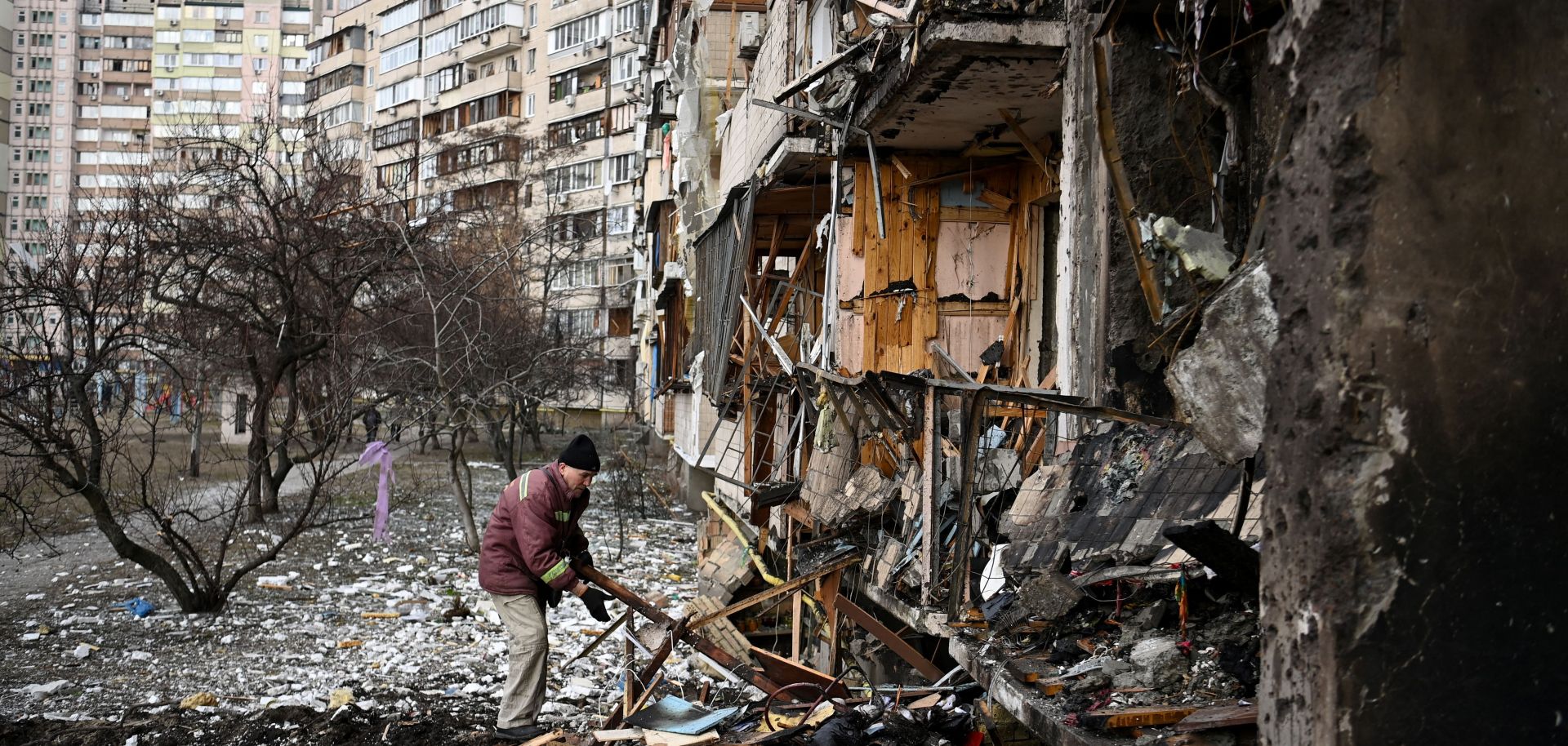
A man clears debris around a residential building allegedly hit by a military shell in a suburb outside of Kyiv, Ukraine, on Feb. 25, 2022.
At the conclusion of the second day of Russia’s invasion of Ukraine on Feb. 25, Russian troops continued their incursions in the country on multiple axes — most notably against the capital Kyiv, which will likely be surrounded and besieged over the coming days. In recent hours, Russian officials have made conflicting statements about inking a potential political settlement with Kyiv to end the conflict. But President Vladimir Putin and Foriegn Minister Sergei Lavrov have both continued to assert the current Ukrainian government is illegitimate and insist on Ukraine’s “denazification and demilitarization,” which is a strong signal that Moscow’s ultimate goal in the country remains regime change. In the coming weeks, there are several potential courses of action that Russia could take in Ukraine, with each having its pros and cons for Moscow:
1) Russia installs a pro-Moscow government in Kyiv while its military occupies large pieces of the country.
In this scenario, Russia would seize Kyiv by force and then put pro-Russian political forces (for example, some of those that fled the country in 2014) in power, who would then change Ukraine’s constitution to ensure the country’s neutral status or demilitarization. This new government would sign an agreement with Moscow ensuring Russia’s right to have military bases in Ukraine and secure public order. The constitutional changes would also include guarantees for the status of the Russian language in the country, as well as the federalization of Ukraine to give more power to regional governments influenced by Moscow. In this scenario, western Ukraine would likely not recognize the new government in Kyiv, triggering continued national resistance and a secessionist movement.
- Drivers: This scenario is the most likely to achieve Russia’s most ambitious stated goals of “demilitarization and denazification,” as the installation of a pro-Moscow regime combined with the constitutional amendments would prevent Ukraine from further integrating with European and transatlantic structures in the long term.
- Constraints: This outcome is also the most expensive in the long run because it would force Russia to keep a permanent military presence in the country and finance a government that would not be recognized by the international community. It would also likely result in a violent nationalist resistance movement, particularly in the section of western Ukraine excluded from the government. Moreover, this scenario would almost certainly result in the West keeping its economic sanctions against Russia in place for an indefinite period, which would progressively weaken the Russian economy. While force, intimidation and corruption could be used to maintain order in the short-to-medium term, the long-term costs and risks would be high.
2) Russia coerces a government in Kyiv to sign a deal and most of its forces leave Ukraine.
In this scenario, Russia would force a government in Kyiv (possibly with Ukrainian President Volodymyr Zelensky’s government on the condition it resigns in favor of a new transitional government), to sign a deal that would constitutionally fixate Ukraine’s neutral and demilitarized status, and possibly some Russian military bases in Ukraine to help guarantee the deal. Ukraine would also surrender its claims to Crimea and cede the eastern Donbas region. The government in Kyiv would also possibly agree to fixate federalization and guarantee the status of the Russian language in the constitution. Russian troops would then exit the country, leaving Ukraine in ruins and in intense political turmoil in the aftermath of the invasion.
- Drivers: The scenario would enable Russia to accomplish many of its biggest goals in Ukraine regarding neutrality and other matters in the short term without having to resort to a lengthy and costly military operation and occupation. The West could also soften its sanctions against Russia over time, especially if it perceives the Ukrainian government as legitimate and Russia’s military presence is kept at a minimum.
- Constraints: Apart from threatening a renewed military intrusion and occupation, Russia would have few levers to ensure Ukraine sticks to the post-war agreements. This scenario would also not change the Ukrainian population’s general anti-Russian political stance, which would only worsen if Moscow forces the country’s government into an agreement after invading its territory. Over time, pro-Western Ukrainians could stage large anti-government protests to abolish the deals it signed with Russia as well.
3) Russia partitions Ukraine in some fashion, most likely along the Dnieper River, leaving the current Ukrainian government in control of a rump state in the west while occupying the other half.
In this scenario, Russia would recognize a large piece of eastern Ukraine (which is home to a large ethnic Russian population) as a new independent state, effectively partitioning the country into East and West Ukraine. The separatist Luhansk and Donetsk republics in Donbas would unify with this new pro-Russian eastern state, which would likely be named Novorossiya or Malorossiya (which translates to “New Russia” and “Little Russia,” respectively). Russia would occupy only the area of its newly recognized government — most likely west of the Dnieper River but possibly including Kyiv, leaving the territory still under Ukrainian government control as a rump buffer state with NATO.
- Drivers: Creating a relatively homogeneous state that pledges to keep close economic, political and security ties with Moscow would be significantly less costly than attempting to occupy more of Ukraine.
- Constraints: But the part of Ukraine still controlled by a pro-Western government would remain the highly militarized “anti-Russia” state that Putin has sought to eliminate, maintaining the risk of additional military confrontations. Most of the international community would also not recognize the eastern Ukrainian state, forcing Russia to remain its main sponsor.
4) Russia settles for degrading Ukrainian defense and economic capabilities before withdrawing without a peace settlement.
In this scenario, unexpectedly stiff resistance from the Ukrainian population, including partisans and the remnants of the Ukrainian military, convinces Russia that establishing sufficient control over the country would be too costly in the near- and medium-term, and that reaching a peace agreement with an illegitimate and unpopular Russian-imposed government would not achieve Moscow’s goals. As an alternative to an expensive occupation, Russia would effectively back off its insistence on a change of government and instead impose max destruction on Ukrainian civilian and military infrastructure, ports, airports, railways, military, factories, arms storages and military bases before withdrawing all ground troops. After killing thousands of Ukrainian servicemen and destroying much of the country’s military equipment, Russia would then withdraw and threaten to repeat the operation against a weaker Ukraine should the government revert to its previous course and rearm.
- Drivers: This scenario would minimize military and economic costs for Russia, but would largely be considered a success for Ukraine, for having survived the overwhelming Russian onslaught without having its territory (other than the breakaway Donbas republics) further occupied or partitioned. The main benefit for Russia in this scenario is that it would probably trigger a slow process of lifting some of the harshest sanctions from the West.
- Constraints: The failure to secure changes to Ukraine's constitution would mean that Russia’s fundamental goals regarding the country’s neutrality and demilitarized status would remain unfulfilled, with Russia conceivably having to resort to a similar operation again several years down the road to achieve those objectives.
