
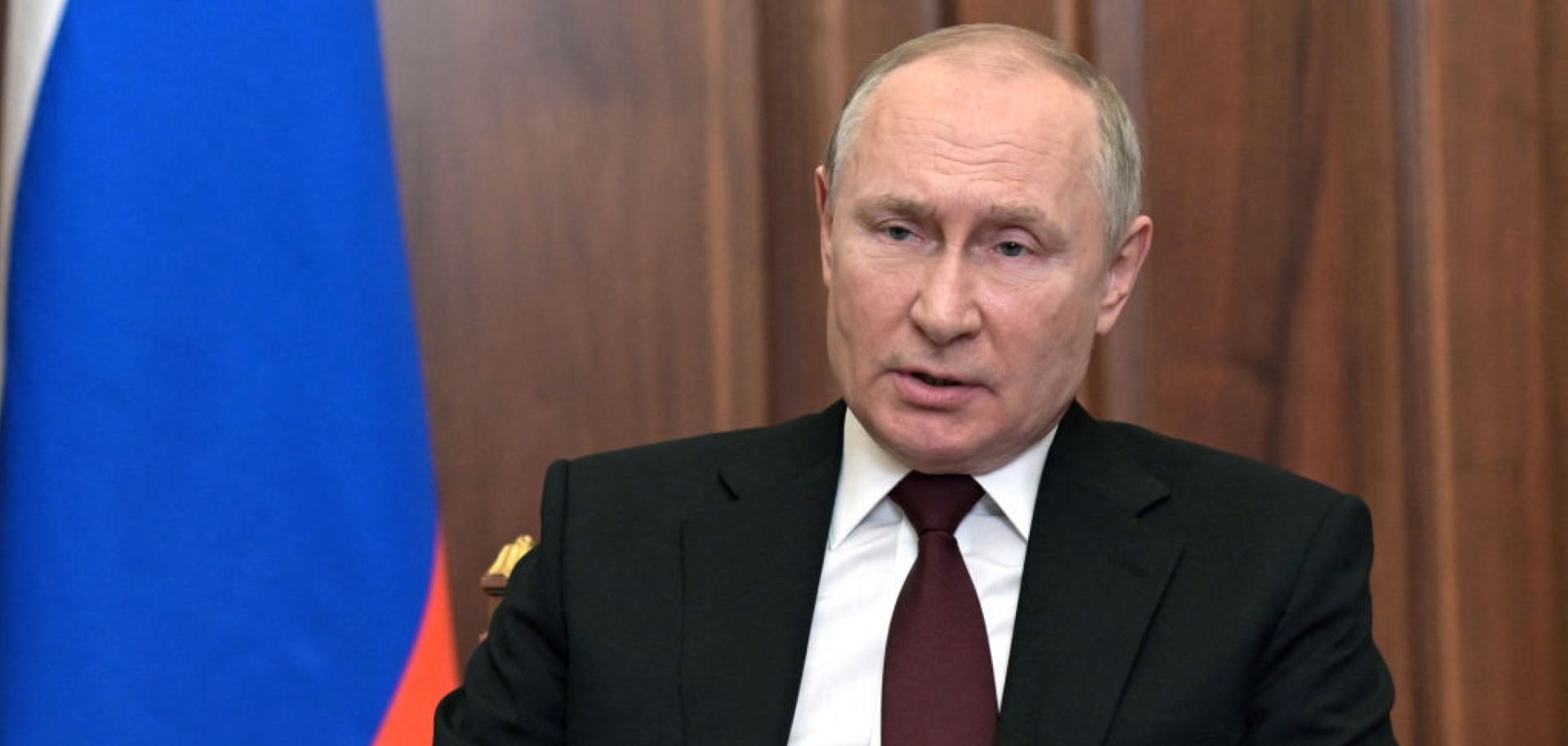
Russian President Vladimir Putin during a Feb. 21 address to the nation at the Kremlin in Moscow.
Russia's recognition of the Luhansk and Donetsk People's republics (LPR/DPR) in Eastern Ukraine as independent countries takes the conflict with Ukraine into a new phase that will likely involve Moscow using the threat of further military action against Ukraine to constrain Kyiv. At a meeting of Russia's Security Council on Feb. 21, top Russian officials supported recognizing the independence of the Russian-occupied separatist regions of Ukraine as independent countries, a decision President Vladimir Putin announced in a televised speech. Moscow's decision signifies the end of the Minsk II Agreement that Moscow had, until days ago, insisted since 2015 was the only way to regulate the conflict. Russia's abandonment of the Minsk peace agreements signifies the end of its previous strategy for exerting influence over the Ukrainian government. Instead of using the LDR/DPR governments as proxies for diplomatic leverage and low-level insurgency against Kyiv, Russia's assumption of more control over the separatist territories gives Russia the ability to either take more decisive military action in the near term, or keep a baseline level of coercive pressure against Ukraine to ensure Russian influence that makes Ukraine unstable and, if seen as necessary, allows Moscow to re-escalate militarily.
Moscow's recognition of the republics' independence could simply be intended to formalize previous tendencies favorable to Moscow. Few countries will follow Russia's example by recognizing the regions' independence, but the move will leave the conflict unresolved like others in the region — such as those in Moldova or Georgia — and demonstrate the West's inability and unwillingness to effectively intervene, thereby also effectively ending the already dubious prospect of Ukrainian NATO membership. Russia's troops in the Donbas could also seek to constrain the separatists, preventing them from dragging Moscow into a military action that would jeopardize Moscow's reinforcement of this adjusted status quo or risk harsher Western sanctions.
Alternatively, Moscow could use the treaties allowing it to station Russian troops in the breakaway republics for military action against Ukraine in the coming days. In this more escalatory scenario, Moscow could seek to pair its recognition of the LPR/DNR with further military action against Ukraine in order to return Russian control over a large portion of the country. Failing to do so would free the Ukrainian government from its responsibilities in the Minsk agreements without Moscow acquiring a new, alternative form of leverage over Kyiv other than military force, while also ensuring the end of European security talks. Moscow could use the forces still massed around Ukraine's borders for a large-scale military operation against Kyiv, or take military-technical response measures such as troop and missile deployments to make this threat a full-fledged alternative form of leverage over Kyiv and the West. Russia will likely deploy its force in a so-called "peacekeeping" role along the contact line in Donbas, which could start engaging Ukrainian troops in an alleged offensive action against the Donbas, providing Russia justification for further military action. The question is whether a Russian military operation would constitute an attempt to expand the territory of the separatist republics to their claimed administrative borders, or to conquer much larger pieces of Eastern and Southern Ukraine (for example, a land connection to Crimea). A Russian attack beginning in the Donbas could envelop the majority of the Ukrainian Armed Forces there and prevent them from falling back to defend Kyiv.
- Recent Russian dis-/mis-information efforts appear to be setting the stage for some sort of military incursion in Ukraine. There have been numerous reports in Russian media in recent days alleging Ukrainian military activities against Russia proper, for example, an alleged raid by Ukrainian special operations forces that led to the capture of a Ukrainian servicemember, and reports of shells striking Russia. The Ukrainians deny these events, and they fit with dis-/mis-information narratives intended to justify large-scale military action against Ukraine, rather than a limited operation to defend the Donbas.
- The treaties do not specifically state what borders Russia recognizes as comprising the LPR and DPR, leaving Moscow's exact position regarding its relationship to the republics' claimed boundaries unclear. Andrey Klimov, deputy chairman of the Federation Council committee on international affairs, said Feb. 21 that the treaties on friendship and cooperation will deal with "those territories that are within the boundaries established today." Russia only recognizing the republics in their current de facto borders would somewhat lessen the imminent likelihood of a Russian military action, while language explicitly endorsing their territorial claims on Ukraine would increase the possibility of a conflict now or in the future.
The West will enact some measures against Russia, but major sanctions are unlikely so long as Russia does not attempt to occupy more Ukrainian territory. Russia will frame its actions as a mere formalization of the status quo that had existed for many years amid Kyiv's refusal to enact Moscow's interpretation of the Minsk agreements. Since Russia's latest overt movement into the Donbas for now has not involved the seizure of any new territory recently under the Ukrainian government's control, many Western leaders will be reluctant to enact harsh sanctions. But the United States has already enacted some symbolic measures and Congress will likely push for a new package of sanctions on Russia.
- The Biden administration signed a new executive order blocking new U.S. investment, trade and financing from flowing to the two Russian separatist-held regions in Ukraine immediately following Russia's recognition announcement.
- A new U.S. sanctions bill on Russia would likely borrow from sanctions already prepared by U.S. senators such as Bob Menendez, Jim Risch or Marco Rubio, but would be somewhat watered down and would clarify what additional sanctions could be enacted should Russia secure more Ukrainian territory.
- EU foreign policy chief Josep Borrell said that "if there is annexation there will be sanctions" against Russia, and the German and French governments have warned Russia not to violate the Minsk agreements. Unnamed EU diplomats reportedly have said the bloc is still debating what kind of Russian actions would trigger sanctions against Moscow.
