
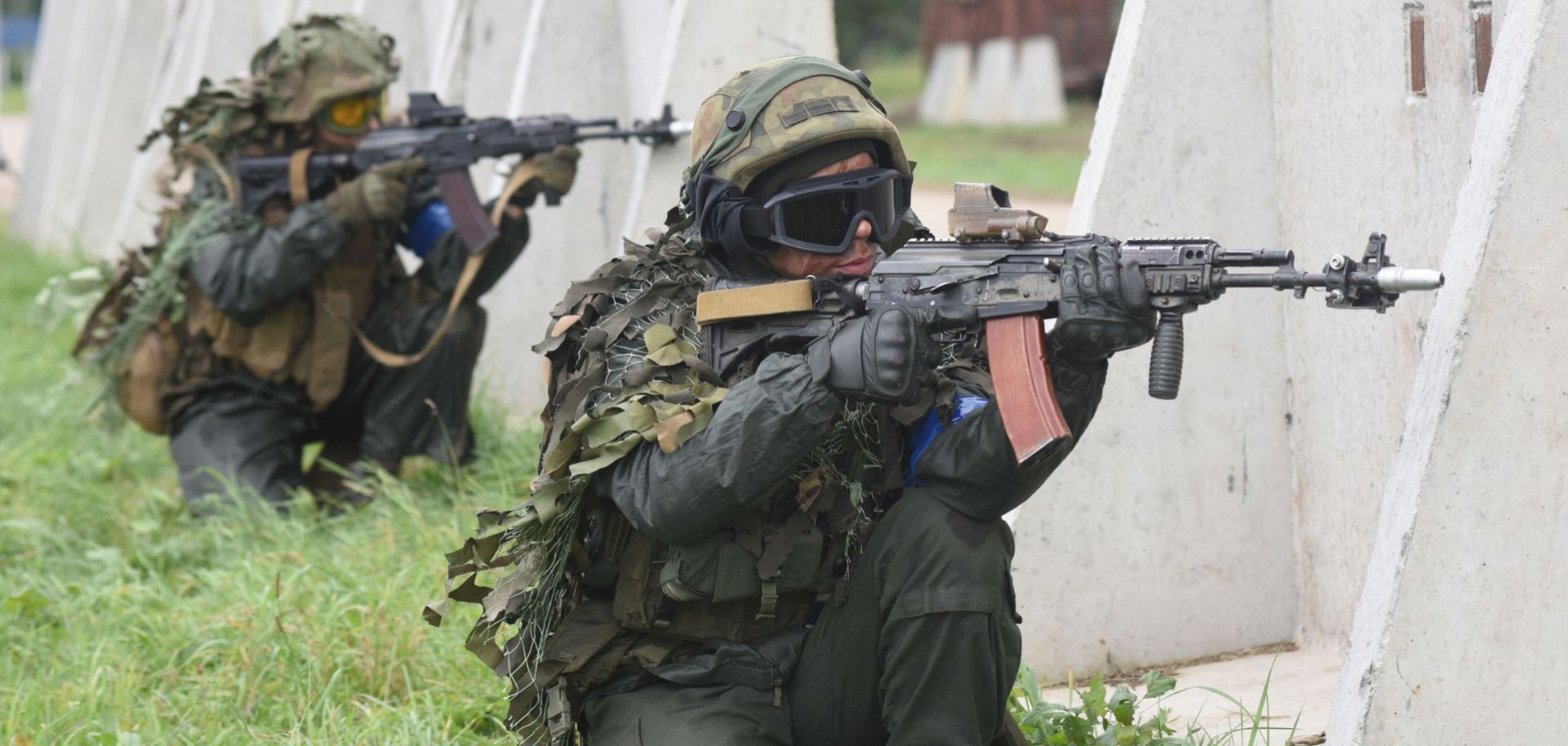
Ukrainian servicemen take part in the joint military exercises with the United States and other NATO countries near Lviv, Ukraine on Sept. 24, 2021.
The likelihood of a major escalation in the Donbas conflict remains low, but is trending upward amid Ukraine’s disregard of the Minsk agreements and Russia’s continued military presence in the disputed areas and near the Ukrainian border. On Oct. 30, the Washington Post reported that U.S. and European intelligence officials were concerned about a renewed buildup of Russian personnel and equipment near the Ukrainian border, saying the movements were irregular and had reignited the same concerns that arose in April, when Russian troops gathered at the Ukrainian border and left equipment and infrastructure prior to September’s Zapad 2021 exercise.
- Troops based in Siberia were observed near the Ukrainian border instead of returning to base following the Zapad exercise, while elite troops normally based outside of Moscow were observed amassing at a site near both the Ukrainian and Belarusian borders, as corroborated by satellite images provided by Politico on Nov. 1.
- On Nov. 3, Ukraine acknowledged that 90,000 Russian troops remained stationed not far from their border and in rebel-controlled areas in Ukraine’s east following the Zapad 2021 exercise. Ukraine's defense ministry said it was particularly concerned with the potential build-up of a Russian rapid response force, citing the deployment of Russia’s elite 41st army near both Belarus and Ukraine’s borders in Yelnya.
- Russia began a new phase of growing its military infrastructure near the Ukrainian border and in Belarus this year, increasing Moscow’s ability to quickly deploy to the Western frontiers in case of a contingency. Russia left additional military equipment, as well as control and communications centers, at sites along the Ukrainian border following the Zapad-2021 exercise, according to Ukraine’s National Security and Defense Council.
Russia’s latest maneuvers near the Ukrainian border exemplify how Moscow will try to get the United States and European states to pressure Kyiv into staying in the Minsk agreements. The peace process outlined in the 2015 Minsk agreements has stalled amid Russian-backed separatists’ regular and often deadly cease-fire violations, as well as their failure to provide full, unobstructed access to monitors from the Organization for Security and Cooperation in Europe (OSCE). Kyiv also insists that Russia’s decision in April 2019 to begin the mass distribution of Russian passports to people living in the separatist controlled areas fundamentally changed the nature of the conflict and made the Minsk agreements unworkable.
- During Ukrainian President Volodymyr Zelensky’s visit to the White House on Sept. 1, the two sides allegedly agreed that the United States would push France and Germany to drop their insistence on sticking to the agreement and specifically the Steinmeier Formula, which is an interpretation of the Minsk agreements supported by Russia that would grant the Donbas constitutionally-enshrined special status and conduct local elections prior to Kyiv being returned control over the region’s border with Russia. Kyiv believes the formula is intended only to increase domestic gridlock in Ukraine and does not stop Russia from using the Donbas as a lever to exercise malign influence over Ukrainian state policy.
- On Sept. 2, Russia refused to extend a mandate, issued since 2014, of international observers from the OSCE to monitor two border crossing points on Ukraine’s border with Russia inside the separatist Donetsk and Luhansk People’s Republics. The move erodes the idea that Russia’s border with the Donbas separatists is still an international border with Ukraine and was likely meant to signal to the Zelensky administration that if it doesn’t follow through with the Minsk agreements, the conflict in Donbas could end up like those in the Georgian breakaway territories of Abkhazia and South Ossetia, with whom Moscow has concluded treaties to allow the deployment of Russian troops on their territory.
- Russian President Vladimir Putin and former President Dmitry Medvedev authored articles in recent months expressing their dissatisfaction with the Ukrainian leadership and signaling that Russia would not engage in dialogue with Kyiv until it agreed to preconditions it is unlikely to do, such as not bringing up the status of Crimea — suggesting Moscow would wait for more pliable leaders to come to power in Kyiv and continue to threaten to escalate the Donbas conflict to undermine Ukraine's current leadership.
- The recent closure of Russia’s mission to NATO is a threat to the security alliance’s European members, given NATO’s growing cooperation with Ukraine’s armed forces. With yet another channel for dialogue with Russia now lost, NATO is now less positioned to collectively engage with Moscow in case of a flare-up. This is a particular concern for Normandy Format leaders France and Germany, which would be expected to play a large role in responding to an escalation between Ukraine and Russia. To deter deepened cooperation between Ukraine and NATO, Russia could also threaten to destabilize the Donbas dispute, knowing NATO members want to avoid exacerbating or being drawn into the conflict.
Ukraine’s recent deployment of drones in a combat role is a tactical development that does not change either sides’ strategic calculus, though some sectors of the political and military establishment may be interested in an escalation of tensions with Russia. Zelensky is compelled to show that his administration is not soft on Russian aggression amid the constant wounding and killing of Ukrainian forces on the front lines. This likely was a key driver behind Ukraine’s recent decision to conduct its first-ever drone attack against separatists in the Donbas conflict. Kyiv’s deployment of a newly purchased Turkish combat drone was aimed at deterring provocative shelling on the border, and does not represent an alteration of Ukraine’s calculations about the intractability of a military solution to the conflict, as the Ukrainian leadership understands that the Russian military would step in to defend the Russian citizens in the separatist-controlled territories. However, some in Ukraine’s political and military establishment may feel the country can squeeze greater military and other support from Western partners with the danger of an escalation. But such a deliberate flare-up would likely backfire politically on Zelensky and his party, as he campaigned on promises of restoring peace in Donbas, and is therefore still unlikely to be deliberately initiated by Kyiv.
- On Oct. 26, Ukraine deployed the Turkish Bayraktar TB2 drone in a combat role for the first time, destroying a separatist artillery unit.
- Azerbaijan’s deployment of the same Turkish combat drone is widely credited for being the decisive factor that enabled Azeri forces to retake its lost border territory during last year’s flare-up with Armenia in Nagorno-Karabakh. This has fueled speculation that Kyiv could seek to quickly deploy the drones in a similar offensive fashion in the Donbas conflict.
The continued decline of its influence in Ukraine could compel Russia to act. Moscow’s ultimate goal is to increase its influence over all of Ukraine. In the past, Russia had several instruments for achieving this, including relying on once-powerful pro-Russian political forces in parts of Ukraine. Moscow’s influence in the country, however, has continued to wane — especially over the past year. The Minsk Protocol has, in turn, become one of the Kremlin’s last remaining constraints on Ukrainian conduct, though even that lever may lose potency as Zelensky looks unlikely to seriously move forward with the Minsk agreements for the rest of his term ending in 2024.
- Leading pro-Russian businessman and politician Viktor Medvedchuk was indicted for treason and put under house arrest in May after his pro-Russian TV channels went off-air in February.
- Support for the largest pro-Russian party in Ukraine, “Opposition Platform – for Life,” has also dropped to 17%, according to a Nov. 2 poll. However, the same poll showed that the approval rating for Zelensky’s Servant of the People Party has also fallen in recent weeks to 18.7% amid corruption allegations, which the Kremlin could take as a sign that the Ukrainian president is vulnerable and could be decisively undermined by an escalation in the Donbas.
Russia’s attempt to establish a tactical deterrence through aggressiveness and brinkmanship means a violent flare-up could occur at any time, which either side could use to revise its strategic stance. Moscow is unlikely to intentionally escalate the conflict in the next several months for fear of jeopardizing its other strategic priorities with the West, which include holding bilateral stability talks with the United States and securing the Nord Stream 2 pipeline with Germany. But Russia’s latest maneuvers are also unlikely to prompt the United States, France or Germany to increase pressure on Ukraine regarding the Minsk agreements. And this could, in turn, prompt Moscow to give separatist forces the green light to increase provocative cease-fire violations. Russia’s steadily growing military presence on Ukraine’s eastern border, of which Russia’s latest movements are emblematic, is intended to intimidate Kyiv from striking back too forcefully against the separatists in the case of such a flare-up and deter Ukraine from enacting a military solution in the absence of progress regarding the Minsk agreements.
- Last month, OSCE monitors were confined to their hotel by Donbas separatists in protest of the capture of one of its officers, demonstrating Russia’s ability to curtail OSCE operations along Ukraine’s eastern border. Such a disruption in the OSCE monitoring mission would be a preferred condition for either side to take action that could escalate the conflict.
