
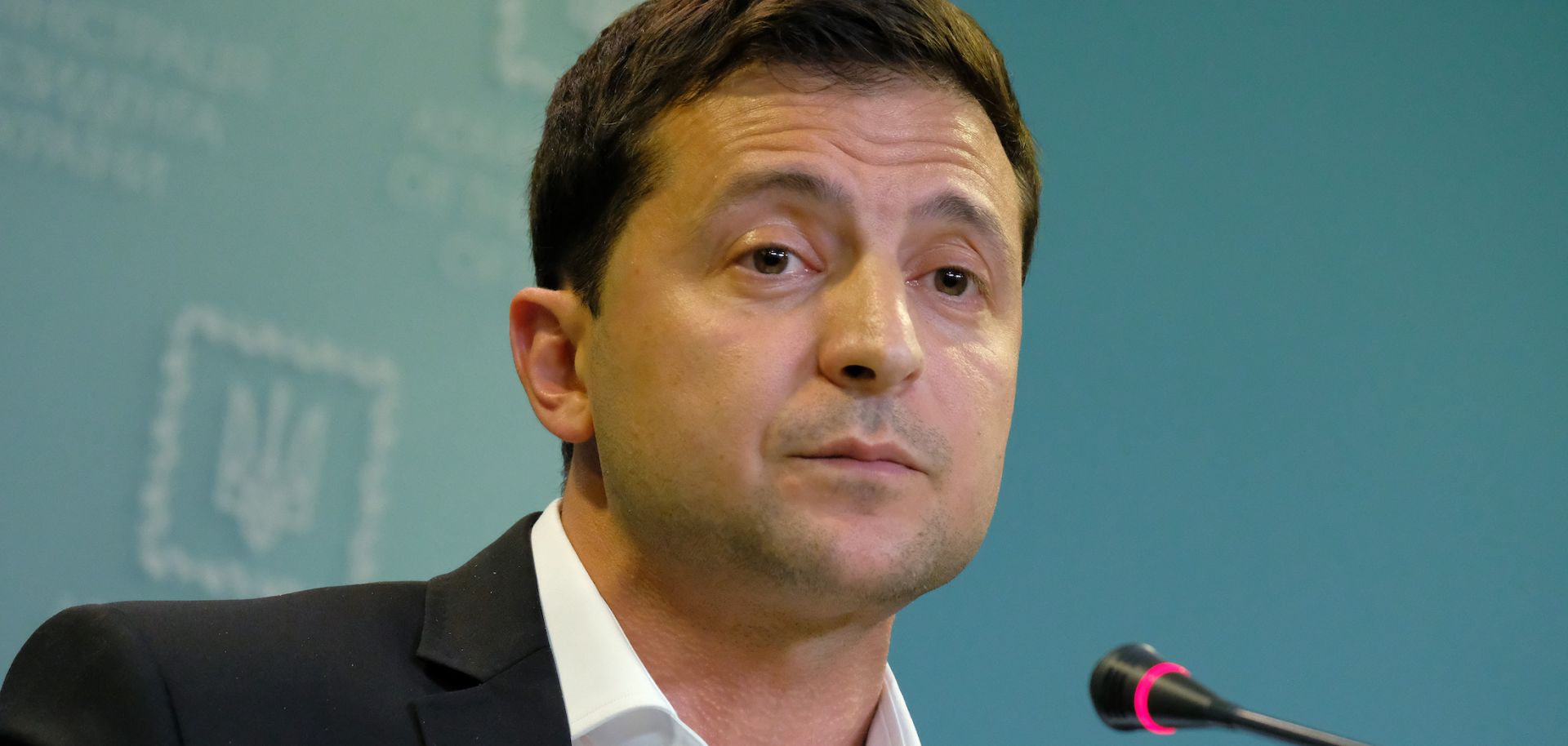
Ukrainian President Volodymyr Zelensky speaks during a press conference in Kyiv on Oct. 1, 2019
New legislation aimed at reducing the influence of oligarchs in Ukraine will saddle President Volodymyr Zelensky’s administration with increased expectations and responsibilities that could jeopardize his party’s international support and political prospects ahead of 2023 elections. Ukraine’s “de-oligarchization” has been at the core of both Zelensky’s 2024 re-election campaign and his bid to court stronger backing from Western partners. The vital element of this effort — the so-called “oligarch bill” — reached a major milestone on Sept. 23 when it passed in its second reading with 279 votes in Ukraine’s unicameral legislature, the Rada. The bill seeks to restrict Ukraine's “oligarchs,” the approximately 12 to 35 business owners who have dominated Ukraine's economy and exercised significant control over the country’s political processes since its independence 30 years ago. The bill’s sudden passage came the day after an alleged assassination attempt against one of Zelensky’s top aides, an incident that observers linked to the bill. The bill now only needs Zelensky’s signature to enter into law, six months after which it would enter into force for a 10-year period.
- Zelensky’s Servant of the People party, which controls a majority of the Rada, adopted the bill using a shortened voting procedure that rejected without consideration most of the over 1,000 amendments submitted to the bill.
- The bill would require oligarchs to publicly disclose their assets and contacts with high-ranking officials, place restrictions on their financing political parties, bar them from holding public posts, and limit their ability to participate in privatization efforts. It will also limit the oligarchs’ abilities to directly own and influence mass media in Ukraine. The bill gives the National Security and Defense Council, headed by the president, the power to designate someone as an oligarch based on meeting three the following four criteria: they have significant influence over mass media, they control a business monopoly, they take part in political life, and/or they have a net worth of $89 million or more.
- While the bill creates strenuous reporting requirements for interactions between the oligarchs and government officials, and restricts their participation in politics and media, the bill does not seriously threaten their control over the Ukrainian economy. The new law is thus unlikely to end oligarchs’ informal influence on Ukrainian politics.
- In May, Ukraine’s National Security and Defense Council said it had identified 13 individuals as oligarchs, but did not disclose their identities. In September, it called their power a threat to Ukraine’s existence.
Ukraine’s Western partners will approach the bill with reserved optimism, but will insist upon equal enforcement and may withhold more robust support measures for Ukraine if the law’s application appears biased or politically motivated. Zelensky’s opponents fear the fungible determination process for designating someone an oligarch makes the law a populist measure, enabling it to be applied and enforced selectively to concentrate more power in the president's hands. This could potentially become a point of criticism from Western governments as well, especially if Zelensky appears to fail to enforce the bill with regards to his main benefactor, Ihor Kolomoisky. In March, the administration of U.S. President Joe Biden sanctioned Kolomoisky, Zelensky’s long-time business partner who bankrolled his successful presidential bid in 2019, for corruption crimes committed in Ukraine. But Ukrainian authorities still have not moved against Kolomoisky despite signals from Western partners. This has led many observers to conclude the Zelensky administration will not target the oligarchs equally in its enforcement of the bill and other Ukrainian laws — allowing certain powerful figures (like Kolomoisky) to continue to occupy a privileged position behind the scenes in Ukrainian business and politics, while targeting others like former President Petro Poroshenko, who remains one of Zelensky’s political rivals. In addition to endangering more robust U.S. and European support, Ukraine’s failure to enforce the oligarch bill fairly and make progress on other domestic reforms could also delay the disbursement of tranches of support from the International Monetary Fund as part of the country’s Standby Agreement with the institution.
- The day before Ukrainian lawmakers were scheduled to vote on the bill, the Venice Commission notified the Rada that its verdict on the anti-oligarch legislation would not be ready until December, and recommended that the Ukrainian parliament not pass the law until the commission's conclusions were received. The Rada likely passed the bill with such haste to preempt criticism from the organization, though some Western partners will likely still echo the organization’s reservations regarding the law.
The bill will increase the Ukrainian public’s expectations of dismantling the oligarchs’ power, which Zelensky’s administration will be unlikely to satisfy. This could hurt his party’s political prospects, possibly resulting in a parliament more prepared to pressure the president to enact reforms following the next elections. The Zelensky administration will undoubtedly tout the new law as the first real step in Ukraine’s history toward reducing the influence of the oligarchs. But the bill’s rushed adoption and potentially disappointing enforcement, along with the fact that it’s unlikely to have a noticeable effect on the lives of regular Ukrainians, will probably combine to create disenchantment over the bill and cause it to politically backfire against Zelensky and his Servant of the People party. Thus, the bill could become a liability rather than an asset in the Servant of the People’s already uphill battle to maintain a parliamentary majority in 2023. While it’d increase short-term instability that Russia will seek to amplify, the decline of Zelensky’s party would most likely ultimately benefit pro-Western forces, including those aligned with former President Petro Poroshenko, who could use their increased influence in parliament to push for deeper and more rapid reforms.
- Only 14% of Ukrainians surveyed in a recent Gradus Sociological Service poll said they believed Zelensky’s anti-oligarch bill would improve the situation in the country, and even less (5.5%) said they believed it would reduce the level of corruption in the country.
- Polls suggest that Zelensky’s approval rating reached a low of around 25% in January 2021, but have since recovered to around 45% as he began taking more decisive action to counter Russian influence in the country — first by shutting down pro-Russian TV channels in February, and then by charging leading pro-Russian politician Viktor Medvedchuk with treason in May.
- Zelensky remains more popular than his Servant of the People party, which has seen its rating fall to around 25% since the 2019 parliamentary elections, when it received 43% of the vote and 57% of parliamentary seats.
- A poor showing by Zelensky’s party in the 2023 parliamentary election, currently scheduled for October, poses a major risk to his own re-election bid just 6 months later in March 2024. This has led to speculation that Zelensky will try to move the next parliamentary election forward to provide less time for potential flaws in the bill to become apparent and a greater cushion for him to adjust should his Servant of the People party perform poorly.
