
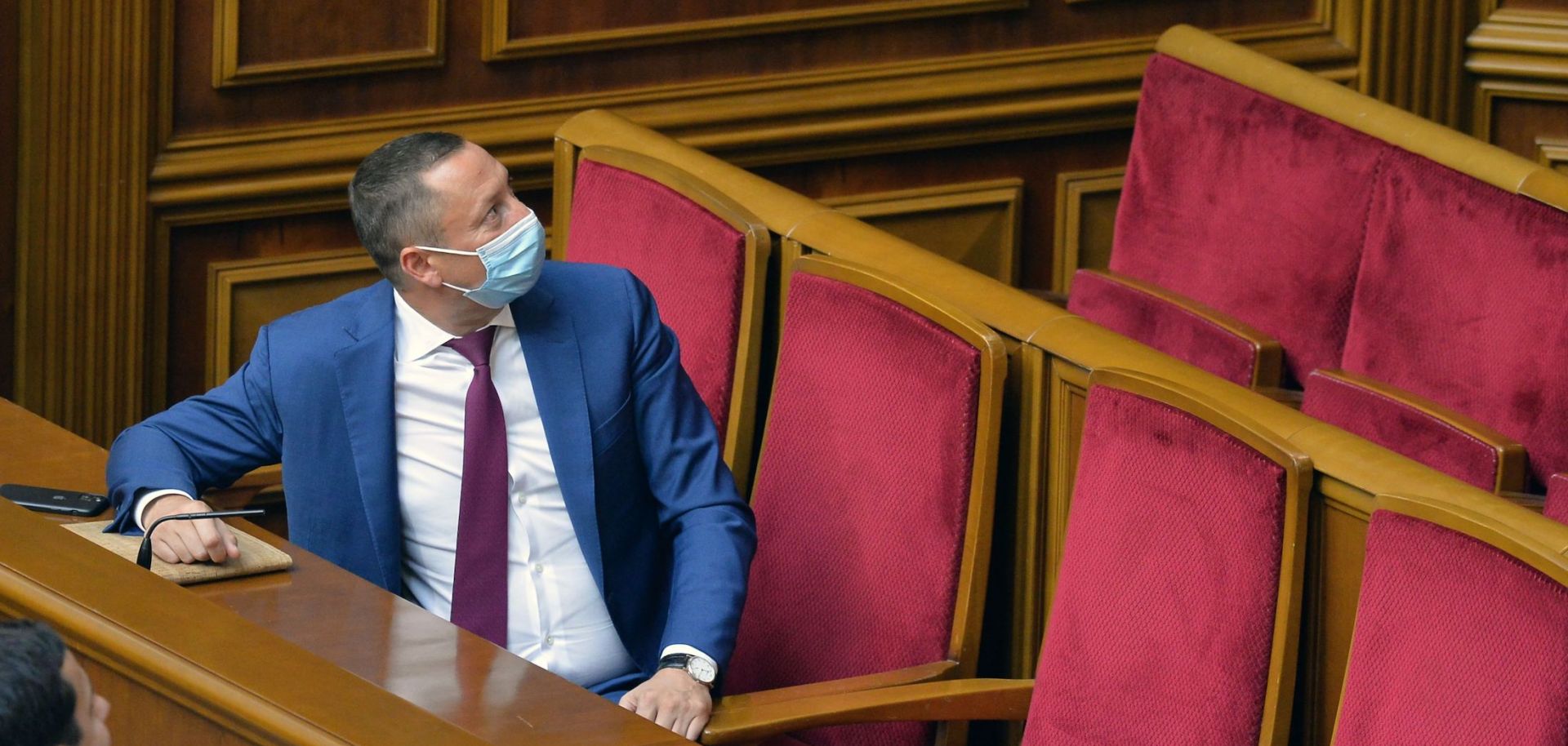
Ukraine's new central bank chief, Kyrylo Shevchenko, wears a face mask as he watches lawmakers vote on his candidacy during a parliamentary session on July 16, 2020.
A potential falling out with the International Monetary Fund (IMF) over monetary policy and the independence of the National Bank of Ukraine (NBU) would be highly damaging, but not catastrophic, to Ukraine's economic recovery efforts. The economic fallout from COVID-19 has made Kyiv heavily dependent on the bailout money it's receiving from the IMF, as well as the European Union. Ukraine's balance of payments and government budget depend on a recently approved $5 billion stand-by arrangement (SBA) with the IMF as a catalyst for official external financial support of nearly $8 billion in 2020-2021.
- Ongoing support from the IMF is needed to demonstrate continued fiscal and debt sustainability, as well as to buy time to address structural issues that include financial stability and a banking system riven with bad loans.
- Ukraine has made significant progress in long-term policy and structural reforms since 2015, when it began efforts to stabilize the economy after a deep economic crisis. But the process was uneven and occurred in fits and starts.
The IMF has placed Kyiv on a fairly short leash, warning that the recent appointment of Kyrylo Shevchenko — an advocate of easier monetary policy and ally of President Volodymyr Zelensky — raises questions regarding the NBU's independence and possible politicization. Ukraine's SBA with the IMF is only partly front-loaded and is so far based on an extensive list of so-called “prior actions” to demonstrate Zelensky's commitment to economic reform, with future disbursements heavily conditioned.
- About $3 billion of the $5 billion total is still slated to be disbursed in 2020-2021, dependent on quantitative performance criteria that include ceilings on government budget deficits, subsidies to state-owned energy company Naftogaz, and domestic credit creation. The IMF deal also places a floor under the NBU's foreign currency reserves, limiting the bank's ability to intervene in foreign exchange markets.
- There are structural policy benchmarks as well, including reviews of NBU operations and policies, as well as further efforts to clean-up Ukraine's troubled banking system, with Shevchenko having been a critic of that program.
Zelensky and Shevchenko's political views are unlikely to cause the IMF to suspend its assistance to Ukraine, though the actions of the NBU will be monitored closely. The IMF expects the central bank's policies to stay within certain responsible boundaries. This may explain Shevchenko's decision to maintain the bank's current interest rate at his first NBU Council meeting on July 23, despite his calls for more rate cuts just days prior. But should Kyiv weaken its central bank's macroeconomic policy framework to stimulate Ukraine's economy, or veer off from pledged structural reforms, it will increase the risk of being perceived as reckless by the IMF.
A falling-out with the IMF would not precipitate an immediate crisis. Kyiv currently has access to nearly $3 billion in policy-lending in 2020-2021 from the World Bank, European Union, European Investment Bank, and European Bank for Reconstruction and Development, which is not explicitly tied to the IMF deal. International financial institutions, however, tend to cooperate in making assessments even if they don't have explicit cross-conditionality. Ukraine also has access to the Eurobond market, having raised $3.4 billion in 2020 But this still pales in comparison with the country's $70 billion worth of gross external financing needs for this year and next.
Losing the IMF imprimatur, however, would eventually endanger Ukraine's finances and economy by heightening investor skepticism, already reflected by a relatively high country risk premium. It would also impede Kyiv’s position in its geopolitical competition with Russia. The IMF aid has enabled Ukraine to sustain its economic independence from Russia. In addition, it provides the financial foundation for Ukraine's military modernization process that centers on deterring Russian aggression. A cutoff from this cash flow could thus not only force future Ukrainian governments to once again lean on Moscow for economic support, but undermine Kyiv's leverage when it comes to Crimea and the conflict in eastern Ukraine.
Amid the COVID-19 crisis, Ukraine could in turn be placed on the verge of a financial crisis. Vulnerabilities include:
- A large increase in current account deficits to -1.7 percent of GDP in 2020 and -2 percent in 2021 from -0.7 percent in 2019. The volume of goods imports in Ukraine is expected to decline by 5.3 percent in 2020, as the country's real GDP declines by more than 8 percent. Export receipts are expected to decline even further with a 7.2 percent drop in volume projected this year.
- Worker remittances are also projected to decline by 25 percent in 2020.
- A fiscal deficit of 7.7 percent of GDP in 2020, falling only to 5.5 percent in 2021, as well as a primary deficit of 4 percent this year after a primary budget surplus in 2019. At 50.4 percent, Ukraine's public debt-to-GDP ratio was not especially high in 2019, but it will increase to more than 65 percent in 2020. Ukraine's debt has also proven to be unsustainable at even relatively low levels in the past.
- Foreign direct investment in Ukraine is also negligible, if not net negative, held back by a difficult business environment (Ukraine is ranked 64th of 190 countries in the World Bank's "ease of doing business" index),
- The amortization of $12 billion worth of medium- and long-term debt in 2020-2021. More than $6 billion in short-term debt must also be rolled over each year, along with roughly $14 billion in trade credit.
Meeting those large financial needs makes retention of IMF confidence and the financing it catalyzes critical for Ukraine to avoid a new economic crisis.
Editor's Note: An earlier version of this analysis misstated Ukraine's position on the World Bank's "ease of doing business" index.
