
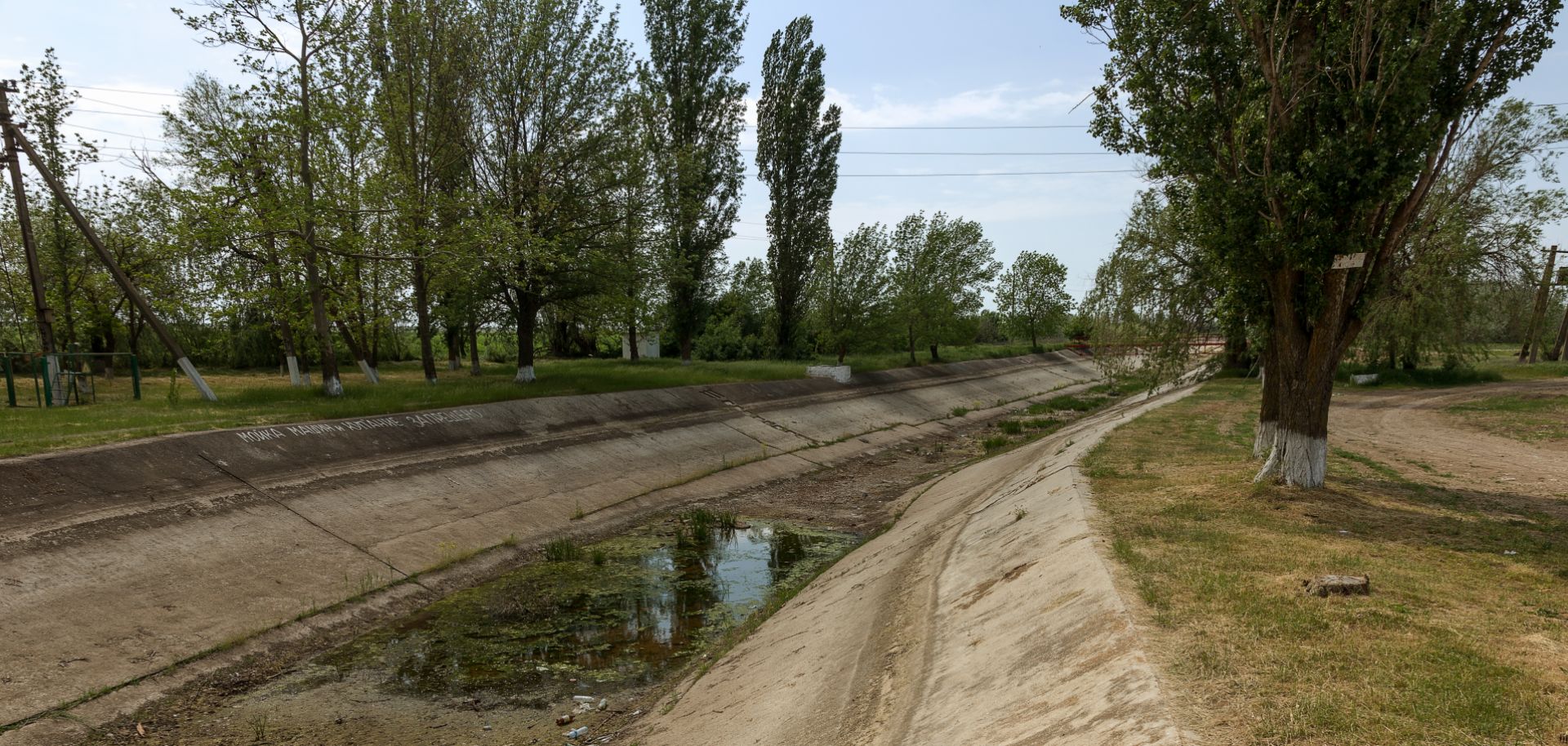
An irrigation canal in Crimea runs dry without access to the North Crimean Canal. Russia’s annexation in 2014 has since severed the peninsula’s access to crucial Ukrainian water flows.
Water scarcity is quickly dimming Russia's hopes for economic growth on the Crimean Peninsula. Reservoirs throughout the region are at record lows for this time of year, with only a few months of reserves left to cover the Crimean population's daily consumption. But while an unusually dry winter is partially to blame, Russia's annexation has been at the core of Crimean water woes by prompting Ukraine to close off the North Crimean Canal in 2014.
Without external access to fresh water, permanent relief for the peninsula can only be obtained by either desalinating water from the Black Sea, or by building new pipelines to feed water from Russia's Kuban River directly into Crimea. But unless Moscow coughs up the capital needed to fund such costly infrastructure projects, Crimea risks becoming a mostly barren military bastion as its industries, agricultural lands and population shrivel up alongside its water reserves.
Crimea's Water Woes
Crimea’s inherent vulnerability to water shortages has always been a part of its geopolitical reality, with recurrent dry spells limiting local water accumulation every five to seven years. The dry seasons from 2018 until now, however, effectively constitute the first of these cyclical droughts since Russia's 2014 annexation of Crimea, which has denied access to the Ukranian water reserves that have historically carried the peninsula through the droughts. In the 1960s, the Soviet Union built the North Crimean Canal connecting the Dnieper River in Ukraine to Crimean reservoirs and irrigation installations. For decades, the more than 400-kilometer-long (roughly 250 miles) canal provided up to 85 percent of the peninsula’s water needs. But as part of its standoff with Russia in 2014, Ukraine blocked the canal to complicate Moscow's control over the region. And the canal has remained closed, cutting Crimea off from its key water lifeline.
This, along with the effects of climate change and prolonged droughts, has exacerbated Crimea's water woes in recent years. Shortages have started to affect its population centers, reducing their ability to sustain normal consumption patterns. Without access to North Crimean Canal water, the Crimean capital, Simferopol, depends entirely on rainfall and snowmelt to replenish its three main reservoirs. But having endured dry years in 2018 and 2019, and without snowfall this winter, these reservoirs have continued to decline. Currently, they hold the equivalent of no more than five months' worth of daily consumption.
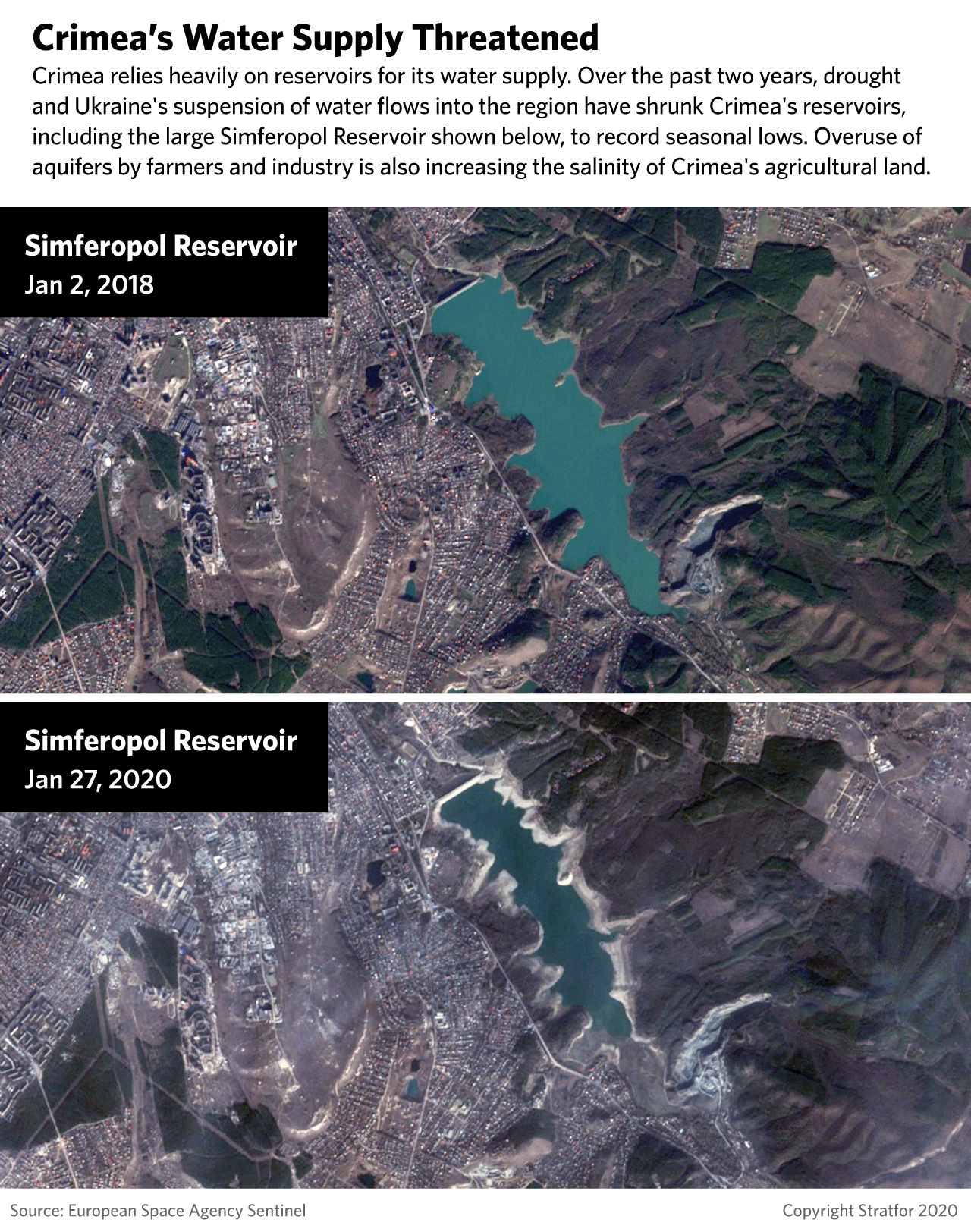
These low levels recently prompted Simferopol to announce it was restricting water flow to only eight hours per day. While a limited refill of the reservoirs has since temporarily delayed those restrictions, the levels of the reservoirs continue to remain low. And depending on weather conditions, they'll eventually drop even lower as summer approaches. Unless consumption is restricted at some point, or the reservoirs are refilled by other means, serious water shortages in Simferopol are all but guaranteed in the latter half of this year.
Water scarcity, however, is not limited to urban Simferopol. Across the peninsula, a large number of reservoirs capable of holding 188 million cubic meters of water (about 500 million gallons) are now down to just 75 million cubic meters. This is at a time when melting snow typically brings the reservoirs to near full capacity. The rivers feeding these reservoirs — such as the Alma River that runs into the Partizansky reservoir at Simferopol — are now nearly dried up. A repeat of this phenomenon across the peninsula has caused a significant decline in vegetation as well. The southernmost area of the peninsula, an epicenter of Crimea’s tourism sector and the home to the city of Yalta, has been somewhat spared from these effects. But it's apparent that if the current situation holds, the overall water supply in the country has become unsustainable in the long term.
Underwater Investments
These water shortages have thrown a significant wrench into Russia's broader plans to boost economic development in Crimea, currently one of the poorest areas under its territorial control. Moscow set aside $13.3 billion to invest in road, rail and tourism infrastructure in the peninsula between 2015 and 2022, making it Russia's fastest-growing economic region in 2019. Throughout the region, construction and manufacturing levels have grown by 20 percent. And in some areas, such as the major port city of Sevastopol, those levels have spiked by 71 percent. Crimea's diminishing water supplies, however, are now weighing heavily on the potential for Russia to see a return on its infrastructure investments in the peninsula, given that water is an essential resource in many industrial activities — particularly in construction and chemical production.
Perhaps no sector that relies more on the water than agriculture, posing a significant challenge to Russia's desire to increase the output of Crimean farmers. Moscow has been especially keen on leveraging its forceful acquisition of the region to boost its own agricultural potential. Even though Crimea makes up less than a fifth of a percent of Russia’s entire surface area, it accounts for over 2 percent of its total grain exports. In recent years, Moscow has sought to expand this production via investments to increase the efficiency of the region's agricultural sector. But drought conditions have caused Crimea's grain production levels to fall significantly short of Moscow’s ambitions for growth.
Crimea churned out 1.7 million tons of grain in 2017, near-record production. But a dry spell reduced production to just 1 million tons in 2018. Local officials managed to bring production back in line with annual averages at 1.4 million tons in 2019, although as water use increases and soil quality declines, the low production levels of 2018 risk soon becoming the new normal. And indeed, Crimea's near-empty reservoirs at this point already suggest another meager harvest for 2020. In addition to insufficient precipitation, the overuse of groundwater resources is also threatening the quality of Crimean soil. To mediate the current water scarcity, Russia has so far relied on withdrawing from Crimea's underground aquifers. But overtaxing these aquifers has progressively deteriorated their mineral composition, increasing soil salinity. This unsustainable practice thus adds to the effects of water shortages by damaging the fertility of agricultural land in Crimea.
No Quick Fix in Sight
Without significant relief in water access, Crimea's agricultural production (and overall economic activity) will only become harder to sustain. But Russia will be hard-pressed to easily or cheaply remedy this reality. In addition to overusing the peninsula's underground aquifers, Moscow has developed several, localized pipeline networks to transport water within Crimea. Such networks, however, offer only a reprieve and won't provide a sustainable fix without access to external water sources. Indeed, scientific studies have shown that even with extensive infrastructure developments allowing optimal use of runoff and groundwater, the peninsula's water supply would still not be enough to sustain both Crimea's agricultural lands and its population's consumption needs.
Reopening the North Crimean Canal would, of course, be the most immediate fix in rectifying the region's water access. But Ukraine has made it clear that it will not consider such an option unless Russia ends its occupation of the peninsula. Moscow has even offered to pay for water supplies, but for Kyiv, any economic interaction with a Russian-occupied Crimea is unacceptable, as it would imply a de-facto recognition of Russian sovereignty over the region. Moscow, however, will be just as unwilling to relinquish control over its newly attained military foothold on the Black Sea.
This leaves Russia with more radical — and costly — options to resolve Crimea's water issues: finding alternative access to external water sources, or desalinating seawater. While Moscow has been experimenting with limited desalination of seawater, making this a fully sustainable solution would require drawing in large amounts of water from the Black Sea, along with overall improvements to efficiencies in Crimea’s water distribution infrastructure including extensive wastewater treatment. Moscow has also considered building a pipeline to transport fresh water from Russia's Kuban River across the Kerch Strait into Crimea’s reservoirs, though this too would entail extensive (and expensive) infrastructure investments.
Hung Out to Dry?
While such major development projects to sustain the peninsula's economic potential are not impossible, it will come at a significant cost for Moscow. The question then becomes just how high Crimea ranks among Russia's already constrained economic priorities — and how that financial opportunity stacks up to Moscow's more immediate military priorities in the region. Even without any efforts to mediate the longer-term water emergency in Crimea, Russia would still be able to comfortably sustain its military presence in the peninsula. The water requirements for such an effort would not be nearly as extensive as broader economic development of the peninsula. With Crimea's tourist sector geographically concentrated in the country's southern region, it could more easily persist with current water access or only limited desalination in place.
Even if Crimea can’t be an agriculturally or industrially significant contributor within the Russian Federation, Moscow will still prioritize the region's sustainable military utility over any calls to relinquish control. For these reasons, Russia is unlikely to consider water scarcity in Crimea as an existential threat to its control over the peninsula. It's thus not guaranteed that Moscow will shell out the capital needed to permanently fix the problem. In such a case, Crimea’s agricultural sector may slowly peter out and its industrial potential never reached, as Moscow retains its hold on the geopolitically advantageous region. With no solution in sight, the region's population, meanwhile, would likely start to relocate in the hopes of finding better economic opportunities and more sustainable living conditions elsewhere in Russia.
