
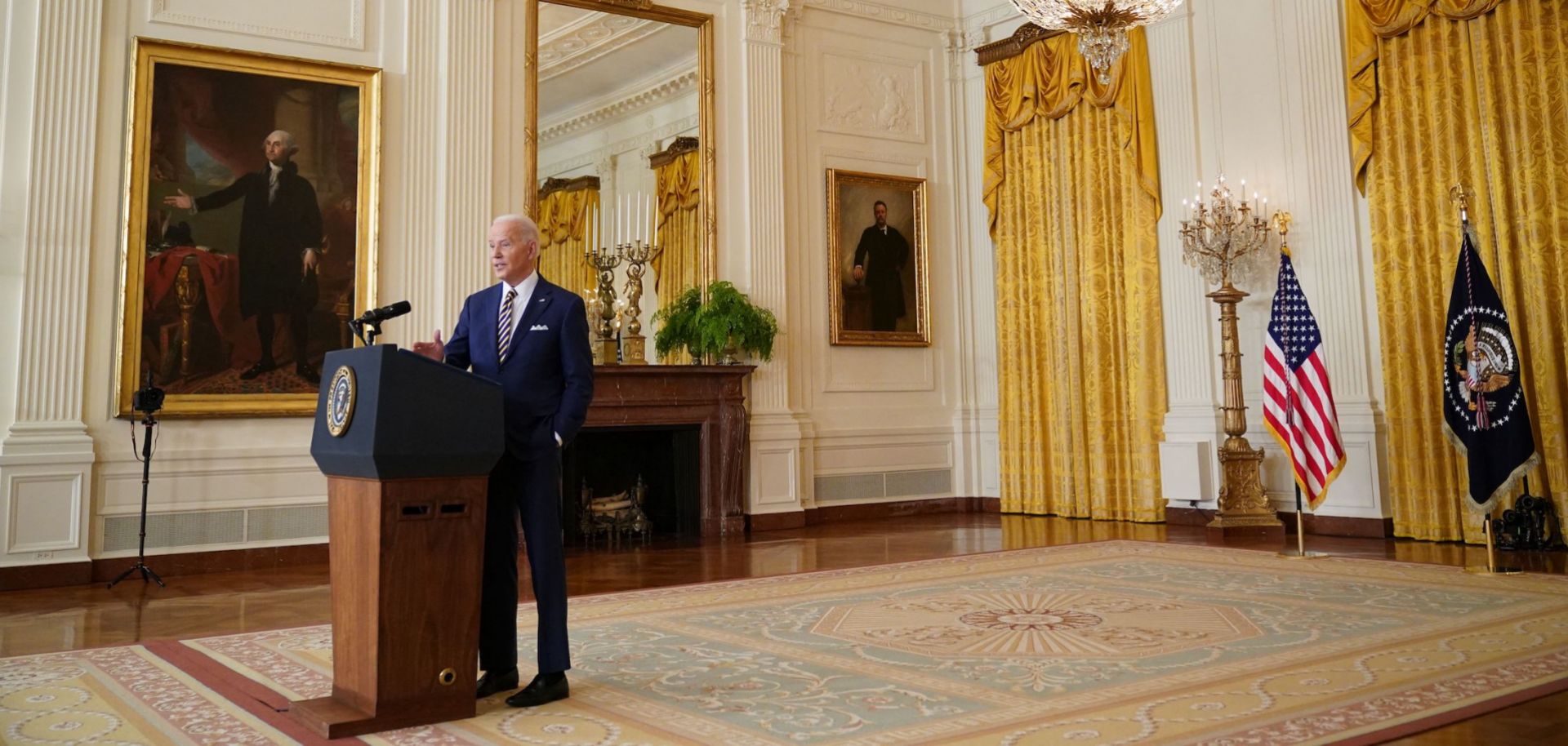
U.S. President Joe Biden takes questions from reporters during a news conference in the East Room of the White House on Jan. 19, 2022, in Washington.
U.S. President Joe Biden’s recent comments on Ukraine will not alter Russia’s calculus as an escalation of the conflict in eastern Ukraine and other measures to increase Moscow’s leverage vis-a-vis the West remain on the table, even if a full-scale invasion is improbable. At a Jan. 19 press conference, Biden predicted Russia would “move in” to Ukraine and suggested a “minor incursion” by Moscow could lead to Western countries “having to fight about what to do and not do,” appearing to confirm there was a gray area regarding the precise threshold for triggering U.S. and European response measures. Immediately following the conference, the White House issued a statement clarifying Biden’s comments, noting “any Russian military forces mov[ing] across the Ukrainian border” would constitute “a renewed invasion” and would “be met with a swift, severe, and united response from the United States and our allies.” But the U.S. president’s remarks have nonetheless stirred controversy, with Ukrainian officials reportedly accusing Biden of giving Russian President Vladimir Putin “the green light [to] enter Ukraine at his pleasure.” Biden’s indication that the West would treat a “minor incursion” differently than a full-scale invasion, however, does not materially change Russia’s assessment of the situation, as Moscow already understood that Western response measures would be proportional to Russia’s next actions.
- In recent days, U.S. officials have indicated the United States is preparing numerous measures in response to Russia’s continued aggression against Ukraine, including removing Russia from the SWIFT intermediary of financial transactions between banks, blocking Russian banks’ access to the U.S. dollar for clearing operations, imposing sanctions on Russian energy projects and companies, and implementing restrictions on Russia’s access to U.S. technology and consumers products (including phones and chips). The United States, however, would likely only deploy such measures if Russia tries to seize and occupy large pieces of Ukraine. A relatively small expansion of the territory under the control of pro-Russian separatists fighting in eastern Ukraine, by contrast, is unlikely to trigger these more drastic U.S. responses, which would not be proportional to Russia’s escalation. European countries are also unlikely to risk further damaging their own pandemic-rattled economies by cutting ties with Russia over a minor escalation of the Donbas conflict — a low-level war that has raged since 2014.
Biden’s recognition that Ukraine will not join NATO anytime soon and willingness to discuss Western weapons deployed there will create space for further negotiation. During the press conference, Biden said that the United States “could work out something” with Russia to ensure NATO didn’t send strategic weapons in Ukraine, and reiterated that Kyiv was “not very likely” to join the Western security alliance “in the near term” as well — speaking to two of Moscow’s key security demands from the West. Russia will wait for the United States’ formal response to Moscow's proposal of security guarantees, which Washington has promised to provide by Jan. 30, before deciding on its next steps diplomatically and militarily. But while Russia’s near-term position won’t change, Putin could determine that these informal assurances are sufficient for continued talks and preferable to a costly military action against Ukraine.
- On Dec. 17, Moscow published a proposal of sweeping security guarantees from the West, which includes assurances that Ukraine is not admitted to NATO and that the U.S.-led security alliance does not expand its presence in it or other former Soviet states.
Tensions, however, remain very high for the next several weeks amid the increasing presence of Russian forces near the Ukrainian border. Russia’s military buildup near Ukraine shows no signs of slowing, as drills in Belarus from Feb. 10-20 will provide Russia with an official excuse to deploy even more troops in the region. On Jan. 19, military experts from Rochan Consulting said the number of Russian troops in Belarus is already likely larger than the number who were in the country for the 2021 Zapad exercise.
Russia is more likely to support the Donbas separatists increasing their aggression against Ukrainian forces compared with staging a formal invasion of Ukraine, which would have greater consequences for Moscow. An escalation of the Donbas conflict would likely precede a Russian invasion, but a Donbas flare-up could merely constitute an attempt to exacerbate Euro-Atlantic tensions by probing the gray area of disagreement over Western response measures. In this scenario, the large presence of Russian forces all along Ukraine’s borders could serve primarily to prevent the Ukrainians from responding with full force to a Russian-backed separatist offensive. European nations such as Germany and France would likely be reluctant to enact particularly punishing sanctions should the situation in Ukraine largely resemble a return to the hotter war between Ukrainian government forces and the separatists prior to the Minsk agreements. Counting on this, Moscow could use an escalation in the separatist Donbas region that lies along the contested Russia-Ukraine border to test the West's support for Ukraine and undermine U.S. credibility both in Kyiv and internationally. But an escalation in the Donbas region could also push the West into more concessions by making a large-scale Russian military intervention appear imminent.
With U.S.-Russia talks unlikely to result in breakthroughs in the near term, Moscow still has plenty of options to increase pressure on the West and Kyiv without having to undertake a major military action against Ukraine. Despite recent discussions in the Russian State Duma, Moscow is unlikely to officially recognize the independence of the separatist republics in eastern Ukraine for now, as such a move would end Russia’s primary strategy of using the Minsk agreements to exert leverage on Kyiv. Instead, Russia will likely take a “military-technical” approach in retaliating against the formal rebuffing of its security demands. One of Moscow’s most likely response measures would be permanently increasing the number of conventional forces based in western Russia — specifically near Ukraine, the Baltic states or in Belarus. Other potential measures include deploying new missile systems near the borders of NATO states, continuing to hint at the deployment of aircraft or strategic missile systems to Venezuela or Cuba (as Putin did during a Jan. 20 phone call with Venezuelan President Nicolas Maduro), escalating information and cyber warfare against the West, and inking formal deals with China to deepen bilateral military and technical cooperation. Diplomatically, Russia could also denounce the 1997 Russia-NATO Founding Act or seek to formally withdraw from agreements and institutions of European security, such as the 1990 Paris Charter. Under normal circumstances, many of these Russian actions would trigger stern disapproval and possible sanctions from the United States and Europe. But against the current backdrop of Russia’s aggressive military buildup near Ukraine, the West would likely forgo doing so for fear of further provoking Moscow. Moscow, for its part, would feel that such measures up its leverage and demonstrate its seriousness in negotiations around Ukraine and an adjusted European security framework.
