
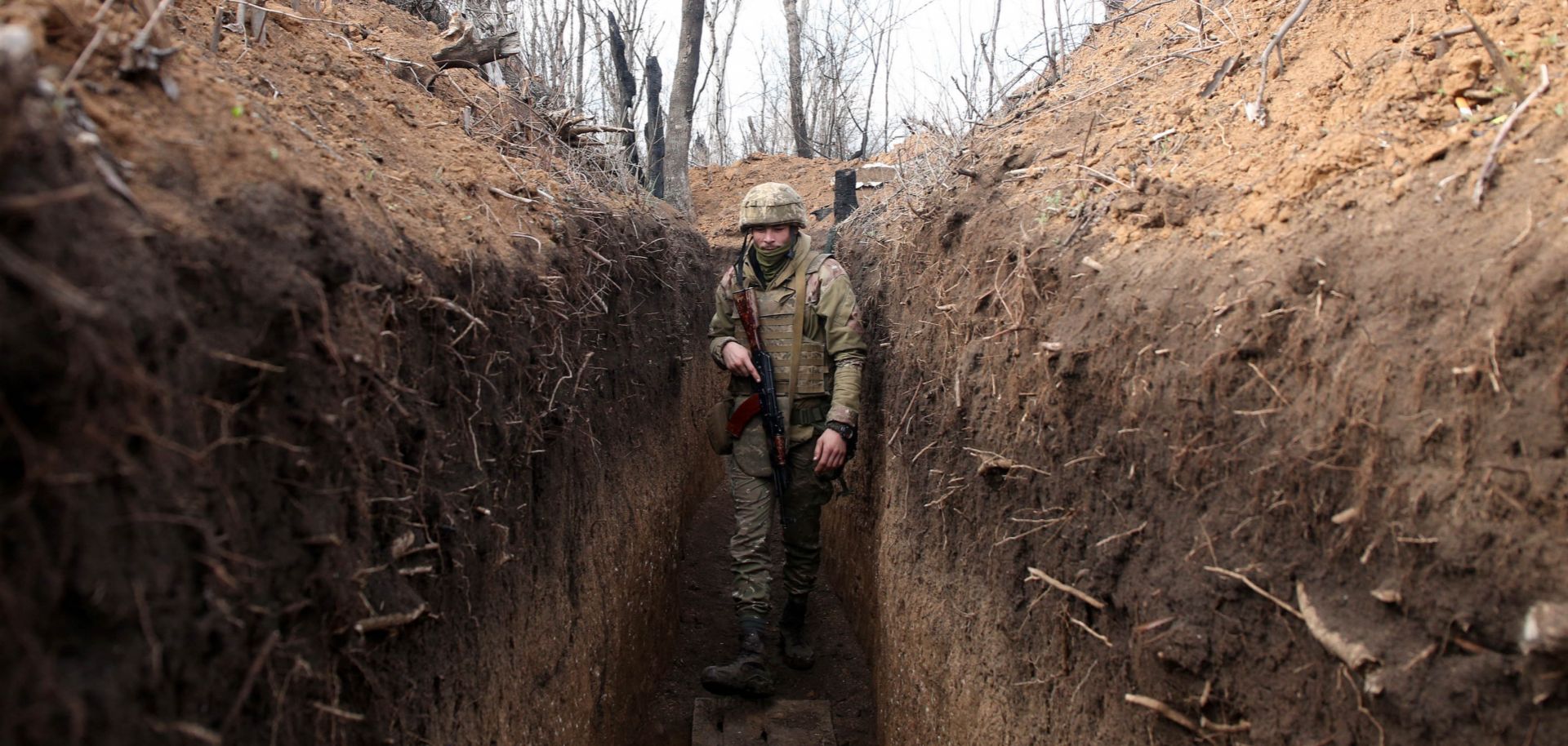
A Ukrainian serviceman in a trench on the frontline with Russia-backed separatistsApril 23, 2021, near the town of Krasnogorivka in the Donetsk region of eastern Ukraine.
Russia's buildup of troops along the Ukrainian border has reignited speculation regarding the future of the Donbas conflict and Moscow's intentions in eastern Ukraine more broadly. For now, the Kremlin's primary motivation is to increase its leverage in impending European security talks with the United States and NATO amid Moscow's push for "security guarantees." These concerns have been particularly acute amid Moscow's months-long expressions of dissatisfaction with the situation in Ukraine. But Moscow's opening position, which Russia's foreign ministry unveiled on Dec. 17, contains demands against NATO expansion to the former Soviet Union or even to develop bilateral military cooperation with these countries, both of which have already taken place and are non-starters for the alliance. The documents' unacceptable content and rapid disclosure by Russia are indicative of their use as an ultimatum, after which Moscow will likely conduct long-planned steps continuing its military buildup, threatening a hotter Donbas conflict, or possibly even conducting an invasion of Ukraine.
Amid this backdrop, there are four main scenarios for the future of the conflict in Ukraine, starting from the most likely to the least likely:
Scenario 1 (Very Likely): Russia maintains tensions but refrains from a military intervention amid negotiations.
In our baseline scenario, Russia's demands for security guarantees and disputes over the Minsk agreements will keep tensions in eastern Ukraine elevated. Moscow will also keep troops and equipment at the border, but a Russian invasion will not materialize. Seeing a credible military threat against Ukraine as leverage against the United States and a critical lever to slow its declining influence over Kyiv, Russia will maintain its buildup of forces, infrastructure and equipment near Ukraine's borders to pressure the West to make concessions. While the U.S. and European leaders will hold talks with Russia, NATO will not formally disavow the prospect of Ukraine's membership in the alliance. Discussions on limiting the eastern deployment of certain NATO weapons systems and incident avoidance and management measures with the alliance will dissuade Russia from conducting a military incursion in 2022. Informal acknowledgment by the West that Ukraine is far from NATO membership (even if the alliance does not formally rule it out) could provide a sufficient "out" for Moscow to save face on the international stage. However, Moscow will continue to insist on Kyiv enacting the Minsk Protocol on its terms as a necessary precondition for avoiding a return to hot conflict in the Donbas. While Western leaders will reassure Russia that the Minsk agreement should be enforced, Kyiv's opposition and the separatists' intransigence will make a real change on the ground unlikely. Ukrainian President Volodymyr Zelensky's administration, however, may engage in cosmetic initiatives toward enacting the agreements (including, for example, new laws regarding the Donbas' special/autonomous constitutional status) that will have no effect on the situation on the contact line. The failure of any real progress will encourage Moscow to authorize the separatists to frequently violate the cease-fire as they have in previous months, while Russia will continue to keep many of its troops and military equipment near the Ukrainian border to keep the threat of a short-notice intervention credible and to deter the Ukrainians from responding forcefully to separatist cease-fire violations.
Scenario #2 (Likely): Russia raises the stakes by escalating the Donbas conflict, short of an overt military incursion.
In this scenario, the Kremlin will determine that it is not receiving sufficient concessions on security guarantees and its interpretation of the Minsk agreements, and will seek tangible ways (short of a new military incursion) to push Kyiv and Washington to make concessions. This will most likely take the form of more cease-fire violations by the Donbas separatists, possibly "offensive" ones with heavy weapons or drones, intended to provoke Ukraine. While monitors from the Organization for Security and Co-operation in Europe (OSCE) report high levels of daily violations, most of these are not characterized as escalatory, but instead designed for deterrence and to project readiness. Increased reports of combative probing maneuvers — particularly those which approach, let alone cross, the Line of Contact separating separatist and government troops — could signal that combat forces are making preparations to return to war. Authorizing the separatists to further increase provocative cease-fire violations would seek to further put Kyiv in a bind. If the Ukrainian military responds forcefully to separatist shelling, Moscow can portray Kyiv as the aggressor and justify Russian intervention, such as a long-planned incursion or invasion. But if Ukraine does not step up its counter-shelling, the Ukrainian military will suffer disproportionate casualties and face accusations of failing to establish deterrence, which will be politically damaging for the Zelensky administration.
There are several additional potential signposts for this scenario. The most obvious would be restrictions on the movement and activities of OSCE monitors. OSCE monitors have access to most areas of eastern Ukraine, and the imposition of significant or prolonged limits on their movement would signal that separatist/Russian forces may be moving personnel and equipment as part of preparations for a return to war, or at least signal this possibility. Another would be increased public statements by high-ranking Russian officials such as Foreign Minister Sergei Lavrov and others calling for the protection of the hundreds of thousands of people in eastern Ukraine who have received Russian passports since 2019. Such statements could signal that Russia is diplomatically preparing to justify an impending military escalation. The risk would particularly increase if President Vladimir Putin repeatedly makes such statements, as it would suggest that Russia is providing legal grounds to justify its right to intervene. Finally, an increase in sensationalist anti-Ukrainian messaging in Russian media stressing alleged crimes against humanity by the Ukrainian government like genocide could indicate that Russian authorities are using propaganda to morally justify a resumption of the conflict by the separatists.
The constant "offensive" cease-fire violations, along with the signposts described above, would serve the Kremlin's goal of suggesting that the status quo (of Ukraine not enacting the Minsk agreements on Moscow's terms and lack of a European security accord) is insufficient for containing the conflict, justifying a theoretical intervention by Moscow with military force to adjust it. With these and other steps, Moscow would be raising the stakes as part of a bid to get more concessions from the West without actually having to resort to higher-cost options like an incursion or invasion, as Moscow can signal it is on the verge of resorting to those steps through a worsening of the Donbas conflict.
Scenario #3 (Unlikely): Russia conducts a new military intervention in Ukraine.
In this high impact scenario, Moscow would use the failure to secure legal guarantees in security talks with the West and the stagnation of the Minsk agreements to justify an incursion or invasion of Ukraine. Russia's buildup could prompt additional Western military and other support for Kyiv while security talks fail to give the Kremlin even rhetorical or symbolic concessions on its biggest demands regarding NATO activity in Ukraine and Eastern Europe. Moscow could conclude that the best time for a military incursion against Ukraine is now rather than in 10 or 20 years, calculating the Ukrainian defense capabilities, national identity and democratic values, as well as the country's relative stability and prosperity, are likely to continue trending upward. As a Slavic nation with deep cultural and historic ties to Russia, this trajectory would create a dangerous precedent for Putin's governance model in Russia itself, as many younger Russians will point to Ukraine as evidence that democracy is possible in Russia, and could argue that the current standoff with Ukraine contradicts Russia's national interests. The Kremlin's original goal was to use the Minsk agreements as a tool to get influence over the whole of Ukraine and the occupation of the Donbas as an instrument to destabilize the country by empowering regionalist movements and pro-Russian political forces. But Russian leadership likely believes that a political or diplomatic resolution is slipping away, and that Ukraine will slide permanently into the U.S. political and security orbit.
An important constraining factor on Moscow's willingness to conduct a military escalation is economic, in particular its desire to avoid new sanctions and preserve economic ties with the West, including Russia's Nord Stream 2 pipeline with Germany. But years of domestic propaganda and a thoroughly sterilized political environment following a renewed wave of repression mean that domestic opposition to an escalation would be insignificant, and while more sanctions would certainly pummel the Russian economy's already weak growth prospects, it is doubtful economic measures alone would deter Russia due to the ideological significance and national security implications the Kremlin has ascribed to Ukraine.
The most likely version of this scenario would be an attempt to seize and occupy large pieces of Ukraine. This, in turn, contains multiple sub-variants, as Russia could seek to establish a land corridor to Crimea or significantly expand the size of the separatist republics. Western response measures would include sanctions on Russian sovereign debt, dollar transactions, and energy projects and other measures that would severely cripple the Russian economy. Given the harsh nature of the West's response to any such invasion, arguably the most likely scenario could be a massive seizure of all of Ukraine east of the Dnieper river, and possibly even the port city of Odessa to secure the entire Black Sea coast. This large territory would most likely be used to create a loyal Ukrainian puppet state (that Moscow would insist is the "real" Ukraine) loosely modeled off Alexander Lukashenko's Belarus, and joining it as the third nation to the Union State with Russia.
Alternative versions of this scenario could involve more limited use of force with an attempt at significant political interplay. One could be preemptive missile strikes on key Ukrainian military installations and infrastructure, such as airfields and arms depots. These strikes would demonstrate that the Ukrainian military will not be able to effectively oppose a Russian invasion, after which Moscow would issue Kyiv an ultimatum to back down to avoid unnecessary bloodshed. Another variant could involve limited incursions into Ukraine by Russian troops meant to destroy large formations of the Ukrainian army to force a political settlement or possible regime change in Kyiv without having to immediately occupy large pieces of Ukraine for an extended period. The advantage of these variants is that they allow Russia to achieve its geopolitical goals at a potentially lower human, economic and political cost than an invasion and occupation. Additionally, a further swelling of Russian troops on the border, possibly followed by a mobilization of reservists, could give Ukraine precious time to conduct its own emergency mobilization that would increase Russian casualties, but Ukraine cannot afford – politically or economically – to mobilize unless an impending Russian invasion is all but certain.
For Russia to resort to this option, Moscow would likely need to bring significantly more equipment and troops to the border in the coming weeks. Russia would likely also opt to pass through some of the escalation signals described above in the second scenario.
Scenario #4 (Very Unlikely): Russia significantly lowers tensions and pulls back large amounts of troops and equipment from the Ukrainian border.
In this highly improbable scenario, Russia would be satisfied with concessions from Western leaders and Kyiv's recommitment to the Minsk agreements, and would draw down its troops and remove equipment from the Ukrainian border to demonstrate that appeasement works and should continue. The West would probably not cave to all of Moscow's demands, but confronted with the continuation of Russia's military buildup, Western leaders could make commitments that Ukraine (and Georgia) will not be admitted to the NATO alliance for several more decades. Pro-Kremlin outlets could spin such a concession as a political win and a step toward regional security and stability. Moscow would cast the statement as a war-averting concession while reiterating that Russia reserves the right to return the troops or take preemptive steps against Ukraine at any point, thereby threatening to simply start the crisis anew should Western leaders appear to backtrack on the declaration in the coming years. This scenario would cause an upheaval in Ukrainian politics and major domestic instability, as the country has sought to join NATO since 2014. Many Ukrainians would likely interpret the sudden blockage of this path to Euro-Atlantic integration as a betrayal, empowering pro-Russian forces capitalizing on disenchantment to argue for improving ties with Moscow, further enraging nationalists and supporters of Ukraine's European course.
