
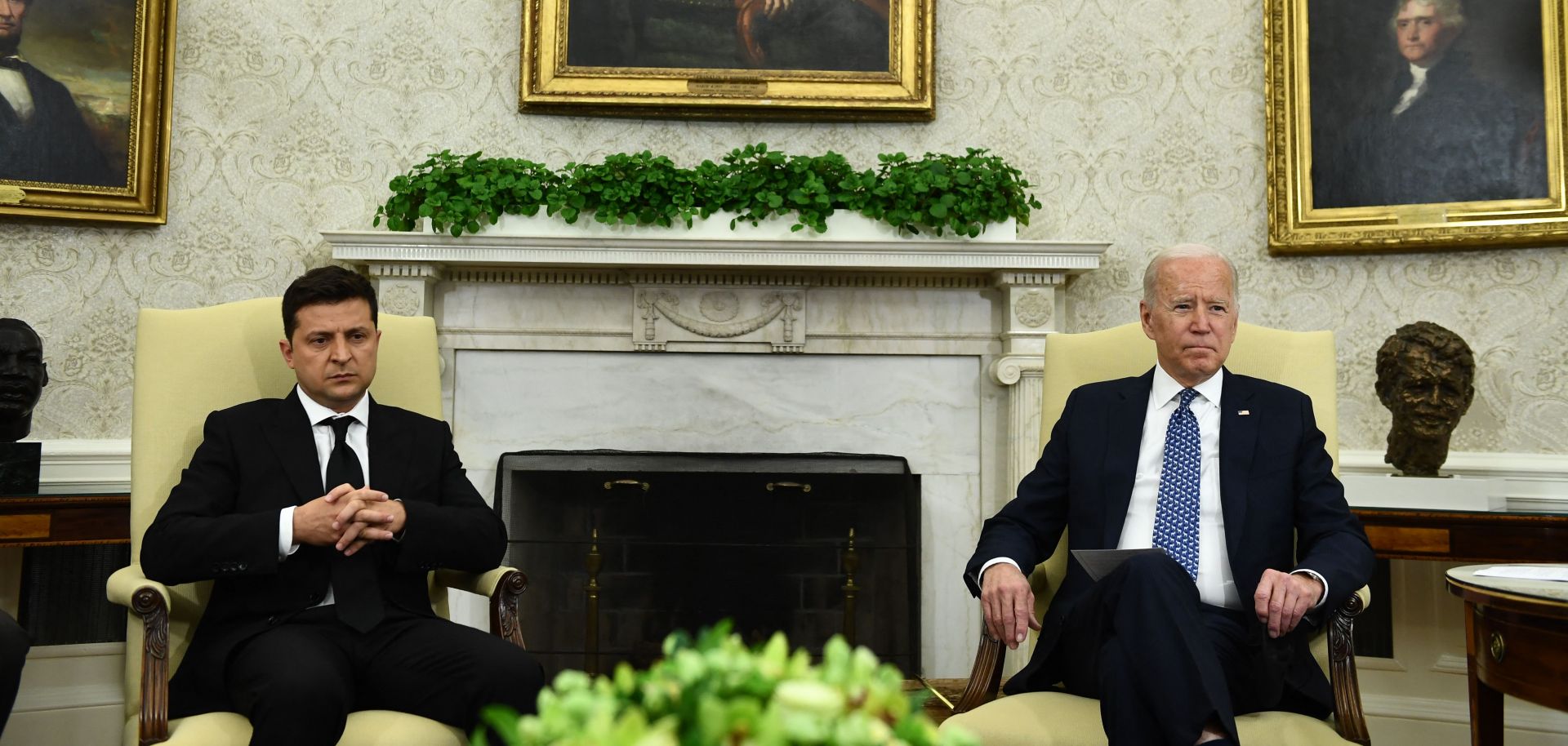
U.S. President Joe Biden (right) meets with Ukrainian President Volodymyr Zelensky in the Oval Office of the White House on Sept. 1, 2021.
Despite new support measures and statements that the strategic partnership between the United States and Ukraine has never been stronger, a clash of short- and long-term interests will significantly challenge the future of the bilateral relationship, first becoming apparent in the Donbas conflict. On Sept. 1, Ukrainian President Volodymyr Zelensky met with his U.S. counterpart Joe Biden at the White House, making Zelensky only the second European leader to do so following German Chancellor Angela Merkel’s farewell visit in July. Immediately prior to Zelensky’s meeting with Biden, the United States announced measures and initiatives aimed at supporting Ukraine’s security, Euro-Atlantic aspirations and reform agenda.
- The Biden administration announced the reinvigoration of the Strategic Partnership Commission (SPC) to codify the newly elevated status of U.S.-Ukraine cooperation. U.S. Secretary of State Antony Blinken and Ukraine’s foreign minister intend to approve a new charter at the SPC’s meeting in Washington this fall.
- In support of Ukraine’s domestic reform efforts, the U.S. government plans to allocate over $463 million in assistance this year, including for programs focused on democracy, human rights, local governance and decentralization, privatization and judicial reform.
- The United States also authorized a new $60 million security assistance package for Ukraine, including critical Javelin anti-tank systems and other defensive lethal capabilities.
- Ukraine and the United States agreed to finalize a memorandum of understanding on commercial cooperation authorizing the U.S. Export-Import Bank to provide initial support of $3 billion for projects in agribusiness, infrastructure, climate and energy.
- In addition, the U.S. government agreed to provide an additional $45 million in humanitarian assistance to Ukrainians affected by the Donbas conflict in need of life-saving assistance such as food, shelter and safe drinking water.
The United States wants to ensure Ukraine’s long-term stability and ties to the West through major reforms and fighting corruption, including within Zelensky’s inner circle. The newly established dialogue channels and support measures will enable the United States to more effectively pressure the Ukrainian government via selective engagement. In doing so, the White House will likely make it clear that the additional political or material support is conditioned on the Zelensky administration’s willingness to follow through on reforms, which it has so far largely failed to do.
- The sluggish pace of Ukraine’s economic reforms and lack of sufficient judicial and anti-corruption reforms have resulted in ongoing delays in the disbursement of tranches from the International Monetary Fund (IMF) as part of the country’s Stand-By Agreement with the international financial institution. The ongoing limbo regarding IMF support is detrimental to Ukraine’s development prospects.
- The United States wants to see the Ukrainian government move forward with legislation to reform the country’s entire judicial sector in line with international best practices. Washington also wants Ukraine to establish an independent anti-corruption infrastructure to implement several initiatives, including those aimed at safeguarding the authority of the National Anti-Corruption Bureau (NABU) and selecting a new Specialized Anti-Corruption Prosecutor.
- As part of the U.S. push against corruption, the Biden administration on March 5 sanctioned the Ukrainian oligarch Ihor Kolomoisky, Zelensky’s long-time business partner who bankrolled his successful presidential bid in 2019. Observers widely understood the U.S. sanctions as an indication that Kolomoisky should be investigated by Ukrainian law enforcement. Ukrainian officials, however, still have yet to move against Kolomoisky, which the Biden administration sees as a sign that Zelesnky is not serious about fighting corruption or the influence of oligarchs and powerful business clans in his country.
Amid the immediate threats posed by Russian aggression and the economic fallout from COVID-19, Zelensky will continue embracing reforms rhetorically while avoiding or delaying some key reforms he believes could undermine Ukraine’s stability in the short term and/or be politically damaging to him. Ukraine’s near-term security concern remains the frozen Donbas conflict along the country’s eastern border with Russia. A flare-up in Donbas would not only be politically unpopular but could provoke the remote possibility of another Russian military intervention. Mitigating this risk thus remains one of Ukraine’s primary priorities, given that ensuring the country’s long-term security with NATO membership is still many years away. Zelensky also fears that heeding U.S. calls for more reforms and anti-graft initiatives could further disrupt Ukraine’s already pandemic-rattled economy, where corruption is rampant — threatening his prospects for re-election in the spring of 2024.
- Corruption is endemic to many parts of the Ukrainian society and economy, including government institutions like the police, judiciary and customs service, as well as the country’s still largely state-owned energy and utility sector.
- Zelensky has for several months been forced to temper expectations that the United States would provide Ukraine with rapid or unconditional assistance. Now that substantial U.S. assistance has come in via the initiatives announced on Sept. 1, Zelensky will find himself increasingly boxed in, facing domestic pressure from both pro- and anti-reform factions while international partners reiterate that they will only help Ukraine as much as Ukraine is willing to help itself.
- Zelensky is concerned that a fight against corruption could lead to higher prices or endanger the country’s growth due to short-term capital flight. Zelesnky has likely not taken action against Kolomoisky specifically due to these same concerns, as well as the threat that deputies within Zelensky’s own Servant of the People party loyal to Kolomoisky could oppose key reforms — increasing domestic strife that Russia would be keen to amplify and exploit. Deputies loyal to Kolomoisky within Zelensky’s party have already quietly worked with pro-Russian politicians under the leadership of Viktor Medvedchuk to block anti-corruption efforts. Medvedchuk, whose pro-Russian TV channels Zelensky forced off-air in February, was indicted for treason in May.
The Donbas conflict is one of the first places where the United States and Ukraine’s clash of interests will arise, threatening their newly reaffirmed partnership. Ukraine is looking for the United States to play a larger role in the conflict to ensure its short-term stability against Russian aggression in case of an escalation. Zelensky’s administration has repeatedly spoken in favor of either involving the United States in the Normandy-format talks on the Donbas conflict, or establishing an alternative format with Washington’s participation. Indeed, Zelensky claimed that he personally asked Biden to do so during their recent meeting. But disagreement within the Biden administration means the United States will most likely continue to defer to France and Germany on the Donbas conflict. The conflict is thus likely to remain frozen in its current state, with neither Ukraine nor Russia prepared to follow through with the Minsk agreements.
- France and Germany continue to push for the so-called Steinmeier Formula, an interpretation of the Minsk agreements that would grant the Donbas constitutionally-enshrined autonomy and the ability to hold local elections prior to Ukraine receiving control of its border with Russia. Proposed by Germany in 2016, the Steinmeier Formula sparked protests in Ukraine for being a capitulation and a dangerous trap unfavorable to Ukraine’s interests.
- Zelensky’s administration believes the United States would stick up for the Ukrainian position against the Steinmeier Formula. Ukraine also hopes that Washington would perhaps even show a willingness to help negotiate a replacement to the Minsk 2 agreement more favorable to Kyiv, which France and Germany have resisted. But the United States has instead declined to confirm its support for this idea. The U.S.-Ukraine joint resolution released Sept. 1 also reaffirmed Washington’s full support for the Normandy Format, marking a subtle swipe at the possibility of greater U.S. involvement.
- Reports indicate that there is significant disagreement within the Biden administration on the Donbas conflict. Some White House officials believe the United States should join the French and Germans in insisting on the Steinmeier Formula, arguing it would open the door for a de-escalation of the Donbas conflict and enable the United States and Europe to more effectively refocus on their true strategic priority in the coming years of rallying against China. Other members of the Biden administration, however, believe the United States should support Ukrainian efforts to scrap the Minsk agreement and start over, even if it risks escalating the conflict — arguing that the enactment of the Steinmeier Formula would be catastrophic for Ukraine.
