
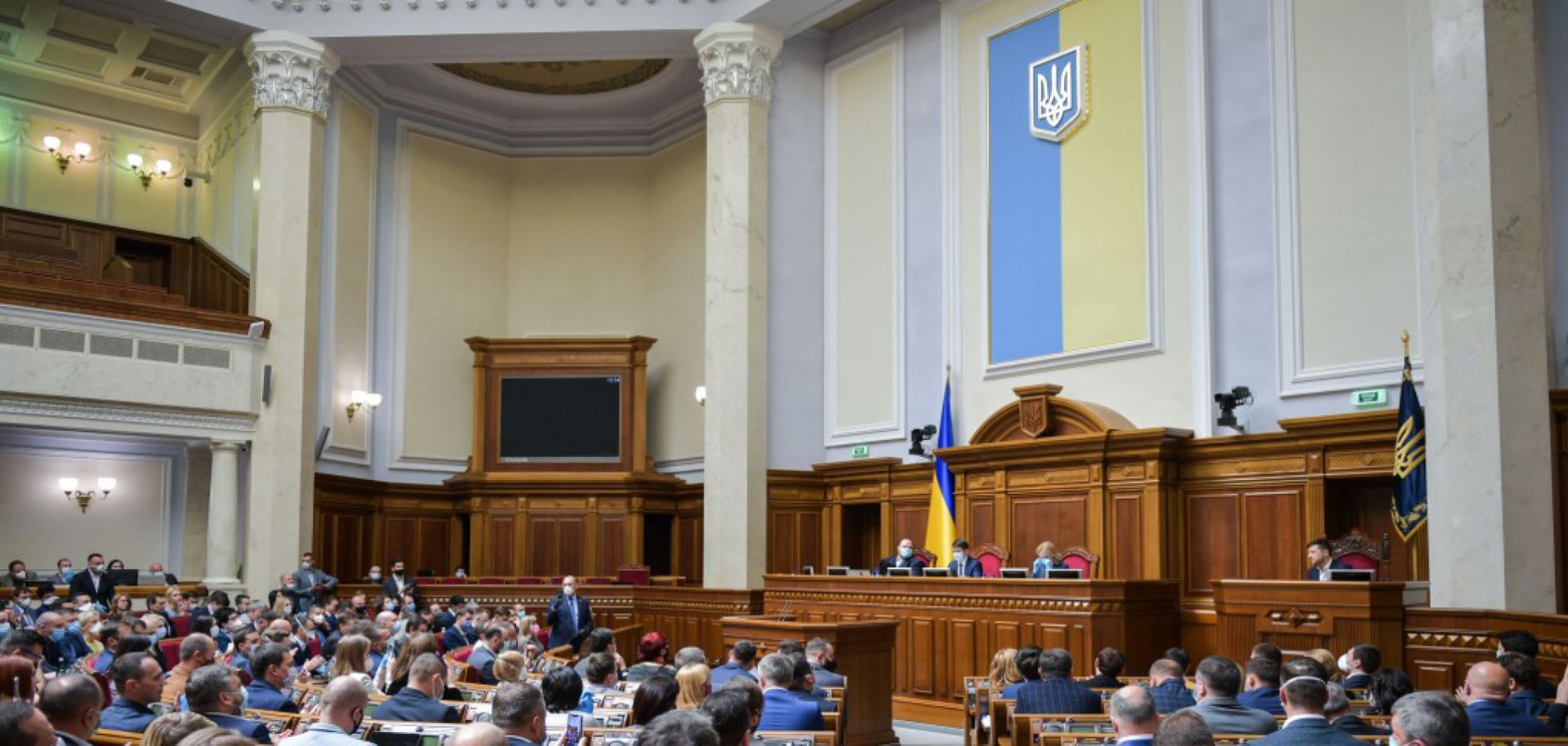
Lawmakers in Ukraine’s parliament vote on a banking reform bill aimed at unlocking financial support from the International Monetary Fund on May 13, 2020, in Kyiv, Ukraine.
Ukraine is poised to get its nascent program of economic reforms back up and running in order to regain key financial support from the International Monetary Fund (IMF). By signaling to others that the country is a worthwhile investment, the move will also help Kyiv raise sufficient funds in the coming year to better manage its external debt. IMF negotiators are tentatively expected to travel to Kyiv in December following conversations between President Volodymyr Zelensky, National Bank of Ukraine (NBU) Governor Kyrylo Shevchenko and IMF Managing Director Kristalina Georgieva. Given the current conditions of the COVID-19 pandemic, it's unlikely IMF staff would have chosen to travel without a high chance of success.
The IMF will want to see the 2021 budget and ensure structural policies have been implemented as promised before releasing funds that would come no earlier than January. At least $1.4 billion from the IMF is immediately at stake, with $700 million that should have been available in September added to a similarly-sized drawing from the IMF scheduled in December if Ukraine’s program remains on track. The IMF has yet to announce the mission publicly after the forced resignation of the previous NBU governor in July raised concerns about the central bank’s independence and anti-corruption efforts in Ukraine’s banking system. In addition, Ukraine’s fiscal deficit will probably hit 7.5 percent of GDP for 2020, which would require additional domestic credit creation that the NBU and Ukraine might have missed. The IMF is also concerned about use of emergency COVID-19 funds for the purpose declared.
Ukraine’s economy, which is currently in a deep pandemic-induced recession, is vulnerable and has high external financing needs. The country’s gross foreign exchange reserves are estimated to now total $24 billion, compared with $22 billion in debt payments (including short-term, trade-related debt) due in the next 12 months, according to data cited by Bloomberg. In contrast:
- GDP in the third quarter of 2020 was -3.5 percent (year-over-year) even though there was a pick-up from disastrous declines of -1.3 percent -11.4 percent in this year’s first and second quarters, respectively. The Ukrainian economy is expected to end 2020 between 5-6 percent smaller than it was in 2019.
- Industrial production has been declining since April, with Western European demand weakened again by a resurgence of COVID-19.
- Exports are invoiced mainly in U.S. dollars and not elastic with respect to the exchange rate, but are subject to global commodities price changes. Ukraine’s currently depressed level of exports further restricts earnings and requires additional financing.
- Ukraine’s current account was in surplus in the first half of 2020 because imports fell faster than export earnings. But the counterpart to that was a large capital outflow of $5.5 billion, which included net negative foreign direct investment.
- Workers’ remittances have declined substantially this year, after accounting for 11.2 percent of Ukraine’s GDP in 2018. The country’s gas transit revenues are down as well.
Without the IMF’s support, Ukraine risks also losing out on another $3 billion in 2020-2021 multilateral policy-based lending from the World Bank, European Union, European Investment Bank and European Bank for Reconstruction and Development. Ukraine has had access to eurobond markets and could possibly cope in the short-term without renewed IMF support. But Eurobond borrowing would be expensive and add to long-term external financing needs without solving underlying issues, including those related to poor governance. A lack of IMF confidence in Ukraine would also heighten investor skepticism and increase external funding costs, which would complicate financial and economic management in later years. It would affect Ukraine’s’ ability to maintain economic independence from Russia as well by empowering Ukraine’s pro-Russian political forces who have long opposed IMF cooperation.
- In July, Ukraine placed a $2 billion eurobond that had an investor yield of 7.250 percent, suggesting a high country risk premium in the current global financial environment. Similarly, the spread on Ukraine’s five-year credit default swaps is just under 500 basis points.
