
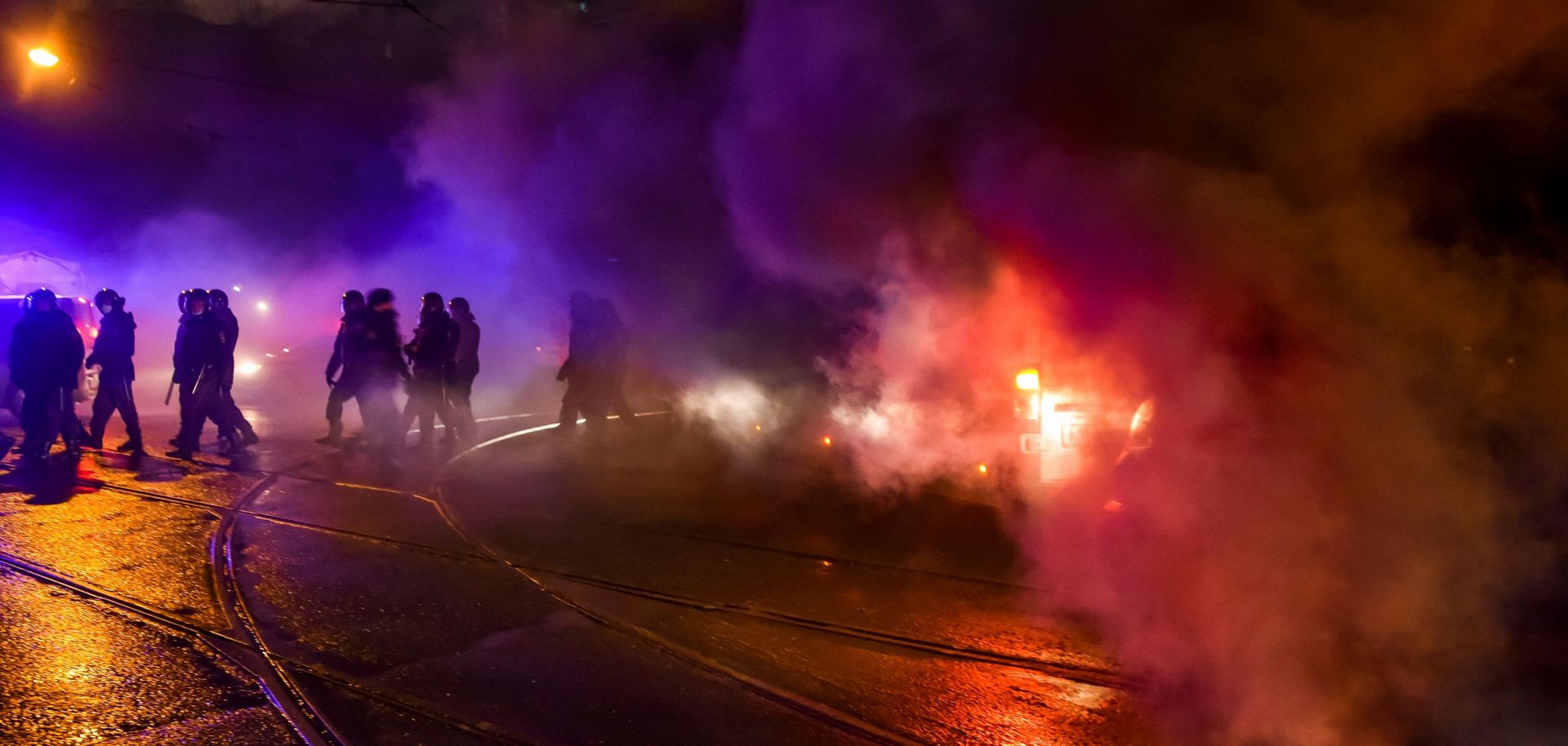
Police walk in the smoke from a burning flare thrown by Russian protesters near the Moscow detention center where opposition leader Alexei Navalny is being held on Jan. 23, 2021.
The heightened crackdown on dissent in Russia demonstrates the Kremlin’s methodic resolve to use all levers of state power to ensure President Vladimir Putin’s policies and worldview endure — even after his eventual departure. The COVID-19 pandemic, low oil prices, unpopular constitutional reforms and unprecedented protests made 2020 one of the most tumultuous years of Putin’s two-decade reign, necessitating an escalated strategy to mitigate threats to his power. In March, Russia’s legislature approved constitutional amendments that would enable Putin to run for another two, six-year terms by nullifying his previous terms. The move was so unpopular that the Kremlin attempted to bury it among other nationalist and populist amendments to drum up support. But more importantly, the amendments revealed Putin’s plans to wield significant power even after he leaves the presidency, as they also contain various adjustments to the separation of powers that enable former presidents to retain informal control over bodies of government.
- Putin ordered the sudden end of quarantine measures to boost his popularity before the controversial amendments went to a popular vote in July. The move publicly contradicted popular Moscow Mayor and floated Putin successor Sergey Sobyanin who had called for increasing COVID-19 restrictions just days before.
- Putin has only directly commented on the motive behind the constitutional changes once, in which he said he wanted to prevent the state bureaucracies from focusing on the search for his successor instead of their work leading up to the 2024 presidential election.
- Putin’s approval rating plummeted following the announcement of the amendments, reaching an all-time low in April. His approval rating has recovered only slightly since then, suggesting that Putin’s push to remain in power via these changes may prove to be more of a political liability than an asset.
The Kremlin’s attempt to assassinate opposition leader Alexei Navalny in August 2020 was likely driven by the fear that protests in Khabarovsk and Belarus could spur a larger anti-government movement in Russia ahead of the 2021 elections for the Russian State Duma. Just days after the July vote for the constitutional reforms, federal security officials arrested the popular governor of Khabarovsk in Russia’s Far East — sparking the largest, grassroots regional protest in Russia in decades. In July, the Kremlin also arrested a prominent journalist on espionage charges and raided the offices of opposition leader Alexei Navalny’s organization. Anti-Putin forces interpreted both of these moves as a clear signal that Putin had a renewed mandate to suppress his opponents. Meanwhile, protests in Belarus following President Alexander Lukashenko's disputed electoral victory in August also risked serving as a playbook for the Russian opposition. Moscow knew Navalny was the only person conceivably capable of pulling off a similar protest mobilization across Russia due to his network of regional offices. Navalny’s arrest and subsequent jailing will not prevent future protests. It will, however, severely hamper the opposition’s ability to weaken the ruling United Russia party or achieve any electoral breakthroughs, which had previously appeared a slim possibility.
- Navalny returned to Russia on Jan. 17, five months after being evacuated to Germany following an alleged assassination attempt by Russian security services. Shortly after arriving at the Moscow airport, Navalny was arrested and jailed.
- Navalny is currently under arrest until a Feb. 2 court hearing, giving the Kremlin enough time to gauge the public and international reaction to his detainment before deciding how long of a prison sentence to grant him.
- Navalny’s alleged poisoning in August 2020 came just weeks after the contested election in Belarus. According to the investigative journalism site Bellingcat, the Kremlin had been plotting the assassination attempt since 2017.
- Demonstrators in Russia, despite being thousands of miles apart and protesting a different regime, repeatedly expressed solidarity with those in Belarus.
Navalny’s indictment is also part of the Kremlin’s crackdown on the “non-systemic” or the real opposition forces in Russia, which Navalny leads, to stave off major instability and keep Putin’s ruling United Russia party in power. In recent years, the Kremlin has sought to bring new quasi-opposition parties into the legislature to compete with lawmakers from “systemic” opposition parties that are also controlled by the Kremlin. Indeed, one of the new quasi-opposition parties likely to enter parliament in 2021 is simply called “New People,” highlighting that this strategy is aimed at satisfying growing calls for fresh players in Russia’s political scene without threatening the Kremlin’s place in power. The fracturing of the systemic opposition will also help the ruling United Russia party retain a comfortable majority in the parliament by hurting the effectiveness of Navalny’s tactical “Smart Voting” initiative, by which citizens are instructed to vote for whichever opposition party is most popular in their region.
Along with Navalny’s persecution and the introduction of a new systemic opposition, the recent enactment of new laws aimed at restricting public dissent further indicates that the Kremlin plans to maintain its crackdown throughout 2021. In the fall of 2020, the Duma passed a flurry of new laws intended to stifle independent voices and wean the Russian people off the influence of Western tech giants, knowing that an outright ban on Western social media would be unpopular and technically impossible. Meanwhile, Kremlin-controlled Russian analogs to Youtube, TikTok and other services are being hastily developed. Russian lawmakers also recently passed a law that enables the government to declare individual citizens (and not just organizations) foreign agents, which has since been used against various journalists and activists.
With Navalny and his organization increasingly marginalized going into the Russian State Duma elections in September, a game-changing surge of protests appears unlikely in 2021. Many anti-Putin Russians will likely be dissuaded from participating in protests ahead of the ballot as the prospect of weakening the ruling party appears increasingly impossible. Electoral events are often required to catalyze major turnout in the streets. But amid the Kremlin’s emboldened crackdown on dissent, the opposition failed to mount street protests following both the July vote on the controversial constitutional changes and the September 2020 local elections (despite the Belarus protests being in full force and having the usual alleged evidence of massive falsifications and corruption). Navalny’s expected detention is sure to spark demonstrations, though they will be relatively minor due to an intimidated public and Russia’s ongoing COVID-19 epidemic. Russia’s prolonged economic stagnation, demographic crisis and restrictive political environment will also continue to provide fodder for sporadic protests.
The next conceivable breakthrough for the Russian opposition looks increasingly like the distant 2024 presidential election, which will be tied to Putin’s succession plans. Russia’s recent history shows that electoral events are often required to catalyze major protests. But with this year’s legislative election unlikely to spur large enough demonstrations, the opposition likely won’t have another opportunity to mobilize a nationwide movement until the 2024 presidential election. If the current pressure campaign on Navalny and his supporters proves successful in 2021, however, the Kremlin will likely pursue a similar pressure strategy to ensure stability ahead of a possible transition to a new president. This means the political field is unlikely to become competitive, and Navalny is unlikely to be allowed to run in 2024.
The Russian government’s ongoing efforts to quelch dissent will preclude significant improvements in its relations with the West. Russia’s domestic developments in 2020 reflect Putin’s long-held belief that the best way to respond to increasing tensions at home and abroad is, in fact, by creating more tension. Undeterred by sanctions, Moscow believes its increasingly brazen conduct at home and abroad will eventually force U.S. and European governments to recognize that cooperation with Putin’s regime as the only way forward. Indeed, revelations around Navalny’s poisoning and the subsequent crackdown were, in part, made possible by U.S. and European reluctance to take meaningful action in response to Russia’s removal of the last shades of democracy. The new administration of U.S. President Joe Biden will seek to reverse this perceived reluctance somewhat, but significant action from Washington and other Western governments is unlikely until widespread political unrest in Russia forces their hand.
- Massive street protests forced reluctant European leaders to more strongly support the Belarusian opposition in 2020, as opposed to turning a blind eye as they did in 2010 and 2015.
Moscow will, in turn, increasingly seek deeper cooperation with other actors such as China, Turkey and Iran. The Kremlin’s current crackdown will accelerate trends that began back in 2014, such as a tightening of Russia’s economic relationship with China, continued diplomatic interest in places like Iran and Turkey, and more proactive efforts to enhance cooperative relations in Africa.
