
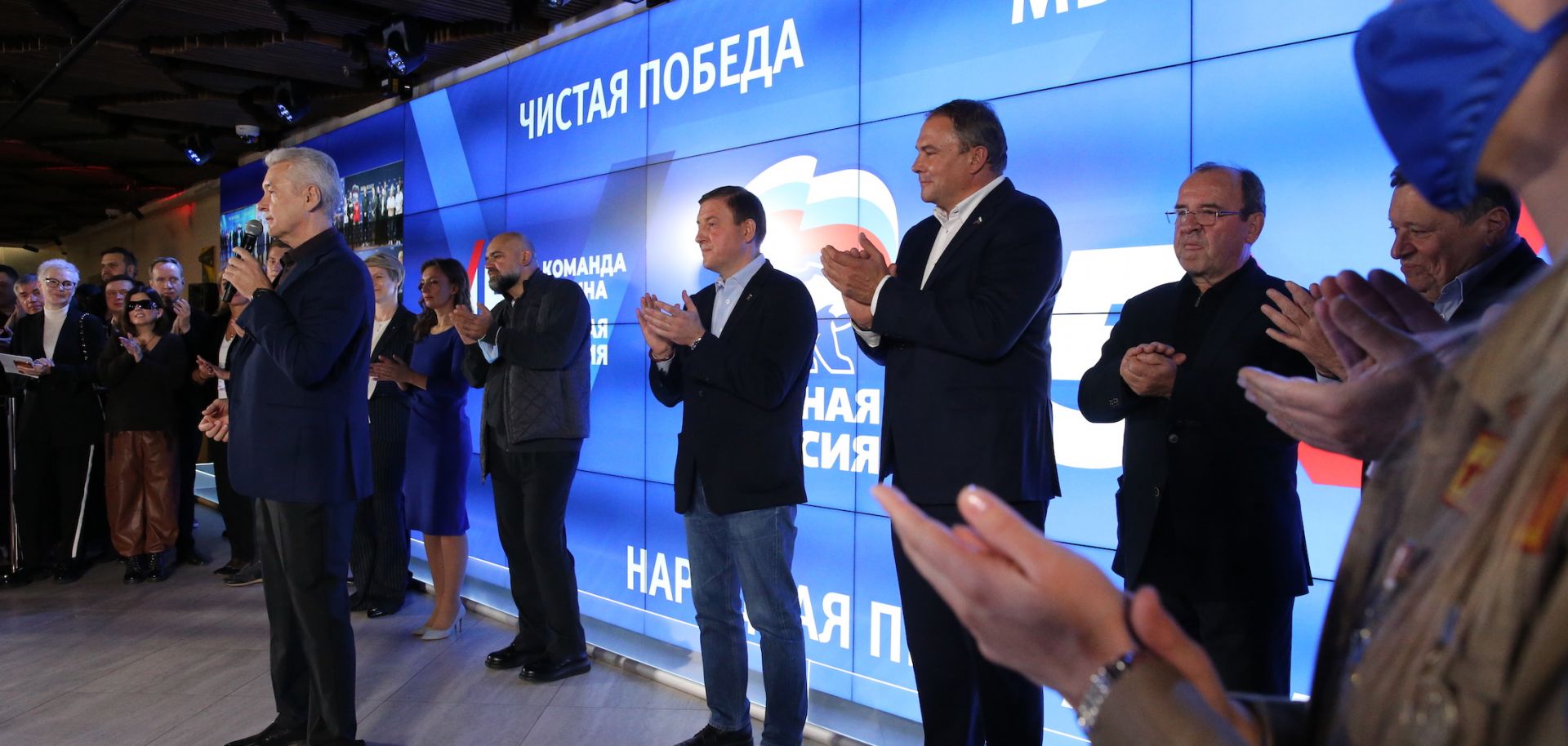
Moscow Mayor Sergei Sobyanin (C) addresses supporters of the United Russia party at the party headquarters during 2021 parliamentary elections on Sept. 19, 2021, in Moscow.
The predictable election win by the United Russia party — which preserved its legislative supermajority despite its falling popularity — in Sept. 17-19 elections highlighted the Kremlin's willingness to take political and economic risks in preparation for a smooth transition to a possible post-Putin era in 2024. According to the official final results, the governing party received nearly 50% of the vote while the Communist Party took a distant second with around 19%; voter turnout stood at about 52%. United Russia is projected to receive 72% of parliamentary seats, comfortably retaining its two-thirds majority that allows it to pass laws and amend the Russian Constitution without support from other parties. The next parliament will have the major role of continuing preparations for a possible transfer of power in 2024, when the next presidential election is due. A parliament in which United Russia lacked a two-thirds majority, or contained even a handful of opposition members speaking openly from the Duma floor, could have stirred unrest ahead of the 2024 election.
- A new Kremlin-controlled opposition party named "New People" will enter the Duma after barely attaining the 5% support required for parliamentary representation, marking the first time since the 1990s that five parties have met the electoral threshold. This party, the creation of which was intended to add a veneer of democratic legitimacy to the election, is unlikely to meaningfully impact parliamentary politics.
- United Russia polled at roughly 30% popularity ahead of the elections, and the Communist Party has rejected the results from online votes, which was used for the first time in a Duma election in Moscow, St. Petersburg and several Russian regions. The votes cast online skewed substantially in favor of the ruling party, which independent observers and opposition politicians immediately cited as evidence that the spread of electronic voting was deliberately rolled out to give an unfair advantage to United Russia. Some statisticians have said as many as half of pro-Kremlin votes in the elections were fraudulent.
- Echoing the Communist Party's concerns, jailed opposition leader Alexei Navalny noted that seven out of eight candidates his "Smart Voting" campaign endorsed in St. Petersburg, and 12 out of 15 in Moscow, won their races when counting only the physical votes, but all of those candidates lost once the online votes were added.
The methods used to secure this year's victory indicate the Kremlin's tolerance for high political risk and economic costs in order to maintain power amid declining popularity ahead of the possible succession in 2024. Russian President Vladimir Putin's popularity has remained near an all-time low since the start of the pandemic. To overcome this, the Kremlin employed costly social programs and increasing control over information flows. The economic measures included one-time payments to the military, pensioners and police that the country's central bank had specifically advised against due to inflation concerns. Ahead of the election, the Kremlin meanwhile increased its control over, and manipulation of, the information accessible to Russians; control of which forces can participate in the political system; coercion of voters; and falsifications of votes on election day. The latter is illustrated by the correlation of higher online vote shares for United Russia, and by how higher turnout at individual polling stations equated in a larger share for United Russia than at other polling stations, which experts believe is strong evidence of fraud.
- On Aug. 25, the Levada Center, Russia's only independent pollster, found that two out of every five Russians cannot afford basic necessities between high inflation and the government's insufficient economic support measures during the pandemic.
- The Kremlin delegated responsibility for vaccination mandates to regional governments in order to deflect blame. The consequent disjointed and inefficient rollout could not overcome the high levels of vaccine hesitancy among Russians. The ineffective rollout left Russia and the Kremlin facing the public backlash from mandates but without the benefit of expanded immunity from sufficient increases in administering shots. With the election over, it is unclear whether Putin now will step in and introduce clear national rules.
- Ahead of the election, the Kremlin campaigned against foreign tech giants in an effort to censor the opposition by claiming their platforms were interfering in the election by hosting content related to prominent opposition leader Alexei Navalny. Ultimately, the services (including Google) complied and deleted Navalny's content and apps. This campaign also included the blocking of virtual private networks.
- Classic measures such as restricting access to video monitoring of polling places, having supporters vote multiple times and voter intimidation occurred, and videos of ballot stuffing swept social media.
- Vladimir Zhirinovsky, leader of the parliamentary quasi-opposition Liberal Democratic party, took the rhetoric of his Communist Party counterparts further by saying that the falsifications in favor of United Russia were a sign Russia was heading down the "Belarusian scenario," suggesting the government's repressions and falsifications in favor of United Russia in the election only delayed the possibility of mass protests until the 2024 presidential election.
Western nations will be reluctant to enact additional punitive measures following the election to back up the potentially sharp rhetoric they will likely issue about election irregularities. Possible Western sanction responses were exhausted after the Kremlin's repression against Navalny and other opposition members starting a year ago. This leaves Western governments unable to respond the way they did to the 2020 Belarusian presidential election despite the Russian fraud being of a similar and systemic nature. And unlike in Belarus, Russia's 2021 election will not be followed by regular mass protests that would force an international response. This is because of the increased risks to Russian protesters due to Moscow's designation of Navalny's organization as extremist. Of course, responding to Belarus was easier for Western governments given Russia's much greater international importance.
- Belarus' 2020 presidential election was similarly marred by widespread accusations of fraud. This prompted the European Union and most European countries to withhold recognition of Alexander Lukashenko's presidential win, and contributed to the country's growing isolation from the West — and reliance on Russia.
- Europe is highly dependent on Russia for energy imports, something all the more clear amid record energy prices in Europe and the controversy over the Nord Stream 2 pipeline. For its part, the United States is attempting to stabilize its relationship with Russia through ongoing talks on strategic stability and cybersecurity, meaning it is also not in a position to escalate with Moscow by rejecting the results of the election.
- Some politicians and activists will likely push Western governments in the coming years to follow the example they set with Belarus and not recognize future Russian elections.
With few clear paths for regaining their popularity and Putin and United Russia and seeing little downside cost in the form of a Western response, the Kremlin will likely resort to the same tactics used to retain stability prior to this election in preparation for the 2024 presidential vote. By then, Putin will be 71, and will have held power as president or prime minister for 24 years. Despite receiving the ability to run again after having his previous terms not count for term limit purposes thanks to 2020 constitutional amendments, there is no guarantee Putin will run again. (Putin has said he promoted the amendments to prevent the Russian elite and bureaucracy from looking for his successor instead of doing their jobs.) And he may very well launch a complex process to designate a successor instead of running again. The measures and manipulations employed prior to this election succeeded in their primary goal of preventing protests, but will likely prompt a major reorganization in the anti-Putin opposition as Navalny's organization is sidelined and parties embark on the difficult task of securing the opposition electorate without prompting Kremlin repression. Absent the risk of a Western response, Russia will see little risk in employing the same tactics up to 2024 to facilitate the power transfer or tamp down any disenchantment should Putin decide to seek another six-year term. The continued deployment of these methods will prevent a significant improvement in Russia's relations with the West in the coming years.
