
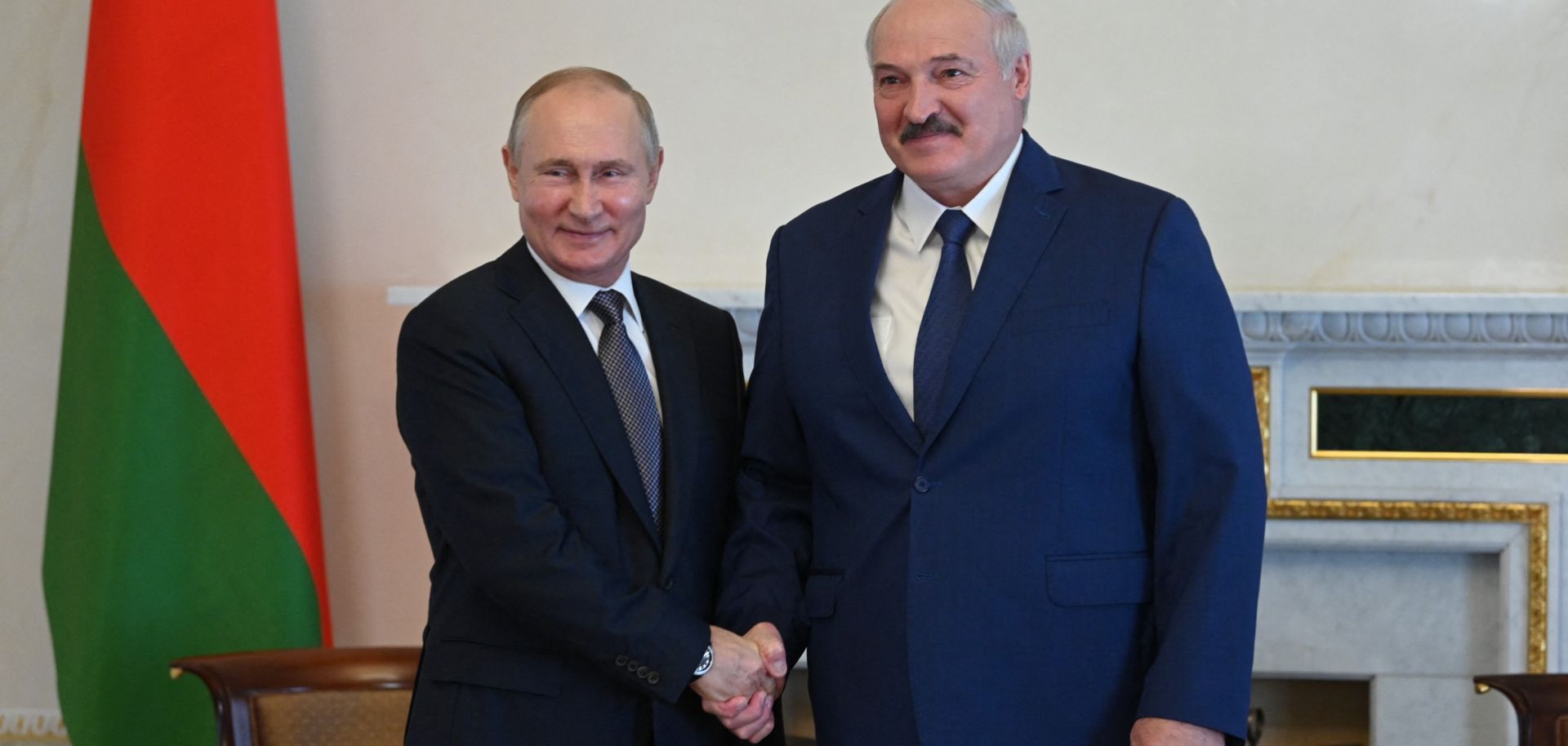
Russian President Vladimir Putin (left) shakes hands with his Belarusian counterpart Alexander Lukashenko in Saint Petersburg, Russia, on July 13, 2021.
Belarus’ changing stance on Crimea confirms its greater alignment with Russia, which will worsen political and economic tensions with Ukraine, as well as contribute to an increasingly volatile situation in the region. In an interview published on Nov. 30, Belarusian President Alexander Lukashenko said that Crimea was “de facto” and “de jure” Russian and that he had agreed with Russian President Vladimir Putin to visit the peninsula, which would “mean [its] recognition [as] part of Russia.” The exact dates of Lukashenko’s Crimea trip haven’t been announced, but the Belarusian leader’s comments and decision to visit the disputed territory starkly contrast with his previous stance on the peninsula since it was annexed by Russia in 2014.
- Lukashenko has called Crimea de facto Russian territory since 2014. But as recently as Aug. 9, he has also said he would only formally recognize Crimea as a Russian territory after “the last Russian oligarch begins to send their products there,” referring to the fact that many major Russian companies do not do business in Crimea due to the fear of Western sanctions.
- Compared with Lukashenko, the Belarusian foreign ministry has maintained a more neutral position on Crimea. The ministry has declined to legally recognize the territory as part of Russia, largely due to fears of both spoiling relations with Ukraine and what a precedent of redrawing the national borders left following the Soviet Union’s collapse could mean for Belarus.
Even if it isn’t accompanied by a legal change in the near future, Belarus’ new position on Crimea could strain diplomatic ties and reduce bilateral trade with Ukraine, which would primarily hurt Minsk. Belarus’ position on Crimea has yet to officially change, which could either come in the form of a statement by the Belarusian foreign ministry at the United Nations, a law passed by the Belarusian parliament, or a presidential decree issued by Lukashenko. The date of Lukashenko’s planned visit to the peninsula also still appears distant, which will give Ukraine time to carefully plan its response. Kyiv will likely enact some retaliatory measures shortly after Lukashenko’s trip, which could deter Minsk from formally recognizing Crimea as Russian territory. But if it doesn’t and Belarus still moves to officially change its position on the peninsula, Ukraine will respond forcefully. This could include suspending the main documents regulating Kyiv’s bilateral political and economic relationship with Minsk — namely the Treaty on Friendship, Good Neighborliness and Cooperation, and the Free Trade Agreement. Ukraine could also go as far as to take actions to legitimize the government of Belarus in exile under Svetlana Tikhaovskaya within the Organization for Security and Cooperation in Europe, the United Nations and the European Union. While a drawdown of economic relations and trade ties would undoubtedly be disadvantageous to both countries, Belarus would feel the brunt of the blow due to its greater reliance on the Ukrainian market compared with the other way around. Ukraine would be able to replace almost all the goods it currently imports from Belarus with supplies from other countries. Belarus, however, has few alternatives and would likely have to rely even further on Russian trade. Replacing Ukrainian purchases of Belarusian refined oil products would be particularly difficult for Minsk since Russia already has enough fuel of its own.
- Ukraine, along with many Western countries, no longer formally recognizes Lukashenko as the president of Belarus after his disputed electoral victory last year.
- On Dec. 1, Ukrainian Foreign Minister Dmytro Kuleba told reporters Crimea was “not an area for compromise” and that Belarus’ potential recognition of the occupied peninsula would “be a point of no return” in the two countries’ bilateral relations, warning such a move could trigger a “full program” of response measures.
- On Nov. 10, following Lukashenko’s initial comment teasing a visit to the peninsula, the spokesperson of Ukraine’s foreign ministry, Oleg Nikolenko, said a de jure change in Belarus’ stance recognizing Crimea as the territory of Russia would have “irreparable consequences” for Ukrainian-Belarusian relations.
- Behind Russia, Ukraine was the second-largest importer of Belarusian goods in 2020, with oil products accounting for 43% of those imports. Conversely, Belarus is only Ukraine’s six-largest trade partner, with the share of Ukrainian exports going to Belarus hovering at only around 3% over the past decade.
Lukashenko’s changed stance highlights Belarusian foreign policy’s subordination to Russia and opens the door for additional Russian economic and political support for Minsk. Lukashenko’s moves will likely trigger additional economic support from Russia, even if the Belarusian foriegn ministry’s official diplomatic position does not change. The adjustment in Lukashenko’s public stance on Crimea happened shortly after Russia and Belarus finalized integration programs on Nov. 4, which will grant Moscow increased control over domestic policy in Minsk. Similarly, Lukashenko’s changing stance on Crimea can be seen as the foreign policy corollary to the programs, as the first clue of the start of Lukashenko’s rhetorical change on Crimea coincided with their signing. Minsk's new stance will impede any normalization of Belarus-Ukraine relations, which is what Moscow wants — although it’ll come at the risk of slapping Belarus with more Western sanctions. Because of the potentially severe costs, Lukashenko likely will insist on major economic incentives from Moscow in exchange for recognizing Crimea as Russian territory, which are likely to come in the form of additional loans and other support from Russia.
- On Dec. 1, Russian Foreign Minister Sergei Lavrov said that an oral statement on Crimea like Lukashenko’s is enough for Moscow, and "nothing more needs to be done, no laws need to be adopted.” Thus, Moscow appears content to allow the Belarusian foriegn ministry to at least temporarily continue to formally stick to its “neutral” position so as to not suddenly provoke the harshest response measures from Kyiv or the West that legal formalization may provoke.
Belarus’ growing alignment with Russia and increasing hostility toward Ukraine will increase regional volatility and add to the tensions already driving fears of an escalation of the conflict in eastern Ukraine. Lukashenko’s new stance on Crimea, coupled with Kyiv’s refusal to view Belarus as a neutral party since August 2020, leaves the Normandy Format (which includes Germany, Russia, Ukraine and France) as the last forum where the leaders of Russia and Ukraine could conceivably meet. However, the Kremlin has repeatedly indicated that it has little interest in using the group for another in-person meeting between Ukrainian President Volodymyr Zelensky and Putin. In addition, Ukraine’s growing disappointment with the Minsk agreements (which are the foundation for regulating the Donbas conflict between Ukrainian forces and Russia-backed separatists) coincides with Belarus’ increasingly threatening rhetoric toward Ukraine, as Lukashenko appears to have fully joined Moscow’s effort to intimidate Kyiv with the possibility of an escalation of the conflict. Lukashenko’s recognition of Crimea will serve to make the possibility of Belarusian territory or troops being used in Russian escalations scenarios more convincing.
- In the same Nov. 30 interview, Lukashenko said that Belarusian forces “will not stand aside” in Moscow’s confrontation with Kyiv and “it is clear whose side Belarus will take,” indicating that he was referring to alleged “aggression” by the Ukrainian military in Donbas. Lukashenko went on to say that he would “do everything to make Ukraine ours.” The rhetoric was in stark contrast to Lukashenko’s statements on the conflict in 2015, in which he said he would “never allow Belarusian territory to be used to attack Ukraine.”
