
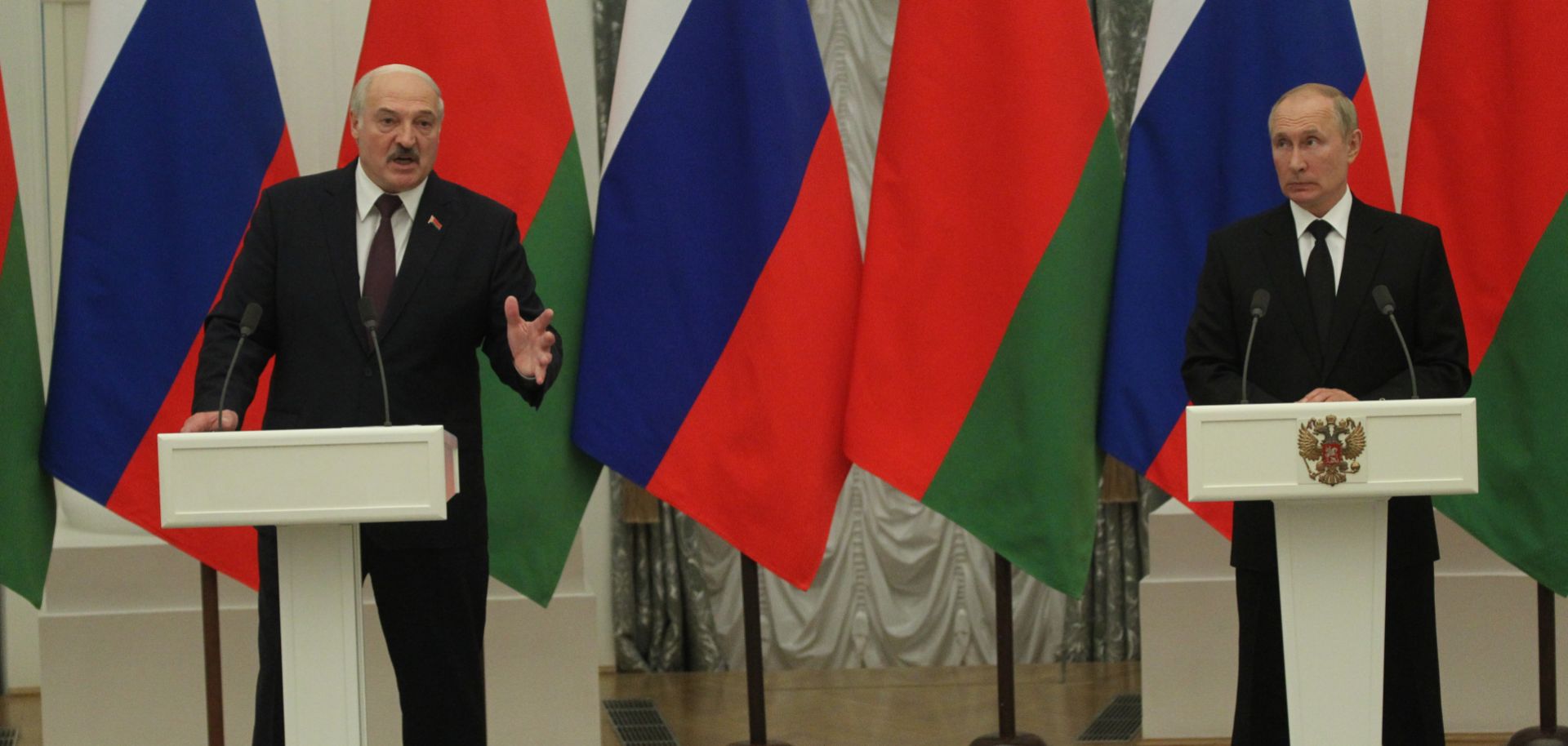
Russian President Vladimir Putin (right) and Belarusian President Alexander Lukashenko hold a joint press conference in Moscow on Sept. 9, 2021.
The newly unveiled integration agreement between Russia and Belarus creates a broad framework for the steady erosion of the latter’s sovereignty in the coming years. On Sept. 9, Belarusian President Alexander Lukashenko stood beside his Russian counterpart Vladimir Putin to announce an agreement on 28 “Union State programs,” previously referred to as “integration roadmaps.” These vague cooperation initiatives are aimed at cementing Russian influence in Belarus through bureaucratic alignment and “macroeconomic policy convergence.” The two countries will “unify” their policies, legislation, and regulations in numerous sectors, including agriculture, industry, and consumer protection. They will also “harmonize” their policies on foreign exchange, cybersecurity in the financial sphere, and even monetary policy. Through these and other measures in the agreement, Moscow is seeking to permanently secure Minsk in its geopolitical orbit amid questions of Lukashenko’s legitimacy in the aftermath of the contested 2020 presidential election.
- The agreement lacks specifics and only briefly explains the goals of each integration program using broad undefined terms like “single market”, “common policy” and “harmonization.” Only four of the programs mention any set date or deadline for any steps of their realization, though even those deadlines are fungible due to their vague wording. Additional technical details expanding on or clarifying the general language in the agreement are unlikely to become available before the official signing of the agreement on Nov. 4.
- High-ranking Belarusian officials have indicated that the target to implement most of the programs is by 2025, the year of Belarus’ next scheduled presidential election, and that for several of the more complex elements, the deadline is even longer, in 2027.
- According to the document, an intergovernmental agreement on Central Bank monetary harmonization should be signed by the end of 2022, as well as a common gas market, unified consumer protection rules, and unified nuclear energy policy by December 2023.
Despite the opaqueness and the extended timeline, the deal will largely accomplish Moscow’s main goal of preventing a repeat of the dissolution of ties seen in Ukraine in 2014. In order to establish the necessary mechanisms to effectively control Belarus, the Kremlin needed to maintain pressure on Minsk to act in Moscow’s interests without inciting Western response or destabilizing Belarus by causing a schism in the Belarusian elite. Russian regulators will likely leverage Russia’s economic heft and Belarus’ indebtedness to largely dictate the gradual integration of the two countries’ regulatory and financial systems in the coming years, per the new rules outlined in the agreement. This will, in turn, enable Russia to control Belarus through economic dependence, sparing Moscow from having to insist on more rapid and deep political or security integration, or a change of power that would have destabilized Lukashenko’s still fragile regime.
- The 2014 Euromaidan uprising against Ukraine’s Russia-backed government has since prompted Moscow to tighten its grip on Belarus amid fears of losing one of its last redoubts of strategic depth against Europe and the West.
The agreement does not contain any military- or defense-related programs, nor does it portend immediate erosions of Belarusian sovereignty that would have provoked a significant Western response. The deal does, however, open the door for such problematic erosions in the longer term. The two leaders discussed creating a “unified defense space.” But Putin suggested that the Zapad 2021 military exercise — which began on Sept. 10 and runs through Sept. 16 — reflects the countries’ close security ties. This suggests that military and defense issues, such as Russia expanding its military installations or presence in Belarus, were likely intentionally left out of the integration agreement to avoid Western reactive measures. For likely similar reasons, the new integration deal also doesn’t mention more problematic measures like the establishment of a single currency between Belarus and Russia, or increased powers for political bodies of the Union State. Western officials are likely to describe the integration agreement as coercive and unequal, and may even enact some symbolic response measures. A truly significant response, however, is unlikely, in part because the Belarusian opposition will not recognize the agreement as legitimate. But the lack of opposition recognition won’t keep the deal from taking effect — making even a minor adjustment of Belarus’ geopolitical alignment toward the West all but impossible in the future, as Belarusian institutions become inseparably tied to and dependent on their Russian counterparts.
