
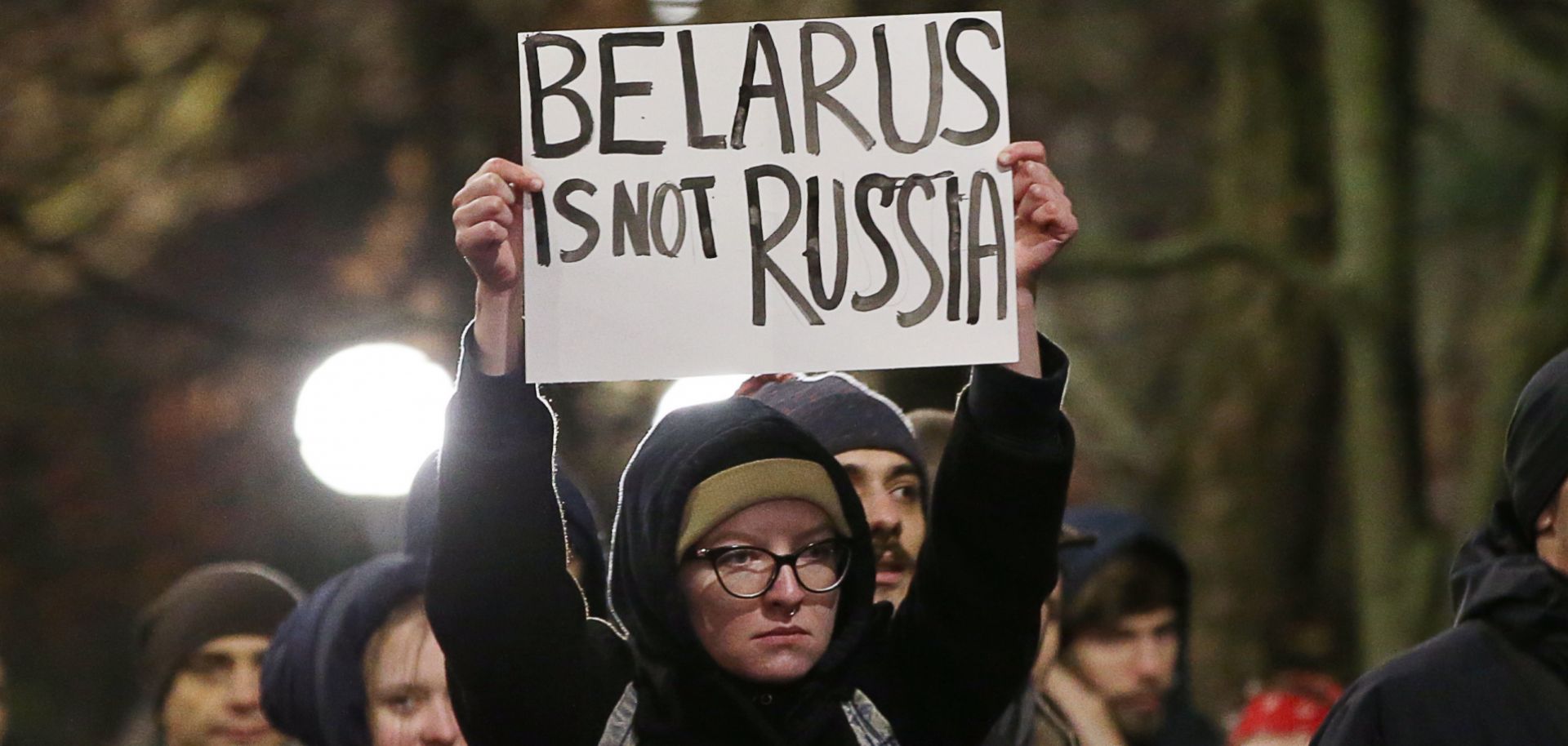
People gather for a rally against Belarus' closer integration with Russia in Minsk's Oktyabrskaya Square on Dec. 20, 2019. Belarus is shaping up to be a new hotspot between East and West.
Almost six years after Ukraine drove a wedge between Russia and the West, there's another potential hotspot in the geopolitical competition between the two in Eastern Europe: Belarus. Moscow has been exerting more pressure on Minsk in an effort to bind it economically, politically and militarily to Russia amid fears that a Belarus leaning West would further deprive the Kremlin of one of its last redoubts of strategic depth against Europe. At the same time, too hot a pursuit could instead have the opposite effect. Given its own preference, Minsk would rather maintain a balance between the two, but given the intensifying competition between Russia and the West, Belarus may be the site of their next showdown.
Echoes of Euromaidan?
Numerous recent meetings between Russian and Belarusian leaders to discuss integration have raised speculation on the nature of their relationship. At the center of the talks is the 1999 Union State Treaty, which envisioned the countries' eventual merger into a single, supranational entity. Such deep integration never occurred, but the treaty's goals — as well as the obvious power disparity between the signatories — have continued to guide their relationship.
After the dissolution of the Soviet Union and the eastward expansion of NATO and the European Union, Belarus has become one of the most quintessential "borderlands" between Russia and the West. Although many perceive it as a Russian satellite, Belarus has worked hard to maintain a significant degree of independence from Moscow, attempting to balance its relations with both the European Union and the Kremlin. For most of the post-Cold War era, this stance did not cause great concern for Russia. In terms of security, longtime Belarusian President Aleksandr Lukashenko's administration remained a stalwart supporter of Russia at a time when there was little competition between Moscow and the West. But as tensions have risen over the past decade, Russia's perception of where Belarus fits into its worldview has also changed.
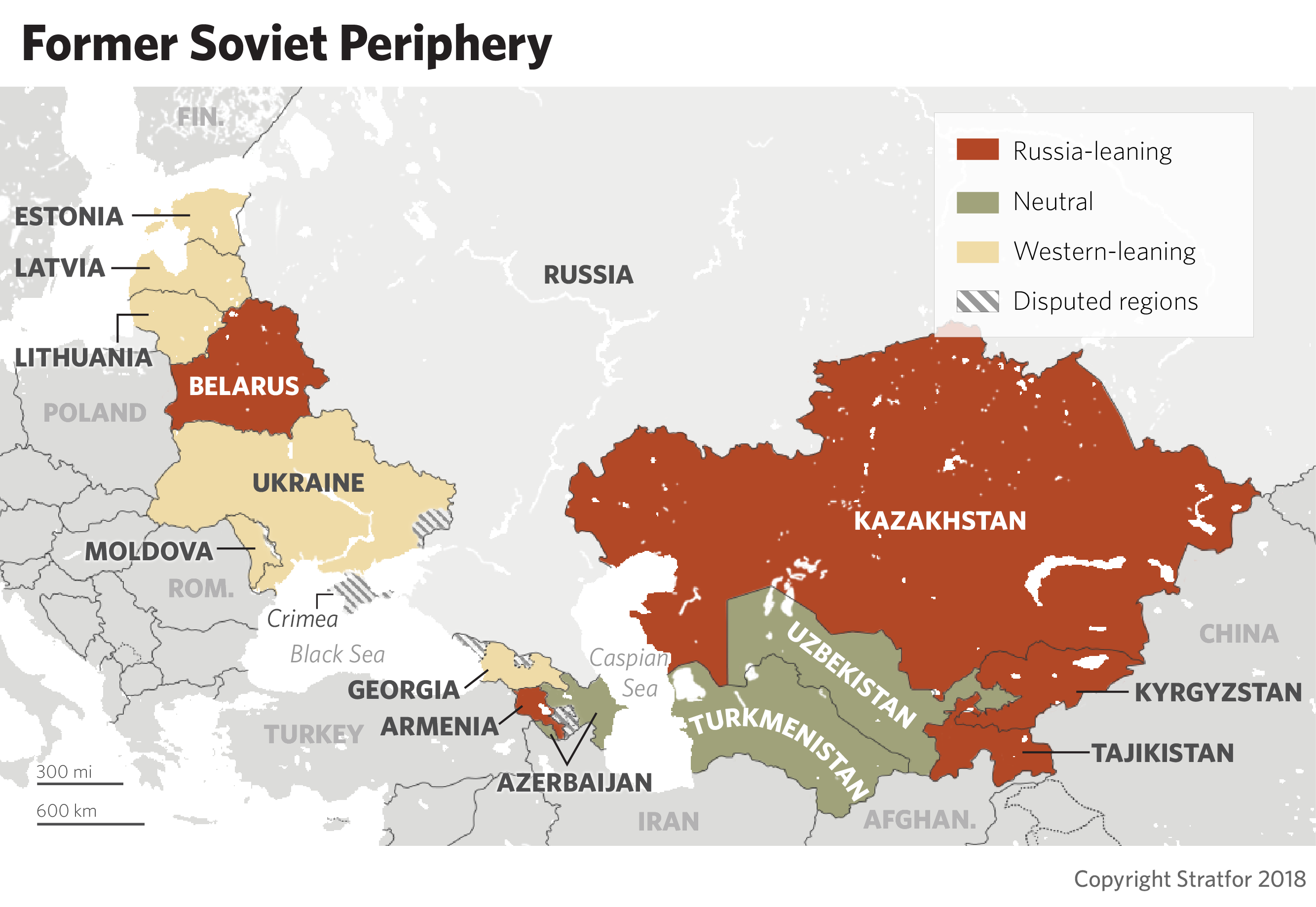
As a result of intensified geopolitical competition, Russia now requires greater guarantees of Belarus' alignment, particularly in the wake of Ukraine's Euromaidan uprising in 2014, which toppled pro-Russian President Viktor Yanukovich. In response to events in Kyiv, Russia annexed Crimea and offered backing to separatist republics in Eastern Ukraine, but that merely solidified Ukraine's definitive move to the Western camp — in contrast to its more neutral stance in previous years in which power rotated between mildly pro-Western and pro-Russian administrations. Naturally, after watching Ukraine throw its lot in with the West, Russia is concerned that a similar shift will occur in Belarus. Indeed, it has watched warily as European investment funds have begun financing Belarusian infrastructure development, Minsk has joined a European energy partnership, and the Belarusian government has pursued visa liberalization with the European Union.
Russia's Efforts to Lock in Loyalty
Since 2015, Russia has gradually ramped up its efforts to forcibly ensure Minsk's loyalty. Russia has become more insistent, for example, that Belarus host a Russian air base. But given that doing so would clearly paint Belarus into the Russian corner, Minsk has refused. Meanwhile, Russia has participated in a number of military exercises with Belarus, including the Zapad (West) exercises, which Moscow hyped widely in a bid to project the image that Minsk remains an unconditional military ally — even if Russia itself may not be entirely convinced of its western neighbor's undying loyalty.
Still, Moscow does have tools to use against Minsk, including an economic relationship in which Belarus imports Russian goods at a cheaper price. Since the dissolution of the Soviet Union, Russia has provided Belarus with heavily discounted natural resources, including natural gas and crude oil. Belarus, in turn, has earned significant revenue from refining the cheap Russian crude and selling the products in European markets at competitive prices.
But now that Russia feels Belarus is wavering in its support, Moscow has decided to attach conditions to these favors. Russia, for one, significantly raised the cost of crude for Belarus earlier this year by removing preferential customs and taxation procedures. In response, Lukashenko, fearing that Belarus could slip into recession, has been trying to persuade Russia to backtrack, but Russia has offered only limited temporary relief. At the same time, the countries are renegotiating the price of Russian gas deliveries to Belarus, and Russian President Vladimir Putin has declared that Moscow will continue to sell natural gas at discounted rates only if Minsk agrees to greater economic integration. The discussions, ultimately, encapsulate what the Union State talks have become: a forum for Belarus to demand continued economic perks from Russia and for Russia to demand closer direct ties lest Belarus stray too far west. Moreover, Russia may even be seeking a high degree of political or military integration in these negotiations, according to some claims, but details of those aspects of the talks are scarce.
Caught in the Middle
For Belarus, this presents a conundrum. Its preferential relationship with Russia has given it economic and physical security, but sacrificing sovereignty to retain such advantages would deprive Belarus of the potential that Lukashenko sees in cultivating a trade relationship with Europe. In essence, the choice for Minsk is between benefiting from Russian subsidies as a vassal or continuing its efforts to develop a more dynamic economy that can become a player in European markets. In an ideal world, Lukashenko would not choose sides, but Russia's increasing pressure suggests that might not be an option in the future.
What's more, many Belarusians resist the idea of making significant concessions to Russia. While most of its citizens view Russia as a friendly nation, few would countenance true domination at Moscow's hands. Young people, especially, are more enthusiastic about Minsk's potential turn toward Europe, where they see greater opportunities for growth and development, instead of Russia, which they believe would put brakes on progress.
As the talks between Russia and Belarus ramp up, so does the risk of miscalculations and the possibility of direct competition there between Moscow and the West — as well as greater antagonism between Moscow and Minsk. While such a situation could play out in many different ways, a standoff could result in Euromaidan-like events. With many Belarusians wary of Russian attempts to exert more power over them, and Europe and NATO anxious about Moscow's actions in the borderlands, Belarus could easily become the site of a new hybrid war — an uneasy state between war and peace in which Russia and the West would combat each other using information campaigns and clandestine operations. In the end, if Russia pushes Belarus too hard, it could well lose its influence over Minsk — just as it did over Kyiv — and create a new global flashpoint.
