
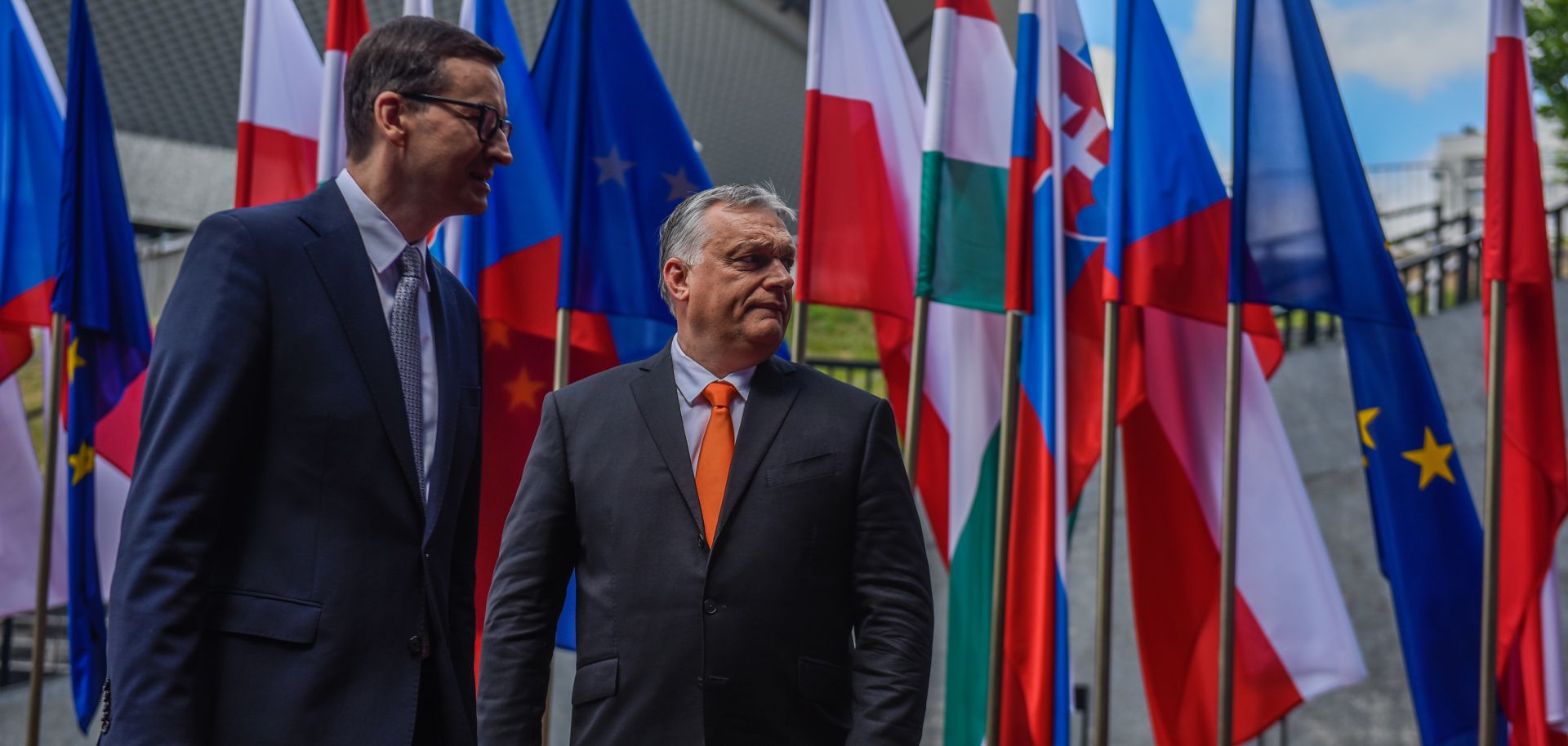
Polish Prime Minister Mateusz Morawiecki (left) welcomes his Hungarian counterpart, Viktor Orban, ahead of a meeting in Katowice, Poland, on June 30, 2021.
A European Court of Justice (ECJ) ruling in favor of linking EU funds to upholding the rule of law will grant Brussels more leverage in its dealings with Euroskeptic member states and could ultimately incentivize countries like Poland and Hungary to de-escalate tensions with the bloc to avoid economic sanctions. On Feb. 16, the ECJ ruled that a mechanism giving the European Commission power to stop funding for EU member states that violate the rule of law is legal. The bloc’s highest court dismissed a challenge from Hungary and Poland, which questioned the legality of the mechanism that was created in 2020.
- The European Commission created the so-called conditionality mechanism in 2020 as a part of the bloc’s 750 billion euro COVID-19 recovery fund. The mechanism allows Brussels to suspend budget payments (including development funds and agricultural subsidies) in the case of rule-of-law issues in a member state that misuses taxpayers’ money.
- Hungary and Poland took the mechanism to the ECJ, arguing that it was politically motivated and specifically targeted at them. For years, Brussels has clashed with Budapest and Warsaw on issues such as judiciary reforms and government pressure on independent media. But the European Commission has so far refrained from using the conditionality mechanism to deprive Poland and Hungary of EU funds because it was waiting for the ECJ to rule on the mechanism’s legality.
Despite Brussels’ new powers, the sanctioning process will remain heavily politicized and subject to delays. The Feb. 16 ECJ ruling opens the door for Brussels to propose punitive measures against countries with a weak rule of law. But imposing such penalties will still require the approval of the European Council, which represents the member states. Sanctions must be approved using a qualified majority system, which means that Poland and Hungary can try to build a blocking minority among member states to prevent sanctions. Moreover, Brussels will have to prove that the weak rule of law in the targeted country is leading to the misuse of public funds, which will limit the European Commission’s room for action over issues such as political pressure on independent media. Finally, the targeted countries can still take the proposed punitive measures to the ECJ, thus prolonging the legal dispute and delaying their implementation.
- Governments in Central and Eastern Europe will likely lobby against imposing sanctions against Poland and Hungary for fear they could be targeted next.
- Countries like Germany and France could also pressure Brussels against using sanctions to avoid further alienating member states where Euroskepticism is already strong. Instead, Berlin and Paris are likely to push for a negotiated solution to Brussels’ ongoing rule of law disputes with Warsaw and Budapest.
- Lawmakers in the European Parliament will likely pressure the European Commission to take a more hawkish stance on rule of law issues, but their influence will be limited since the EU legislature is not involved in the actual approval process of punitive measures.
While the risk of sanctions is not immediate, the conditionality mechanism could compel Poland and Hungary to ease their disputes with the European Union in order to avoid penalties. The ECJ ruling in favor of tying EU funds to respect for the rule of law represents another step in the bloc’s institutional push for leverage against rebel member states. To pressure Poland and Hungary to comply with EU rules, Brussels has already delayed the approval of plans to spend loans and grants from the bloc’s COVID-19 recovery fund in recent months. In October, the ECJ also began issuing a daily fine of 1 million euros against Warsaw over its failure to suspend the country’s disciplinary chamber for judges (which the ECJ argues undermines the independence of Poland’s judiciary system), and recently threatened to start imposing another daily fine of 500,000 euros over a controversial coal mine on Poland’s border with the Czech Republic as well. Poland, Hungary and other countries (particularly in Central and Eastern Europe) with potential rule of law issues are all net receivers of EU funds, which means that they could lose billions of euros if those funds are suspended. While anti-EU sentiment will likely remain strong in the region due to pervasive anti-globalization and nationalist sentiments, this threat of economic pain could force rebel governments to seek compromises with Brussels.
- On Feb. 3, Polish President Andrzej Duda announced a legislative proposal to scrap a controversial disciplinary chamber that supervises the work of judges and prosecutors. Duda’s announcement indicates a desire to reduce tensions with Brussels and avoid sanctions, as the chamber has become one of the main points of contention between Warsaw and the European Commission.
- In October, Poland’s constitutional court questioned the supremacy of EU law by ruling that the ECJ did not have the power to interfere with the Polish government’s decisions on the judiciary. The ruling alone does not create any immediate conflicts unless Warsaw acts on it (by, for example, ignoring a ruling by the ECJ). But the long-term question about Poland’s compliance with the EU’s legal framework remains.
