
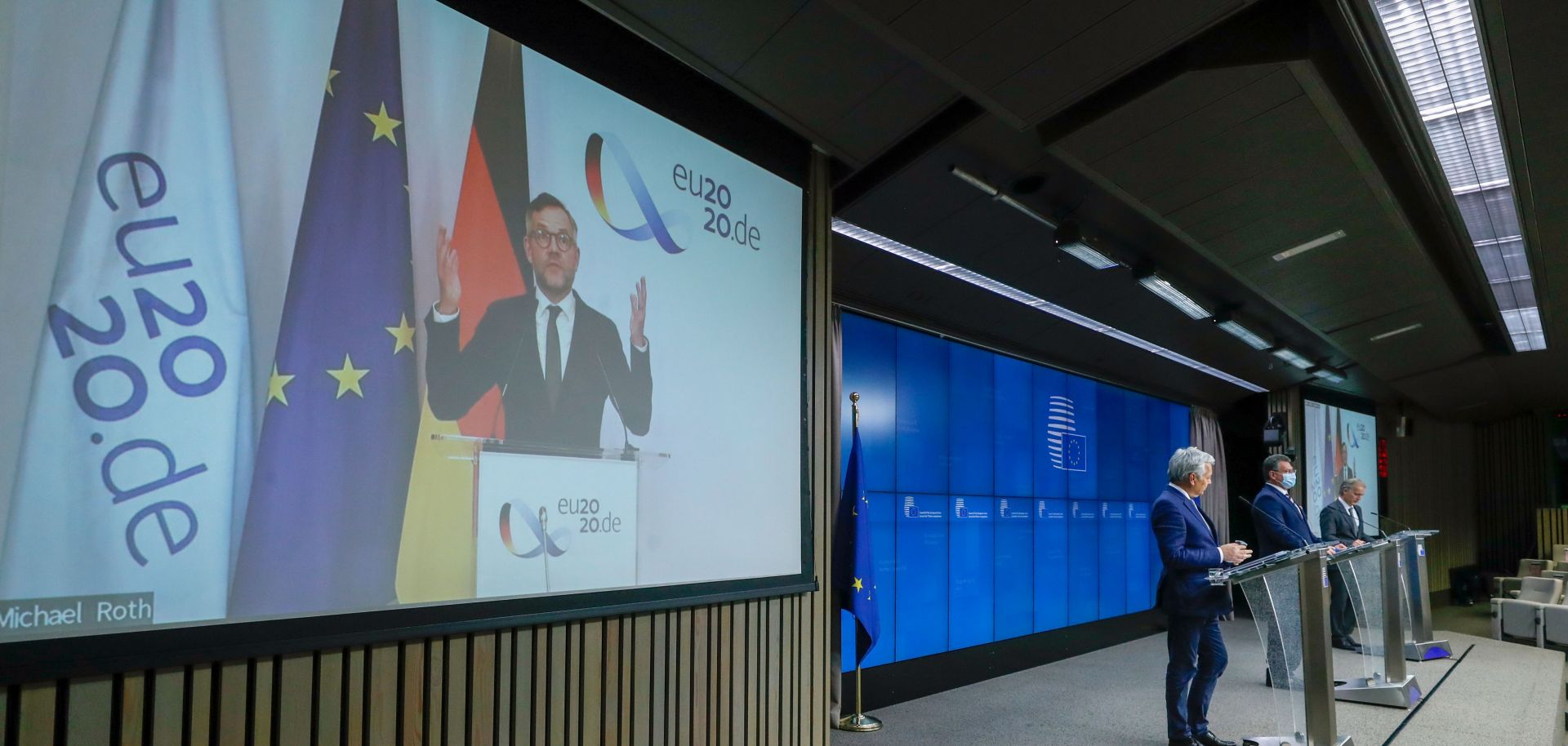
German Minister of State for European Affairs Michael Roth speaks on the screen during a virtual EU press conference in Brussels, Belgium, on Nov. 17, 2020.
An ongoing dispute over a 1.8 trillion euros ($2.1 trillion) EU spending package could jeopardize the bloc’s economic recovery. While there is still room for a compromise, any delays in the disbursement of these funds would be particularly damaging for southern European countries, which have experienced the deepest pandemic-related GDP contractions in 2020. On Nov. 16, Poland and Hungary vetoed the European Union’s 1.1 trillion euros ($1.3 trillion) 2021-2027 budget and a 750 billion euros ($890 billion) COVID-19 recovery fund because they include a mechanism to link the disbursement of money to upholding a strong rule of law. Warsaw and Budapest argue that this mechanism is political and will target them specifically. A Nov. 19 summit of EU leaders failed to reach an agreement to break the impasse.
- The European Council and the European Parliament agreed in early November that EU funds should be linked to a strong rule of law in the recipient countries.
- In recent years, the European Commission has warned about the rule of law weakening in Poland and Hungary over issues such as reforms of the judiciary and alleged political pressure over critical media.
- Countries such as France and the Netherlands insist that there must be a very close connection between EU funds and EU values.
- Slovenia is the only country that is currently supporting Hungary and Poland in their push against the disbursement mechanism.
The European Union still has several tools to reach a compromise and end the current political crisis. It may also exclude Poland and Hungary from the funds, though only as a last resort. The German government, which holds the rotating presidency of the European Union, said it is working on a compromise solution. Hungarian Prime Minister Viktor Orban said on Nov. 20 that the negotiations will continue and a compromise will eventually be found. The issue will probably be discussed during a Dec. 10-11 EU summit. Some of the options to break the stalemate include:
- Adopting a narrower definition of the rule of law. In September, Germany proposed to sever EU funding only when corruption or misuse in the handling of EU funds is detected, a much narrower interpretation of the rule of law mechanism. A compromise along these lines would require convincing countries like France and the Netherlands, who defend a broader interpretation.
- Changing the voting mechanism to approve sanctions. According to the current plan, EU governments must approve rule of law-related sanctions using a qualified majority. The voting mechanism could be changed to reassure Hungary and Poland that they will be able to block sanctions against them.
- Issuing a political declaration saying this is not a mechanism against specific member states. EU governments have proposed to issue a statement saying that Hungary and Poland will not be specifically targeted by the rule of law mechanism, but Budapest and Warsaw rejected the offer, arguing such a promise would not be legally binding.
- Excluding Hungary and Poland from the COVID-19 recovery fund. They could do this by turning the recovery fund into an intergovernmental treaty where Poland and Hungary are excluded or by using the “enhanced cooperation” mechanism, which allows for some EU member states to deepen their cooperation while excluding other members of the bloc. The European Union will try to avoid this option because excluding Hungary and Poland would deepen the political disputes within the European Union and show that the bloc is unable to reach consensus.
Europe’s economic recovery from the COVID-19 crisis is at stake because countries in Southern Europe and, to a lesser extent, Central and Eastern Europe, are counting on EU funds to boost economic activity. Italy and Spain, whose economies have been the worst hit by the lockdown measures, are the main receivers of the relief fund. Rome and Madrid have already included this money in their spending plans for 2021, which means that any delays in the arrival of funds would force them to adjust their budgets. In the meantime, Central and Eastern European countries (including Poland and Hungary) are net receivers of money from the European Union’s budget. This means that, despite their current position, Warsaw and Budapest are interested in these funds being eventually unblocked. They are also likely to be pressured by other countries in the region to soften their position.
- Italy has been allocated 209 billion euros ($248 billion) in grants and loans from the recovery fund, while Spain has been allocated 140 billion ($166 billion) from the recovery fund.
- Poland has been allocated roughly 133 billion euros ($156 billion) from the European Union budget and recovery fund, while Hungary has been allocated around 41 billion euros ($49 billion).
- The governments of Slovakia and the Czech Republic, which alongside Hungary and Poland are members of the Visegrad Group, have called on Budapest and Warsaw to lift their veto.
- The governments of Romania and Bulgaria have both expressed their support for the rule of law mechanism.
- If its 2021-2027 budget is not approved by the end of the year, the European Union will need to use a provisional annual budget in 2021 that extends the spending ceilings used in 2020.
