
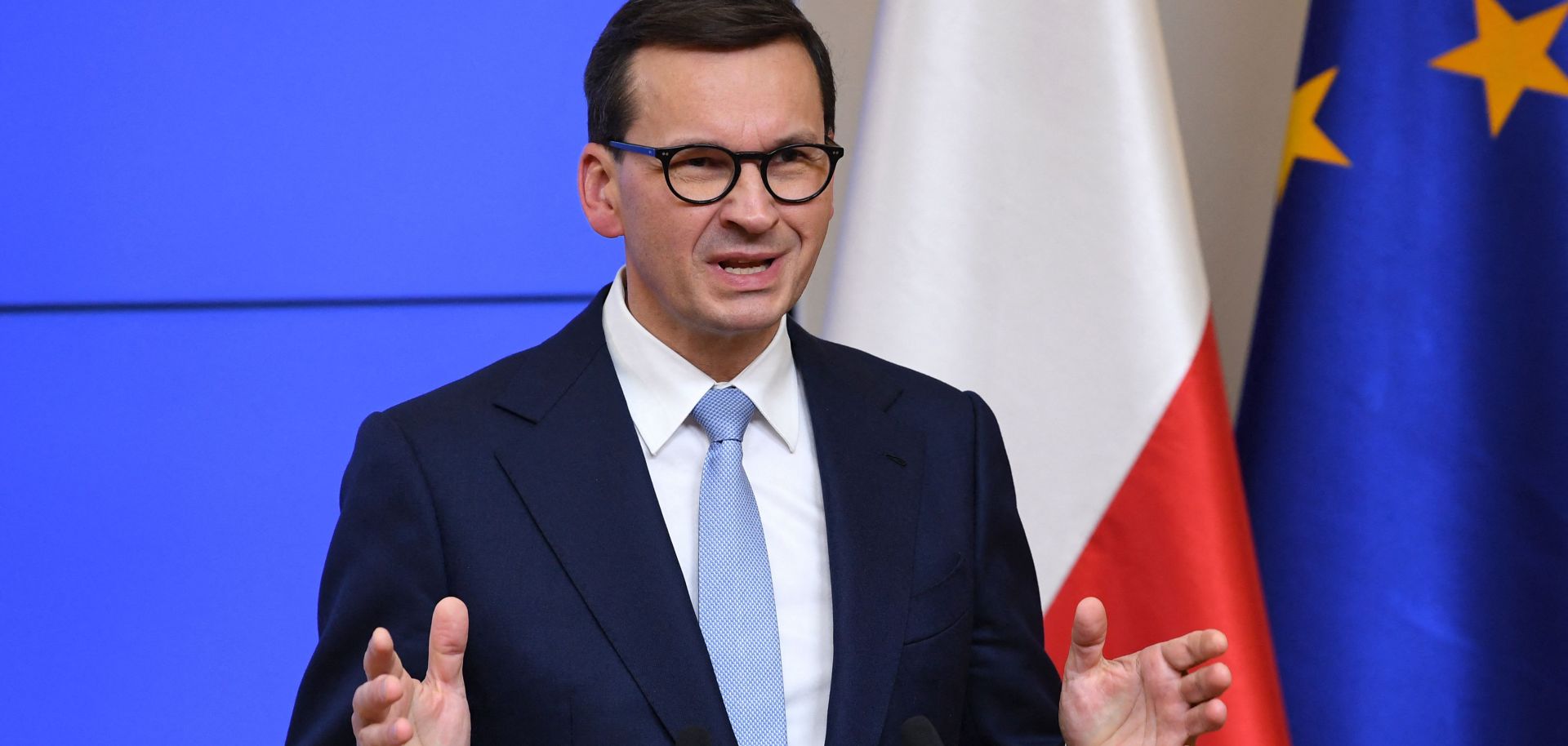
Polish Prime Minister Mateusz Morawiecki speaks during a press conference on Oct. 22, 2021, after meeting with EU leaders in Brussels.
Resolving its judicial dispute with the European Union would grant Poland billions of euros worth of EU funding, but the larger question surrounding the primacy of EU law in the country will continue to create political and economic uncertainty. On Oct. 28, European Commission President Ursula von der Leyen said Brussels will approve Poland’s plans to use money from the bloc’s COVID-19 recovery fund if Warsaw dismantles a controversial disciplinary chamber that supervises the work of judges and prosecutors. Von der Leyen noted she hoped to reach such an agreement and thinks it’s “doable,” but the suspension of the chamber — which critics say undermines the independence of Poland’s judiciary — was absolutely necessary.
- In 2018, Poland created a disciplinary chamber for judges and prosecutors as a part of broader judicial reforms. According to the Polish government, the goal was to eradicate corruption from the country’s judiciary system. But the European Union has argued the chamber enables the government to pressure judges.
- In July, the Court of Justice of the European Union (CJEU) ruled that the chamber weakened the independence of Poland’s judiciary and asked Warsaw to abolish it. Instead, the Polish government asked its own Constitutional Tribunal to rule on the issue. In early October, the Polish tribunal ruled that the CJEU does not have the power to rule on Poland’s internal judicial reforms. The ruling posed a fundamental threat to the European Union’s legal order, according to which EU law is superior to national laws and CJEU rulings are superior to national courts’ rulings.
- To pressure Poland to comply with the CJEU ruling, the European Commission is delaying the approval of 24 billion euro ($28 billion) and 12 billion euro ($14 billion) in loans for Poland. Polish Prime Minister Mateusz Morawiecki recently accused the commission of “blackmail” and defended the judiciary reform.
- On Oct. 27, the CJEU ordered Poland to pay a daily fine of 1 million euros ($1.2 million) over its failure to suspend the disciplinary chamber for judges. If Poland refuses to pay the fine, the funds could be deducted from its allocations in the European Union’s 2021-2027 budget.
Von der Leyen’s statement suggests Brussels wants to focus on the narrow issue of Poland’s judicial reforms instead of the broader issue of supremacy of EU law, which increases room for compromise. In recent days, the European Commission has been under pressure from countries including Germany and France to reach a political compromise with Poland and avoid a prolonged legal battle with an uncertain outcome. Brussels may also have accepted the fact that imposing truly painful economic or political sanctions on Poland is a long process subject to veto from several EU governments. The Polish government has suggested that it could dismantle the controversial disciplinary chamber, which would be a low-cost strategy to de-escalate tensions with Brussels and receive EU funding without really addressing the broader challenges to the European Union’s legal order.
- On Oct. 17, the Polish government said it would dismantle the disciplinary chamber as a part of wider judiciary reforms, but did not provide a timeline. On Oct. 28, Poland’s EU affairs minister told the Polish parliament the disciplinary chamber “in its current composition will cease to exist."
While a compromise with the European Commission would unlock billions of euros in loans and grants for Poland, it would not solve the rule of law issues in the country or the legal questions emanating from the recent Polish court ruling. Abolishing the disciplinary chamber would also end the CJEU’s daily fine on Poland. However, such a compromise would not address the issue of Poland’s questioning of the European Union’s legal order and the supremacy of CJEU rulings. This would leave the door open to future legal and political crises, as Warsaw could use the Constitutional Tribunal’s ruling to challenge CJEU rulings or EU laws in the future. It would also result in continued legal uncertainty for businesses, investors and households in Poland by making the supremacy of EU law (which is a defining characteristic of the European Union) less of a given compared with the bloc’s other 26 members.
- On Oct. 8, Poland's justice minister praised the Constitutional Tribunal’s ruling and said that it defended Poland’s sovereignty against EU attempts to turn the country into “a quasi-colonial state.”
- While opposition parties have accused the Polish government of trying to take the country out of the European Union, the bloc has no mechanisms to expel member states. This means that Poland can only leave the bloc if it chooses to, which is unlikely since EU membership remains one of Poland’s geopolitical priorities.
