
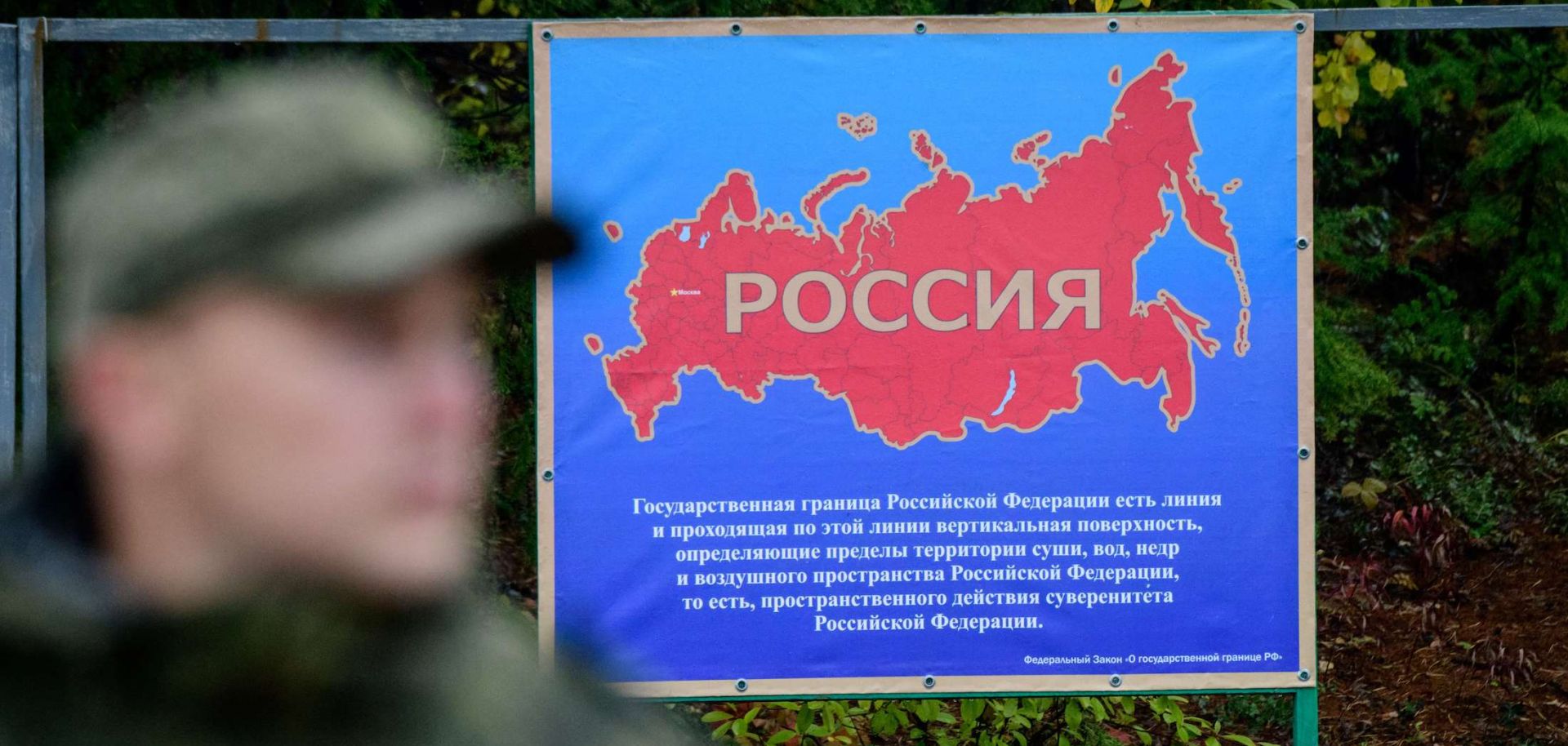
A Russian soldier stands next to a poster showing a map of Russia during military drills in Siberia.
Author’s Note: I was wrong about Ukraine. I concluded that the Russians would constrain their activity to the east of the Dnieper River. I am proud to say that my colleagues at RANE challenged my assessment, as our team built a robust set of scenarios, and refused to rule out Moscow taking a maximalist position on Ukraine. The central reason for my miscalculation was that I emphasized strategic logic and failed to adequately consider political ideology. This often works, but individuals, not logic, are the ultimate decision-makers. Political ideology can at times grow so strong that it becomes a reality in itself — a factor just as significant as physical territory, balance of forces, economics or demographics. As an analyst, it is vital to not only accept a missed call, but to seek to understand and learn from it. Below is an initial review of my error, and some thoughts to improve future analysis.
Logic and Ideology
Russia’s three-front invasion of Ukraine, and Kyiv’s unpreparedness despite weeks of Western warnings, highlight a key risk in strategic analysis — that is, failing to appreciate how political ideology can at times bypass strategic logic. There was no pressing need for Russia to take a maximalist position on Ukraine at this time. Ukraine's membership in NATO was at least a decade out. Arms sales and shipments to Ukraine were not sufficient to embolden Kyiv to try and retake the breakaway republics in the east. Russia’s perceived threat from Ukraine was a longstanding one, but one that had no compelling reason to need to be solved now, particularly through such a costly and risky method as Moscow chose. But strategic logic can be subsumed by political ideology, clouding the overall strategic assessment and skewing the risk vs. reward ratio. In Russia’s case, the repeated idea that an independent Ukraine is both a historical anomaly and a fundamental threat to Russian security can become so strong that it becomes a reality in itself.
Russia is not the only country susceptible to letting ideology cloud strategy. The U.S. decision to de-Baathify Iraq after the 2003 invasion is a glaring example of ideology shaping policy despite the strategic reality on the ground. While it may have been noble from an ideological point of view, it removed most experienced bureaucrats. U.S. planners failed to accept the structural reality of Iraq, and the risks of effectively isolating the Sunni population while assuming the previously marginalized Shiite and Kurdish populations would embrace them. The result was the rise of the Islamic State and ongoing political instability nearly two decades later. The United States similarly allowed political ideology to shape operations in Afghanistan, long after the initial strategic reason for the invasion had been neutralized. In the end, there was an ignominious exit, and the return of the Taliban to power.
It is not that political ideology is bad. It defines nations and cultures. But when a focus on ideology leads to a failure to understand and consider the underlying strategic reality, policies often fail spectacularly. This was the warning of British geographer Sir Halford J. Mackinder in his 1919 book Democratic Ideals and Reality, written at the close of World War I. Mackinder warned the victorious allies that if they allowed their ideological zeal to shape the post-war settlement, they risked setting the stage for a repeat of the war. He was, unfortunately, correct. But Mackinder, in his study of power and nations, didn’t decry democratic ideology; he accepted it as an important factor to consider in assessing future risk. And he applied a similar methodology in assessing the constraints and compulsions of the losing side. One of my colleagues at the Mackinder Forum, an international group of geopoliticians, noted to me that Mackinder both juxtaposed the concepts of ideology and reality in Democratic Ideals and Reality, and showed how ideology could become a geopolitical fact or, in other words, its own reality.
Framing Russia’s Ukraine Challenge
In assessing Moscow’s decision to launch a full invasion of Ukraine, ideology is the missing element — the one that explains Russia’s willingness to conduct a militarily, politically and economically risky operation without any pressing geopolitical need. From a strategic point of view, a Western-oriented Ukraine is a potential threat to Russia. Even if unlikely to occur for many years, the chance of Ukraine in NATO would further encircle European Russia to the west and south. From Moscow’s perspective, Ukraine is a potential dagger aimed at the soft underbelly of Russia. Moscow had similar concerns about Georgia, and in 2008 invaded the country to undermine any attempt by NATO to gain a foothold in the Caucasus. In Belarus, Moscow was much more successful in using political and economic connections to ultimately draw the country firmly into Russia’s orbit.
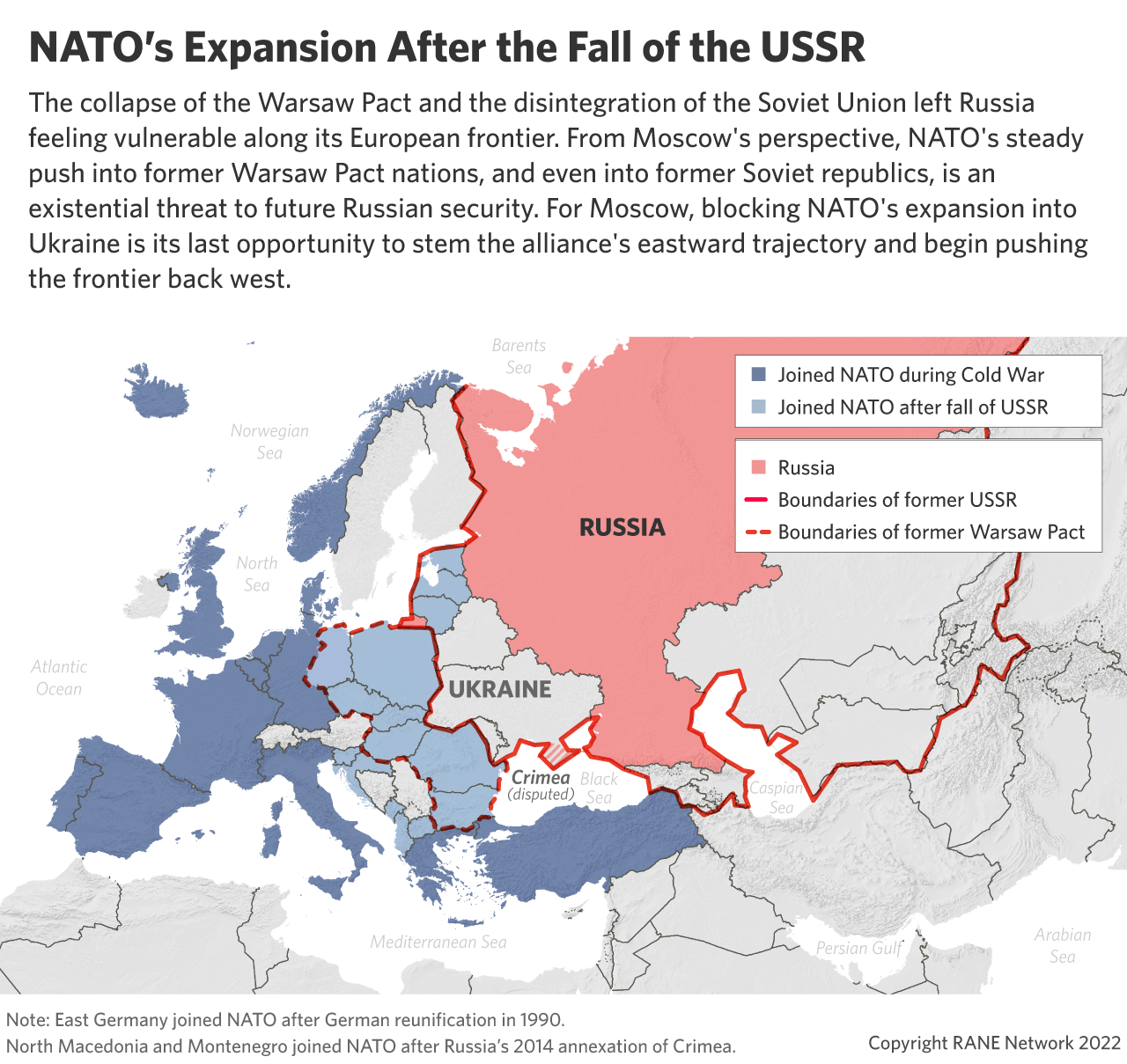
In Ukraine, Moscow also relied for years on political and economic tools to shape Ukrainian politics. Moscow felt that lever slipping away during the 2004 Orange Revolution, and lost with the 2014 Euromaidan revolution. Later that year in 2014, Russia annexed Crimea and supported eastern Ukraine’s breakaway Donetsk and Luhansk republics. While these actions didn’t lead to a political revolution in Ukraine or the return of Russian influence, it did further undermine Kyiv’s applicability for NATO membership, effectively addressing a key Russian security concern.
This makes Russia’s current war unexpected — not due to a lack of intelligence declassified and shared by the United States, but from a strategic perspective. It is a Russian imperative to prevent NATO from expanding into Ukraine. This could be done through political manipulation in Kyiv, the “Finlandization” of Ukraine, or a further expansion of the buffer space in eastern Ukraine. It could also be accomplished through brute force, with Russia overthrowing the Ukrainian government and putting in place a puppet regime. But the other options are significantly less costly, less risky, and have a higher chance of success.
Lower and Higher Risk Options
Moscow may have felt it lost the ability to manipulate Ukrainian politics, but it could still have recognized the breakaway republics in the country’s eastern Donbas region and pushed the contested buffer space further west to include the whole of the Donetsk and Luhansk oblasts or other areas of eastern Ukraine with a relatively high proportion of ethnic Russians. Russia could have used recognition of the breakaway republics as justification to advance into eastern Ukraine, seizing territory as it pushed westward to gain more buffer territory without launching a full-scale invasion in the rest of the country. In this scenario, Russian troops in Belarus would serve as a looming threat to Kyiv, forcing Ukraine to keep forces north of the city and unable to assist in the fighting in the east. In the end, Moscow would allow Ukraine to sue for peace, and in a political settlement expand the independent republics and ensure a demilitarized buffer zone. Russia may have even been able to get a promise from Ukraine to give up its NATO dreams.
Constraining Russian activity to the east of the Dnieper would likely have kept Europe internally divided over the appropriate level of economic, military and diplomatic response. It would have also reduced the likelihood of significant NATO forces moving further east, along with the risk of Finland (and perhaps Sweden) discussing potential NATO membership. Without some pressing need to make a move at this time, the strategic logic for a limited invasion would appear to have been the preferable option. It would not have completely eliminated any future shift in Ukraine’s security relationships that could one day challenge Russia, but it’s unlikely NATO would seriously consider expansion into a divided country — particularly one where doing so would trigger an immediate Russian military response. Over the years, the United States and especially Western Europe have loudly voiced calls for democracy in Ukraine and the country’s future Western orientation. But on the ground, U.S. and European leaders have remained extremely cautious, limiting key weapons transfers to Kyiv and seeking to avoid risking direct conflict with Russia.
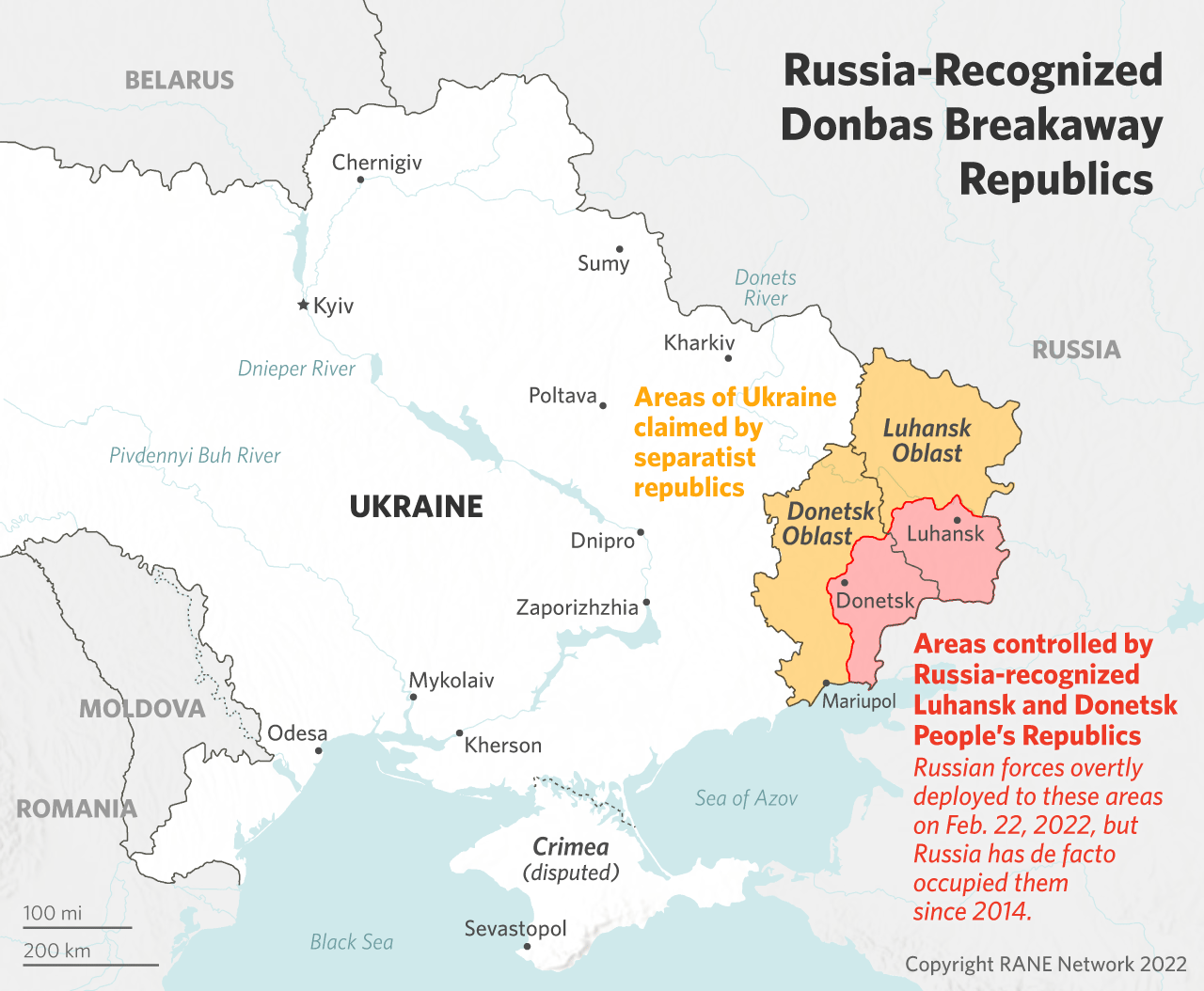
Russia instead chose the maximalist option of invading Ukraine in a bid to significantly degrade the Ukrainian military, and potentially sieging Kyiv to force a political realignment, all while engaging in significant fighting in eastern Ukraine to expand the breakaway republics. This has triggered a rapid maximalist response from Europe, the United States and beyond, at least in regards to geoeconomic and diplomatic tools. Western nations are also stepping up key arms transfers to Ukraine, though they continue to refrain from actively intervening militarily. Russia’s new deals with China and moves to build up additional foreign exchange reserves over at least the last six months indicate Moscow had to have expected the wide-ranging sanctions.
But for that mitigation strategy to work, Russia needs to quickly achieve its goals in Ukraine — namely, degrading Ukrainian military capacity, expanding the buffer space around the breakaway republics, and pressuring the government in Kyiv to abandon dreams of EU and NATO membership — with at least some veneer of political legitimacy.
Toward that end, Russia’s invasion has included the formal recognition of the self-determination of the two new republics, a formal agreement to allow Russian troops in their territory, and a formal Russian vote to allow the deployment of forces abroad. For Russia to have any hope of easing sanctions and its isolation after the conflict, it will need some sort of internationally recognized legitimate treaty or agreement with the Ukrainian government. At this point, however, it’s unclear whether even that would help Russia recover access to the international financial system.
Political Beliefs and Decision Making
There are two factors that may have contributed to Moscow's decision to take such a high-risk operation for only minimal additional strategic benefit over much lower-risk operations. First is that Russia saw a brief window of opportunity shaped by high oil prices, continued Western social and political divisions due to COVID-19 policies, Europe’s dependence on Russian energy, and the U.S. focus on China. That may have given Russia confidence that there was little chance of a military response by NATO. But even without those factors, it was highly unlikely the Western security alliance would have physically intervened in Ukraine. The second and more likely factor is that political ideology in Moscow has ossified and become something concrete, rather than a nationalistic rallying point that can be turned up and down at will. Russian leaders see not merely the need for Ukraine to be a buffer space between East and West, but that Ukraine (like Belarus) needs to be re-integrated into a broader Russian sphere of influence as the first step in pushing the NATO frontier back from the Russian borders.
In looking at leadership and ideology, this is where one could point to Russian President Vladimir Putin. Putin has issued several papers and speeches on Ukraine, including his interpretation of Russia’s history with the country and the idea that Ukraine effectively has no right to independence from Russia. To some, this suggests that Putin is just a crazy megalomaniac bent on the restoration of the Soviet Union. But Putin’s line of reasoning is not his alone — it is longstanding in post-Soviet Russia and is often used as a political tool to shape perceptions. Further, in a country as large and complex as Russia, it is hard to believe that the mere whims of a single individual can dominate all decisions. Yes, Putin has more individual power and agency than a democratically elected official in the West may have, but the Russian government and military have plenty of structural constraints that limit a single individual’s ability to always get their way, particularly when the stakes are so high.
Assessing political leadership requires initially looking at them as rational, though rationality is situational. Putin’s ideology is not his alone. And that ideology has taken hold — enough to begin reshaping the perception of risk and reward from a full-on invasion of Ukraine. Russian political ideology has masked the underlying strategic reality that seizing Ukraine is unlikely to lead to the capitulation of NATO. Instead, it is likely to have the opposite effect, reigniting NATO’s sense of purpose by identifying a clear and present danger. From an ideological perspective, Moscow may “need” Ukraine back in the fold. But from a strategic perspective, a buffer space in eastern Ukraine provides Russia with security and leaves NATO divided. Eastern European nations and the Baltics may emphasize the Russian threat, but their further flung counterparts in Western Europe would see constrained Russian moves as a continuation of the status quo. Differing regional perspectives would prevail, and that would contribute to Russia’s strategic security.
Ideological Actions With Real-World Consequences
By allowing ideology to supersede strategic logic, Russia now finds itself in a dangerous position. If it cannot force a rapid political settlement with Ukraine, ensuring neutrality and perhaps the independence of eastern Ukraine, it risks getting bogged down in a much longer war — one where attrition may well favor the Ukrainians, particularly as weapons flow in from NATO. Russia would fail to gain its political ends from such a drawn-out conflict, and would also find itself increasingly economically and politically isolated. A prolonged war with Ukraine would strain Russia’s relations with China, which has important ties with Kyiv and relies on Russia, Ukraine and Belarus as key components of its Belt and Road transportation corridor to Europe. In short, all of the risks that strategic logic highlighted, that led me and others to expect Moscow to pursue more modest goals, remain realities that Russia must face.
In assessing the likely paths countries may take, looking at constraints and compulsions, at capability and capacity, help shape the picture of strategic logic. What are the imperatives? How does time change the relative weight of each factor? What are the likely responses of others? What makes now the time to act or refrain from action? But this impersonal approach has its limitations because, in the end, it is not logic that shapes the future, but decisions made by people. And political ideology can and does color the less personal strategic logic people use to justify their choices.
Global leaders who fail to grasp the underlying realities of a situation and allow political ideology to exceed strategic logic often make decisions that yield unexpected and undesired outcomes. And for those of us analyzing these decisions, failing to appreciate the potential weight of political ideology will lead to incorrect forecasts.
Using impersonal logic cannot alone predict the behavior of geopolitical actors, but it can reveal the baseline reality within which actions are taken. It may not change the decision, but it can expose the chances of success.
