
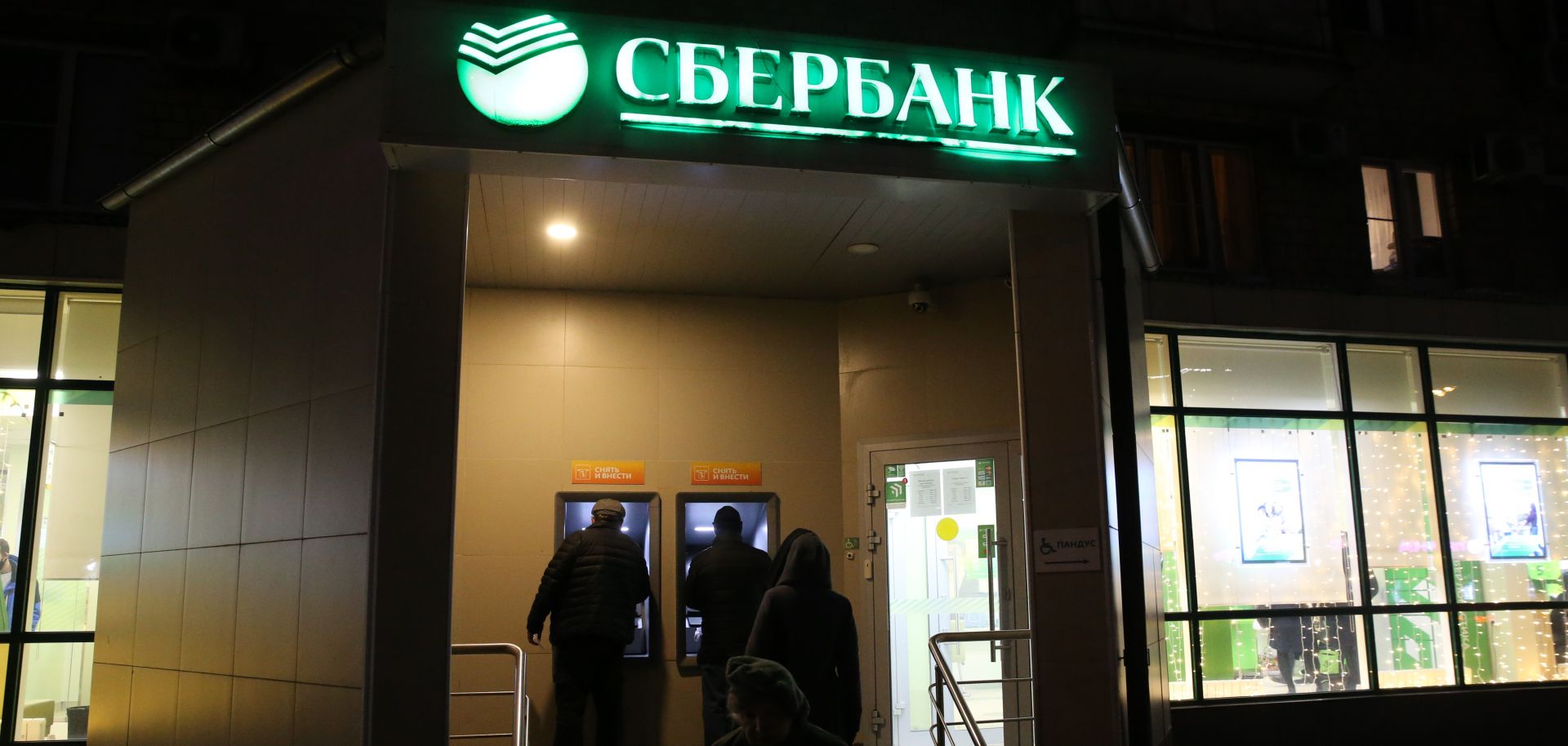
People in Moscow line up at ATMs outside a branch of the Russian state-owned Sberbank on Feb. 28, 2022.
Western sanctions against Russia are threatening deposit runs on Russian banks, plummeting the ruble, encouraging international investors to divest Russian assets, and opening the door to more long-term damage to the Russian economy. Russian President Vladimir Putin likely thought the West would be slow to react to his government's invasion of Ukraine and, if the West did respond, it would be mild because of Europe’s internal divisions and its heavy dependence on Russian energy. But less than a week after Russia launched its invasion, the United States, the United Kingdom, the European Union, Switzerland, Japan and others have begun taking coordinated action to freeze the assets of dozens of Russian individuals and entities and prevent Moscow from accessing its $630 billion pile of foreign exchange reserves, with a substantial portion being rendered illiquid. The sanctions are already causing economic disruptions in Russia and have the potential to harm the country’s business and investment prospects for years to come.
One of the West’s most significant moves includes a joint statement on Feb. 26 committing to ensuring “selected Russian banks are removed from” the SWIFT international financial messaging system. The joint statement by the European Commission, France, Germany, Italy, United Kingdom, Canada and the United States also called for restrictive measures on the Central Bank of Russia’s (CBR) ability to use international reserves held abroad, the establishment of a task force to ensure effective implementation of sanctions, and asset freezes on sanctioned individuals and companies. The signatories, along with other European and Asian Pacific powers, have since announced additional sanctions against Russia.
- On Feb. 28, the U.S. Treasury Department’s Office of Foreign Assets Control prohibited U.S. entities from dealing with the CBR and froze its assets either held in the United States or held abroad. The United States previously imposed asset freezes on individual Russians, including President Vladimir Putin and Foreign Minister Sergei Lavrov, as well as Russian parliamentarians and various wealthy individuals. The United Kingdom is taking similar actions, which is also banning the servicing of Russian vessels in its ports.
- Likewise, the European Union has sanctioned individual Russians and frozen assets held in EU member countries. The bloc has also banned Russia from issuing bonds or other securities in European markets.
- French and Swiss banks have stopped providing letters of credit for Russian exports. Swiss banks are also slashing the valuation of Russian assets pledged as collateral, which is triggering margin calls on investments.
- Australia, Canada, Japan and South Korea are adopting sanctions as well.
- China is not participating in sanctions, but its two largest state-owned banks are no longer issuing letters of credit to Russian exporters — probably fearing secondary U.S. sanctions that would limit their access to U.S. financial markets.
If Russian banks are cut off en masse from the SWIFT global financial messaging system, it would further cripple the Russian economy and its ability to transact internationally. For now, there are pending intentions to block named banks from sending instructions for financial transactions. But Western countries are trying to retain the ability to pay for Russian commodities, especially energy exports. The U.S. Treasury Department has added Sberbank and VTB — the first and third-largest Russian banks, respectively — as well as the CBR to its Specially Designated Nationals And Blocked Persons List (SDN), which prohibits U.S. banks and other financial institutions from dealing with them and blocks assets. Gazprombank, which finances Russian oil and gas exports to Europe, has notably not yet been sanctioned by Western governments, likely in an effort to keep essential commodities flowing to Western European economies in the absence of immediate alternatives. There is, however, a potential for Gazprombank to be targeted in the future.
- Limited alternatives to the SWIFT payment system are available, but it will take years to develop viable ones. CBR has tried to run its own proprietary messaging system (SFPS or System for Transfer of Financial Messages) for Russian and foreign banks, but there are only about 400 users. Similarly, the People’s Bank of China established the Cross-Border Interbank Payment System (CIPS) in 2015 and signed a memorandum of understanding with SWIFT in 2021 to facilitate payments transactions through intermediaries dealing with the Chinese economy.
- On Feb. 28, Russian Central Bank Governor Elvira Nabiullina told a press conference that Russia’s Financial Message Transmission System (SPFS) was ready, at least for domestic operations in Russia, to “smoothly” replace the international SWIFT system — adding it was also ready to connect international users. Russia has prepared and tested this system for many years, but it will not fully mitigate the initial shock of SWIFT removal for banks and associated counterparties.
- However, the dollar is involved on one side of nearly 88% of all foreign exchange transactions globally, according to BIS data, and is nearly two-thirds of international foreign exchange reserves. Absent a U.S. economic catastrophe, attempts to circumvent dollar usage are unlikely to succeed in the next 10 years, as attested by China’s failed attempts to internationalize its currency.
The sanctions are already harming Russia by effectively paralyzing its banking and financial system, with foreign exchange trading suspended and banks reporting shortages of cash. So far, the Ukraine invasion has not directly affected the productive capacity of Russia’s economy since the war is currently being waged outside Russian territory. But project freezes from a lack of financing or new investment will reduce potential growth, already estimated by the World Bank at less than 2% a year. Sanctions are having the most immediate and powerful effect on financial linkages, which are the essential plumbing underlying economic exchange in the real economy. Fears of being cut off from global capital markets are spurring runs on Russian banks, with ATMs in Russia running out of money. People in Moscow, meanwhile, are rushing to buy luxury goods with high resale value in an attempt to preserve their purchasing power.
- On Feb. 28, the CBR raised its main policy rate from 9.5% to 20% in an attempt to lure deposits back into bank accounts. But the high demand for goods, combined with the CBR’s move to provide liquidity to Russian banks, will result in further inflation and Russians shunning assets with fixed returns as the price level rises and the ruble depreciates further.
- The CBR also introduced capital controls on Feb. 28, mandating 80% surrender requirements of hard-currency export receipts and banning foreigners from selling Russian securities. The announcement came shortly after onshore trading of the Russian ruble was halted and the ruble lost a third of its value in offshore markets. This means that Russians are effectively hoarding scarce foreign currency, probably in fear of it being expropriated and the domestic ruble cost of transacting abroad is skyrocketing.
Meanwhile, international investors are trying to divest Russian assets, including oil companies that may walk away from Russian domestic investments and take losses rather than bearing the cost of legal and operational problems and reputational risk. In addition to the sanctions imposed by their governments, some Western companies are also effectively voluntarily terminating joint ventures with Russian companies or refusing to provide services. On Feb. 27, for example, BP said it would take a $25 billion loss by abandoning its 20% share in the Russian state-controlled oil firm Rosneft. The British oil giant also said it would exit other Russian businesses, including joint ventures with a book value of about $1.4 billion. The following day, U.S. oil giant Shell announced it would exit all of its Russian operations, including its 27.5% stake in the Gazprom-operated Sakhalin 2 liquified natural gas (LNG) plant. It's currently unclear how U.S. supermajors Chevron and Exxon plan to deal with their Russian holdings. But BP and Shell’s announcements will still chill the international investment climate for foreign direct investment and investment into new projects/brownfield investments to maintain production, without which aging energy infrastructure will be difficult to maintain.
- Russia’s $1.5 trillion economy is heavily reliant on extractive industries, with oil and natural gas accounting for two-thirds of the country’s total exports and minerals making up most of the remainder. This reliance limits the Russian economy’s adaptability and increases its vulnerability to global market shocks.
The loss of confidence in Russian assets and the Russian economy among Russians is likely to cause additional economic pain to the country. Russia has been trying to sever its dependence on a dollar-dominated financial system since its annexation of Crimea triggered sweeping international sanctions in 2014. But the new round of sanctions imposed over the Ukraine invasion will stymy Moscow’s mitigation efforts to de-link from such systems. Severing or severely limiting Russian financial linkages with U.S, European, and other Western financial institutions will, at a minimum, slow and inhibit Russian receipt of payment for exports, which will, in turn, devastate the ability to import and invest. Moreover, government and central bank efforts to prop up ruble liquidity will add to inflation and, on the back of already slowing economic growth, result in Russian stagflation as businesses and consumers hoard real resources or try to spend on an increasingly shrinking amount of goods. As investors face increased market risk, and as credit and settlement risks also rise exponentially, there’s a chance Russia could enter a recession.
- Only 16% of CBR foreign exchange reserves are believed to be held in dollar instruments and the sovereign wealth fund has no dollar assets in its $170 billion portfolio. Additionally, Russia does not depend on external borrowing for its balance of payments as it had a massive current account surplus of $19 billion in January, and many observers thought the $630 billion stock of foreign exchange reserves would insulate Moscow from sanctions. Nonetheless, commodity exports are conventionally priced in dollars, even though some recent contracts have been in euros and Chinese renminbi.
