
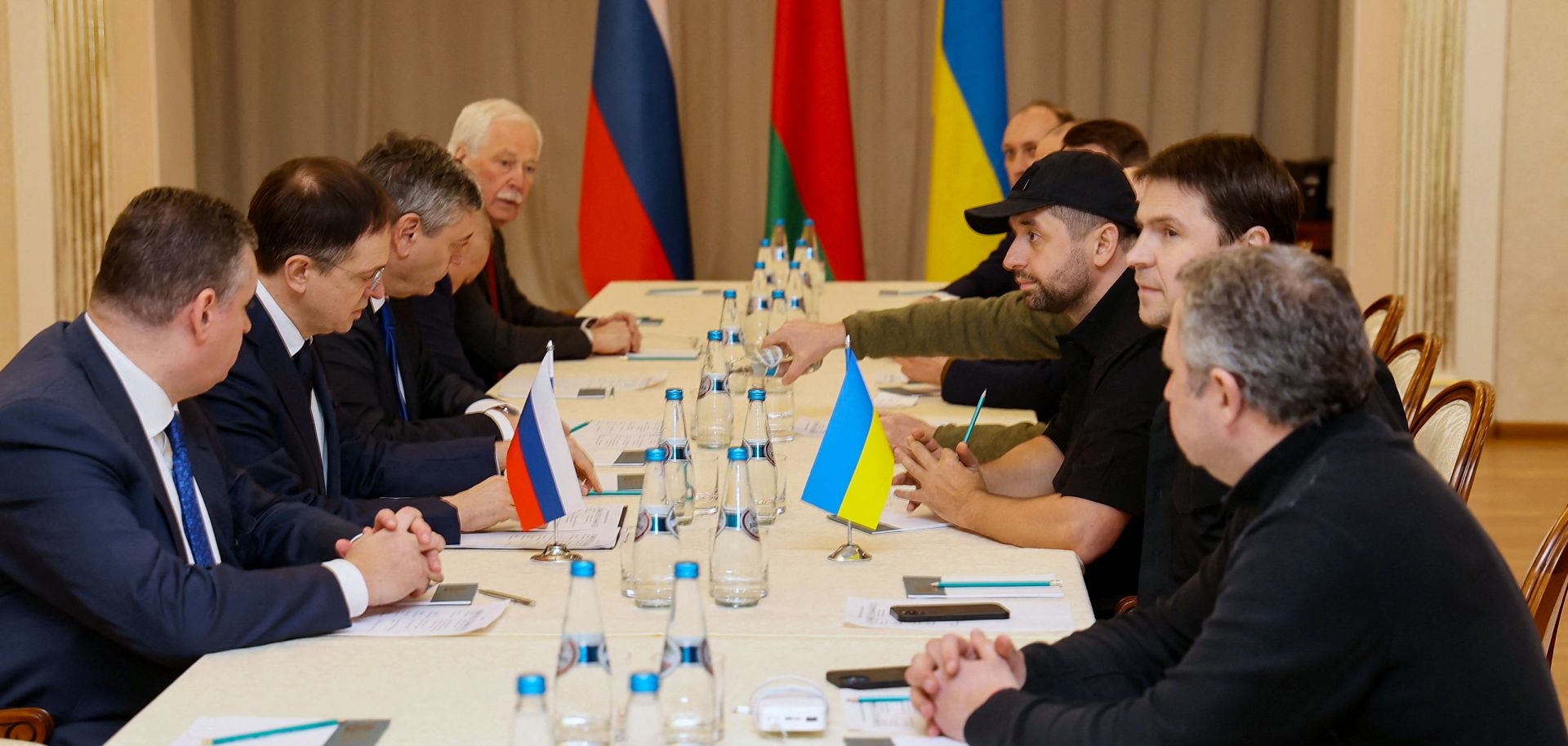
Members of delegations from Ukraine and Russia hold talks in Belarus following the Russian invasion of Ukraine on Feb. 28, 2022.
Russia and Ukraine’s belief that they can win the war, coupled with Moscow’s goals of regime change and occupation and the strong political pressure Kyiv faces against making concessions, mean that a diplomatic solution to the conflict is unlikely in the near term. On March 3, Russia and Ukrainian delegations met for another round of negotiations to end Russia’s invasion of Ukraine. While a cease-fire was discussed, it will probably not happen in the near future. Moscow likely believes that Ukrainian armed resistance can be broken in a matter of weeks, and that its increased seizure and occupation of Ukrainian towns and cities will assure its control over any negotiations. Kyiv, meanwhile, is betting Russia doesn’t want to conduct an expensive and potentially high-casualty seizure and occupation of Ukraine, and that if Ukrainian forces are able to maintain control of major cities, Moscow will eventually soften its demands and make a deal to save face before crippling sanctions make the war more unpopular in Russia. As long as both Russia and Ukraine think further developments on the battlefield will work in their favor, they will avoid making diplomatic concessions that the other side, as well as their respective citizenries, could misperceive as weakness or capitulation. Therefore, on-the-ground military realities will dictate the future of the conflict in the coming days and weeks.
- On March 2, Russia’s defense ministry for the first time acknowledged the loss of Russian soldiers since launching the invasion of Ukraine on Feb. 24, saying that 498 Russian military personnel have so far been killed in combat and 1,597 have been wounded. The admission marked a shift in Russian messaging that could signal Moscow is seeking justification for implementing martial law in the country and restrictive measures on the home front, as well as the mobilization of more forces to participate in an occupation of Ukraine.
Russia’s basic demands for a cease-fire deal — which include Ukraine’s “demilitarization” and neutrality, as well as formally recognizing Crimea as Russian territory and the separatist republics in Donbas as independent states — are all unacceptable for Kyiv. Russia's primary objective is preventing Ukraine’s further integration and cooperation with Euro-Atlantic structures — namely NATO and, to a lesser extent, the European Union. Ukraine’s aspiration to join these Western blocs is codified in articles in its constitution, which Moscow wants to replace with legal provisions ensuring Ukraine's neutral, nonnuclear status. Russia also wants to enshrine the limitation of Ukraine’s defense capacities by adding provisions that limit NATO training, military infrastructure and the country’s access to modern weapons supplies. Ukraine is highly unlikely to accept such demands, however, because they are politically unacceptable and only undermine its future security. Of Moscow’s proposed terms, Ukraine is theoretically most likely to agree to a neutral status in exchange for Russia withdrawing its troops. But Ukrainian President Volodymyr Zelensky faces intense political pressure to not cave to demands regarding recognizing any Russian occupation or annexation of Ukrainian territory. Kyiv is also unlikely to accept recognizing the Donbas separatist republics in their claimed borders because it would make the eight-year battle Ukrainian forces have waged against Russian-backed separatists in the territory effectively all for nothing — a point underscored by the fact that tens of thousands of Ukrainian soldiers face encirclement and potential death in Donbas in the coming days rather than retreat from the territory.
- In February 2019, Ukraine amended its constitution to include wording in the preamble about “the European identity of the Ukrainian people and the irreversibility of the European and Euro-Atlantic course of Ukraine.” In Article 102, the country’s president is described as “the guarantor of the implementation of the state’s strategic course towards acquiring full membership in the European Union and North Atlantic Treaty Organization.”
The Ukrainian government’s strong internal political constraints against concessions will push Russia to increase the use of force and eventually pursue a costly occupation of Ukraine. On March 1, Russian Defense Minister Sergei Shoigu said protecting Russia from “the military threat posed by Western countries that are trying to use the Ukrainian people in the fight against our country” was the main goal of Moscow’s “special military operation,” and that Russia would continue its offensive until it achieved its goals in Ukraine. Shoigu’s remarks underscore the national security imperative underpinning Russia’s invasion — which, in Moscow’s view, leaves no room for compromise in satisfying its demands, and thereby justifies even an expensive occupation of Ukraine to guarantee they are met. But even if Ukraine were to accept its demands, Russia would have no clear levers to guarantee Kyiv upholds them, other than continuing to occupy Ukrainian territory or threatening another invasion. Indeed, Ukraine’s refusal to fully enforce the Minsk agreements in recent years has probably convinced Moscow that the enforcement of any political deals with Kyiv cannot be guaranteed without the use or threat of force. Russia is thus highly likely to continue occupying at least some of the Ukrainian territory east of the Dnieper river that it’s seized in recent days — using Ukraine’s failure to satisfy its ambitious demands for neutrality and demilitarization as justification for an increasingly brutal war and occupation.
- Russian President Vladimir Putin has repeatedly insisted on the “denazification” of Ukraine, which signifies Moscow’s pursuit of regime change should talks with the Ukrainian government fail, while also serving a domestic propaganda role for Russia. Russia could frame backing off this threat of regime change as a "concession,” enabling it to keep all its other demands in place.
While the number of Ukrainian manpower and equipment losses is unclear, Ukraine’s military situation is likely to worsen in the coming days, as Russia pursues its goals by force. Many of Ukraine’s most experienced and well-equipped soldiers remain in the eastern Donbas region. The Ukrainian armed forces have probably determined that these forces would become vulnerable to air attack if they were to attempt to retreat to the Dnieper River, all while having to abandon large amounts of stockpiled equipment. Therefore, a risky attempt to withdraw the troops from this exposed region could seriously jeopardize Ukraine's strategy of dealing large casualties to the enemy. Russia, however, is likely calculating that its negotiation position will be stronger once it eliminates the Ukrainian forces from the country’s east. It’s thus only a matter of time before these soldiers stuck in Donbas and other parts of eastern Ukraine find themselves encircled by Russian forces, portending more bloodshed and painful battleground losses for Ukraine.
