
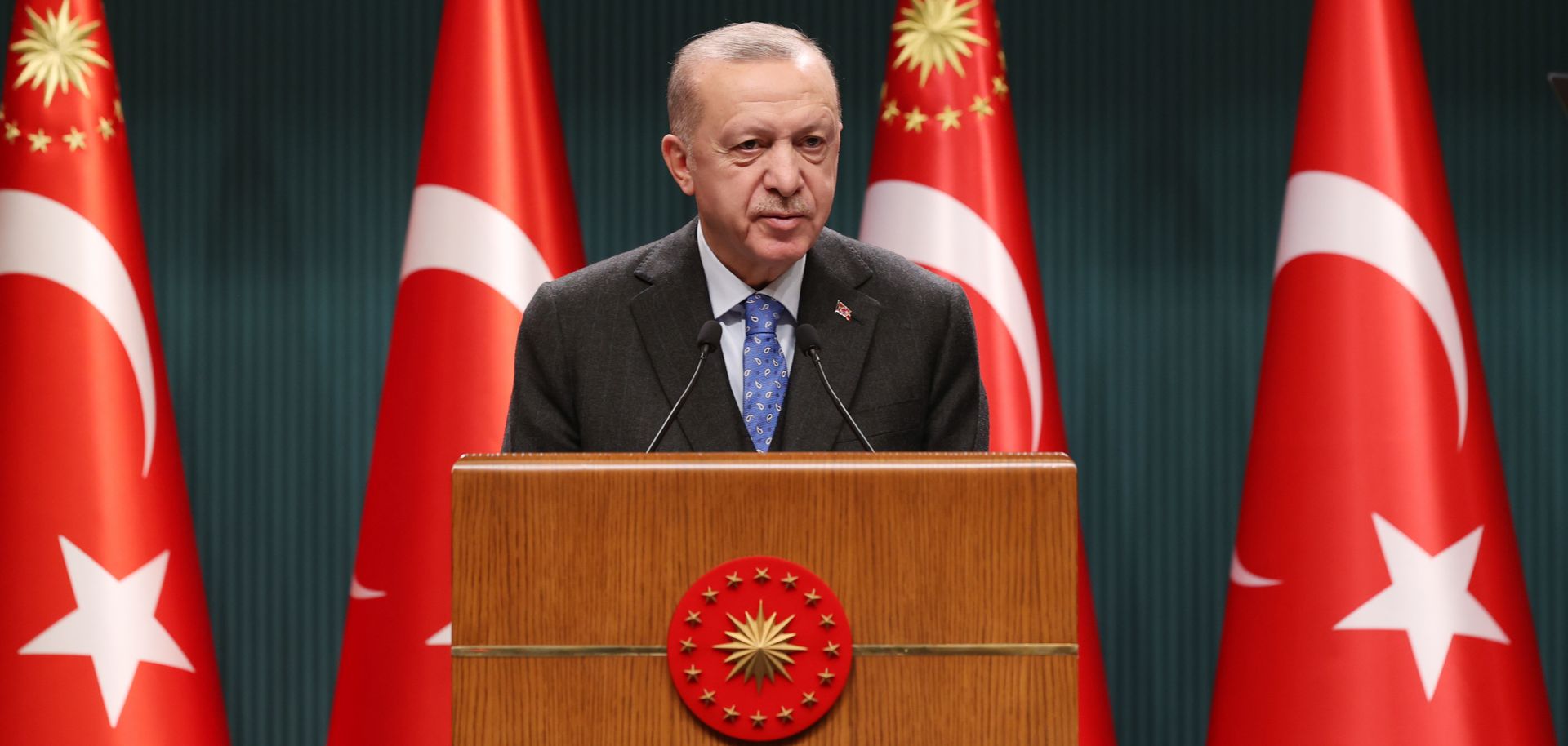
Turkish President Recep Tayyip Erdogan makes a statement on Feb. 28, 2022, in Ankara after holding a cabinet meeting focused on the Russia-Ukraine crisis.
Driven by its need to keep stable relations with Russia, Turkey will resist pressure to join NATO’s isolation campaign against Moscow in response to the Ukraine invasion. Turkey’s historically strained relations with Russia are facing a new test as Russian military forces invade Ukraine and Ankara’s Western allies line up to isolate and punish Moscow. But Turkey is reliant on Russian tourists, energy and good diplomatic relations; it’s also still interested in diversifying defense ties away from NATO. This has left the country hesitant to embrace the West’s sanctions strategy, with Ankara so far avoiding direct cuts to Russian economic ties. On Feb. 27, Turkey said it would enact provisions of the 1936 Montreaux Treaty that allow it to block its key straits to countries engaged in battle. Ankara, however, also stuck to the stipulations of the treaty that allow Russian warships to pass to return to base, which — combined with the fact that the Russian ships needed for the invasion were already in place — renders the move ineffective in changing the dynamics of Moscow’s ongoing military campaign. Unless Moscow directly provokes Ankara in some way, the measures Turkey takes against Russia will likely continue to remain largely symbolic.
- Turkey and Russia have deep economic and defense ties. In 2020, Russia was Turkey’s 10th largest export market. Russia also provided the third-largest market for Turkish imports that same year. In addition, Russians made up 4.7 million of the 24.7 million tourists who visited Turkey in 2021. 21% of Turkey’s overseas construction activity takes place in Russia, and 64% of the country’s imported wheat comes from Russia. Turkey has also purchased the Russian S-400 missile system to diversify its defense sector.
- Turkey’s ties with Ukraine are smaller than those it has with Russia, but remain important to Ankara. Ukraine was the 20th largest export market for Turkish products in 2021, while just over 2 million Ukrainians visited the country in 2021. Ukrainian wheat made up 13.4% of all Turkish imports. Turkey has also sold its Bayraktar TB2 UAV combat drones to Ukraine and, in February 2022, agreed to co-produce them with Kyiv.
- Under the 1936 Montreaux Convention, the Turkish Straits are to remain open to commercial and military traffic. But the treaty allows Turkey to block military traffic during wartime, which it did during World War II to keep Axis ships from attacking the Soviet Union, as well as during the 2008 Russo-Georgian War to keep large U.S. ships from entering the Black Sea.
In an effort to both avoid Russian retaliation and showcase its independence from NATO, Turkey will not fully block Russian military activity in the Black Sea, cut off economic ties to Russia, or join in on Western sanctions designed to block Russian business internationally. In 2015-16, Russia enacted sanctions on Turkey after tensions flared over the two countries’ backing of rival factions in the Syrian civil war. As part of the sanctions, Moscow suspended its visa-free travel program in Turkey, which ultimately led to a collapse in Russian tourism that has only recently begun to recover. In October 2020, Russia also bombed a Turkish-backed proxy force in northwestern Syria’s Idlib province in retaliation for Turkey’s involvement in the Azeri-Armenian war that year, demonstrating that Russia will respond to actions in one theater with retaliation in another. Turkey’s food and energy prices have been rising as well, with the country’s annual inflation rate now nearly 50% — making Turkey even more vulnerable to restrictions on Russian exports of wheat and energy.
- In Syria, Turkey backs rebel groups that guard some 1 million refugees the Turkish government does not want to take in. Syrian President Bashar al Assad’s government, meanwhile, remains backed by substantial Russian and Iranian forces able to conduct a fresh military operation that could displace those Turkey-backed forces.
- Turkey is relying on a strong tourism season this upcoming summer to help rebuild its foreign currency exchanges and restore a key economic sector, which took a substantial hit during the height of the COVID-19 pandemic. Any loss in Russian tourism would worsen Turkey’s economic outlook by harming its vital tourism sector and weakening its access to foreign currency.
- In January, Turkey had to cut energy supplies by 40% to its industrial zones because of a gas interruption from nearby Iran. This cut impacted Turkey’s manufacturing sector, a key area of economic strength, and has made Ankara more risk-averse to future interruptions.
As Russia’s invasion of Ukraine continues, Western allies will likely ratchet up their sanctions pressure and economic isolation of Russia and try to corral Turkey to join the campaign. But unless Russia itself provokes Turkey, Ankara is unlikely to shift its strategy. While the West sanctions Russia’s President Vladimir Putin and his inner circle, Turkey will likely resist calls to join Western sanctions by cutting its substantial economic ties with Moscow. Ankara will also likely resist calls to cut all defense ties with Russia, such as by dismantling the Russian S-400 missile system Turkey took delivery of, for fear that such a move will undermine Turkey’s drive for independence from Western influence. However, Turkey’s calculation about joining the Western-led isolation campaign would change in response to potential Russian provocations, whether those are accidental strikes on Turkish shipping in the Black Sea, harm to Turkish civilians abroad, or a fresh flare-up of fighting in Syria between Turkish-backed rebels and Russian troops.
- On Feb. 24, a Turkish-owned ship was damaged in the Black Sea by a projectile. Turkey did not immediately assign blame, but the attack highlights the risks to Turkish shipping in the region as fighting continues. Should Russia clearly be responsible for a future attack, Turkey could fully close the Turkish Straits or impose sanctions of its own on Russia.
- Errant air defense and fighter jet missiles have the potential to travel hundreds of miles off target and strike neutral civilian areas, ships or aircraft. If Turkish civilians are caught up in an incident like that and Ankara blames Russia, it could bring Ankara closer to the West’s isolation campaign.
- As Syria and its allies carry out provocative moves near Turkish-controlled territory to remind Ankara of their capability to rapidly escalate, rising food prices will increase instability in both Turkish-controlled and government-held Syrian territory, potentially spurring offensives by rebel groups against Syrian government forces designed to force Damascus to increase aid. However, such attacks could escalate and draw both Turkey and Russia in on opposite sides, spurring Turkey to move closer to the Western isolation campaign of Russia.
