
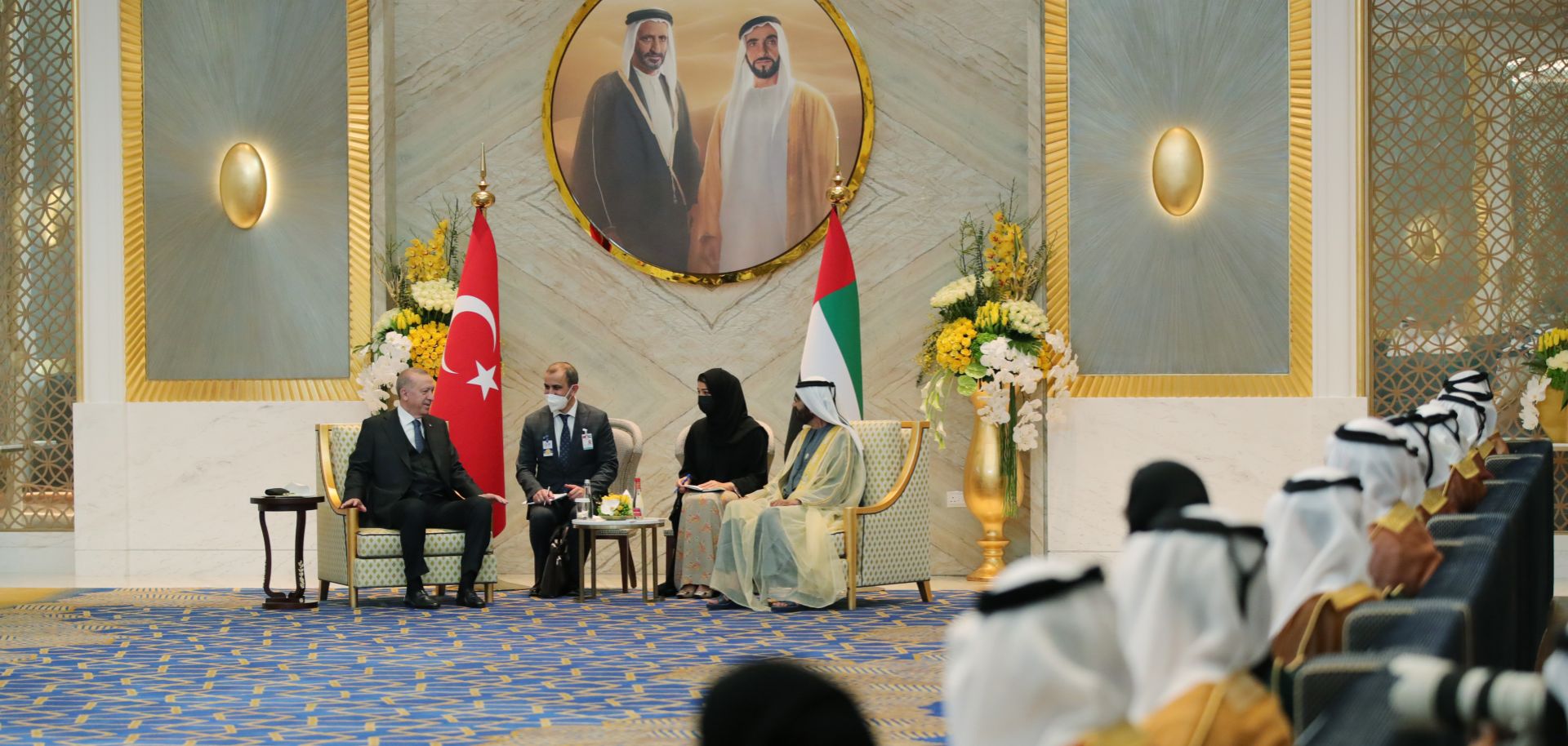
Turkish President Recep Tayyip Erdogan meets with Dubai’s emir during a visit to the United Arab Emirates on Feb. 15, 2022.
Turkey’s push to rebuild its economic and diplomatic relations with regional rivals won’t be enough to solve the macroeconomic problems produced by its domestic policy choices. On Feb. 14, Turkish President Recep Tayyip Erdogan visited the United Arab Emirates in a landmark event designed to signal improved ties between the two countries after years of informal boycotts, rhetorical threats and proxy theater competitions in Libya, Somalia and Egypt. During the visit, Ankara and Abu Dhabi pledged to work together in research, defense and the economy. Days later, a $3 billion Turkish bond sale saw heavy participation from Emirati investors.
- Turkey’s inflation reached a 20-year high of nearly 50% in January. To defend the country’s currency, the Turkish government has heavily relied heavily on its dwindling foreign exchange reserves which, when calculated with both assets and liabilities, were a net negative in December 2021 following expensive central bank interventions to shore up the Turkish lira.
- In January, the United Arab Emirates agreed to a $4.74 billion currency exchange with Turkey to help boost the lira. In addition, the recent visit to the United Arab Emirates accompanied a pledge of up to $10 billion into Turkey’s economy.
- UAE-Turkish relations soured after the Arab Spring in 2011 put them on opposite sides of the revolutions unfolding across the region, with Turkey backing the Islamist Muslim Brotherhood’s rise to power in Egypt and Tunisia as the Emiratis worked to prevent the spread of political Islam in the Middle East. These factions, however, have since lost power, with Egypt disposing the Muslim Brotherhood in 2013 and Tunisia’s once-dominant Islamist Ennahada party now suppressed by the country’s increasingly powerful president. Turkey also backed Qatar, the United Arab Emirates’ neighbor and rival, during the 2017-21 blockade.
Turkey’s next likely move will be to court another former rival, Saudi Arabia, to secure investment and defense agreements. Like the United Arab Emirates, Saudi Arabia also participated in boycotts and sparred with Turkey over its support for Qatar and backing of Islamist political parties. But now that those primary drivers of conflict have diminished, Riyadh is increasingly interested in productive investments abroad as part of its economic diversification strategy. Compared with the United Arab Emirates, Turkey’s outreach to Saudi Arabia may go slower due to the remaining diplomatic complications caused by Turkey’s role in publicizing the Saudi-ordered assassination of journalist Jamal Khashoggi in 2018. But this is unlikely to fully prevent Riyadh from seeking increased economic ties with Ankara.
- Saudi Arabia has started to co-produce Turkish-designed reconnaissance drones, and Turkey believes Saudi Arabia could be a growing market for other Turkish-made combat drones which, unlike U.S.-made drones, would have fewer restrictions on their end-use, like deploying them in Yemen. For Saudi Arabia, purchasing drones from Turkey is also less likely to alarm the United States than purchasing drones from China, as Washington sees Chinese defense ties in the Persian Gulf as a threat to its own military interests.
Despite the eventual benefits of these deals, Turkey’s greater economic woes — including central bank mismanagement, investor distrust, the fallout from the COVID-19 pandemic, inflation and private sector debt — can only be solved through domestic policy changes. One of Turkey’s main problems is its leader’s politicization of the country’s economic strategy. Erdogan has fired recurrent central bank governors to ensure the bank adheres to his unorthodox belief that high interest rates are un-Islamic and cause inflation. And there are few signs he plans to reverse that attitude anytime soon, promising on Feb. 18 to continue his fight against rate hikes. Turkey also needs to ramp up tourism to help recover foreign exchange reserves and improve employment prospects, but it remains unclear how many traditional tourists, particularly from Europe, will visit in the high season this summer. Turkey’s private sector debt, meanwhile, is becoming increasingly expensive to service; less than 20% of the $169.4 billion in externally held debt the country racked up in 2021 is denominated in liras, with the majority held in euros and U.S. dollars — making repayments more costly as the lira’s value declines against the dollar.
- Erdogan has vowed to maintain his unorthodox economic strategy through the upcoming June 2023 national elections, betting that religious Turkish voters will reward his policies with high turnout while global macroeconomic conditions will eventually shift to favor Turkey.
