
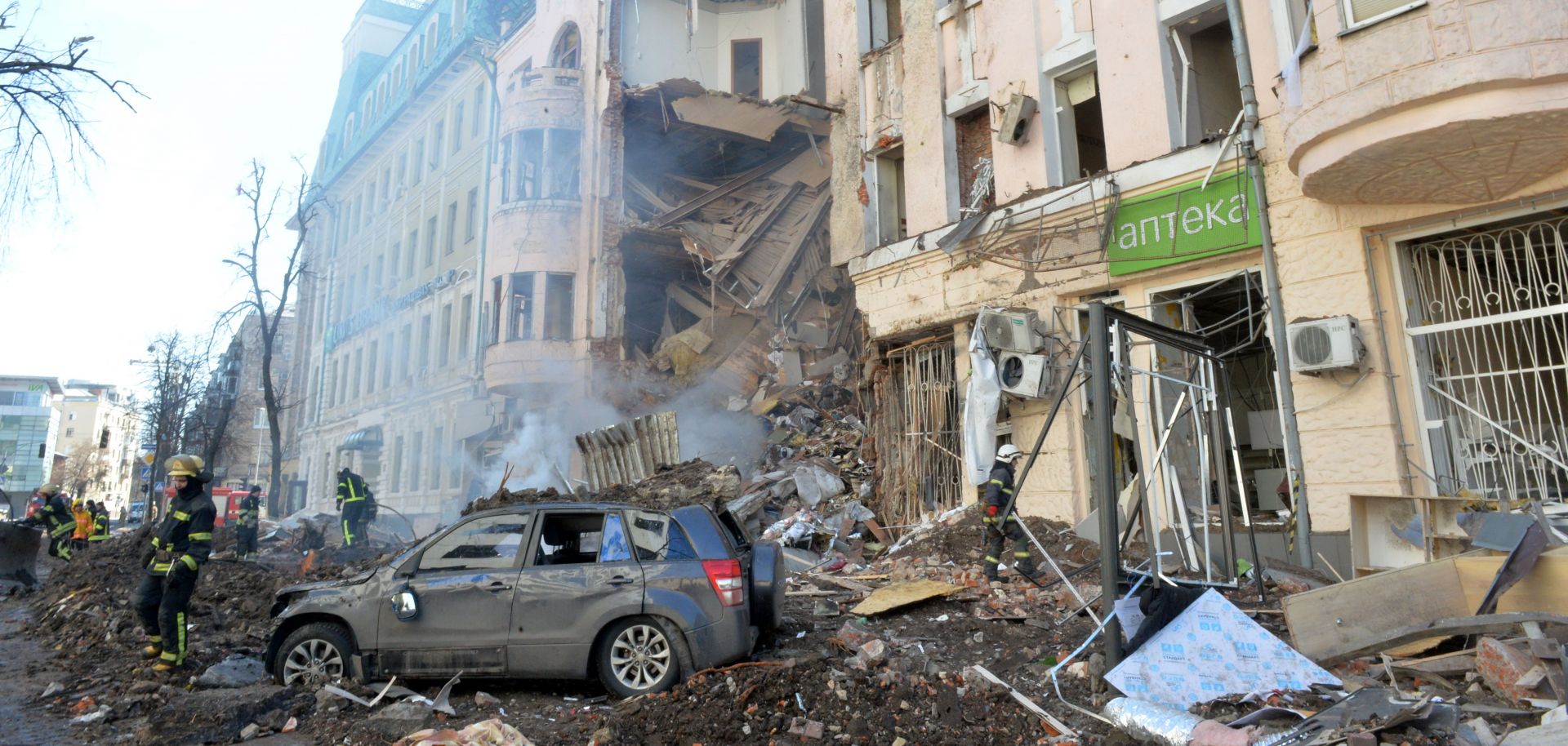
Firemen work to clear the rubble after a Russian rocket exploded just outside the Ukrainian city of Kharkiv on March 14, 2022.
Despite reports of progress in Russia-Ukraine talks regarding the latter's ''neutrality,'' Moscow's insistence that Kyiv also surrender significant territory means the two sides are unlikely to reach a peace deal soon. In the meantime, Russia will seek to increase its negotiating leverage by seizing more Ukrainian cities and regions, which will risk prolonging the conflict and further limiting room for a comprehensive deal. On March 16, reports emerged that Ukraine and Russia had made progress on the wording of a 15-point peace plan for a cease-fire and Russian withdrawal of troops, as well as a mutually acceptable vision of neutrality including limits on its armed forces. But this does not represent a major change in Ukraine's position nor a major step toward ending the war. The topic of Ukraine's neutrality is the least controversial for Kyiv among Russia's demands because the Ukrainian government has accepted that its NATO aspirations have failed to protect Ukraine, and that Russia's invasion did not progress its bid to gain membership in the Western security alliance. Therefore, larger constraints to a peace deal remain, including Kyiv's reluctance to formally recognize the loss of its territories and Kyiv's insistence that in exchange for renouncing its NATO ambitions, Ukraine must receive security guarantees of protection from the likes of the United States, United Kingdom or Turkey. These demands will hardly satisfy Russia, which is unlikely to withdraw from the Ukrainian territories it has occupied until Kyiv relents. Ukraine's Western partners may be reluctant to guarantee Ukraine's security for fear that it would put their own national security at risk.
- On March 7, Ukrainian delegation member Davyd Arakhamia said that while movement on Ukrainian neutrality was possible, it would be almost impossible for Ukraine to bow to Russia's demands that Kyiv recognizes Russia's 2014 seizure of Crimea, as well as the independence of the Russian-occupied breakaway republics in eastern Ukraine's Donbas region.
- On March 15, Russia's lead negotiator Vladimir Medinsky said that discussions included the Swedish or Austrian version of a demilitarized state that has its own armed forces. But Ukraine's top negotiator Mikhailo Podolyak rejected over-focusing on these models, saying talks with Moscow to end fighting should focus on ''security guarantees.''
Russian officials maintain maximalist goals, which Moscow will seek to achieve through either negotiations or the mere imitation of negotiations amid continued conquest. Statements from Russian officials implying that a deal is close could be part of an attempt to cast Russian demands as reasonable and the only obstacle to peace as Kyiv's obstinance, while in reality, Moscow will continue to regroup its forces, consolidate seized areas, and return to the offensive to further improve its negotiating position. Medinsky also said that Russia's goal for the talks is for Ukraine to become ''a friend and neighbor, with whom we will be developing relations and building a common future'' and that Moscow is seeking an agreement to last ''for the lifetime of many generations.'' This suggests that Moscow retains goals for the talks that are almost impossible for the current Ukrainian government to achieve, and for most of the Ukrainian population to accept, if Ukraine wants to remain sovereign.
- On March 16, Russian President Vladimir Putin told regional governors that Russian negotiators were ready to discuss ''the neutral status of Ukraine, its demilitarization and denazification,'' which he identified as ''precisely the principal issues for Russia [and] for our future.''
- On March 17, U.S. Secretary of State Antony Blinken said he has ''not seen any meaningful efforts by Russia to bring this war that it is perpetrating to a conclusion through diplomacy.'' Blinken also noted that he ''didn't see signs right now that Putin is prepared to stop,'' adding ''on the contrary, if you listen to, just for example, his most recent remarks yesterday, that suggests that he is moving in the opposite direction.''
As the invasion continues, Russia will face its own internal constraints against allowing the Ukrainian government to regain control over the territories it has lost, which could severely reduce the room for a peace deal. Putin is unlikely to give up his long-term strategic goals, which include bringing Ukraine into Russia's sphere of influence via political control and the country's demilitarization. A peace deal could merely serve as a strategic pause for these goals to be completed in later months or years after Moscow accuses Kyiv of violating the agreement. As Russian casualties continue to mount in the war against Ukraine, Putin will also feel intense pressure to show that the continued loss of Russian soldiers has brought concrete gains for Russia. On the ground, developments suggest that Russia is moving forward with attempts to establish pro-Russian regional regimes in places like the Kherson and Zaporizhia regions, creating a land bridge from the Donbas to Crimea, that will oppose the Ukrainian government. In addition, Russia is reportedly increasing the number of troops in Ukraine following three weeks of heavy fighting that resulted in significant Russian casualties. Social media reports showed Russian forces from Russia's eastern, central and southern military districts heading toward Ukraine. Russia is deploying reserves from as far as Armenia and South Ossetia in Georgia to create new units from the remnants of units lost early on in the invasion. These troop movements suggest that Russia could be using negotiations to appear reasonable and assemble reinforcements before escalating its attempts to control Ukrainian territory. Russian forces are unlikely to depart Ukraine before Moscow secures a deal that addresses all of its security demands, including Ukrainian neutrality and recognition of Crimea as Russian and the Donbas region as independent, as this would be an embarrassment for Putin not perceived to be worth the large human and economic price Russia has already paid for the war. Therefore, Putin is likely to continue investing resources until he achieves these goals one way or another.
- On the evening of March 16, for the first time, the U.S. Pentagon assessed that Russia is sending ''replacement troops'' to backfill for combat losses. These fresh forces will likely be pushed into frontline battle roles, while depleted units that have taken greater manpower and equipment losses will move to roles such as logistics protection and occupation.
