
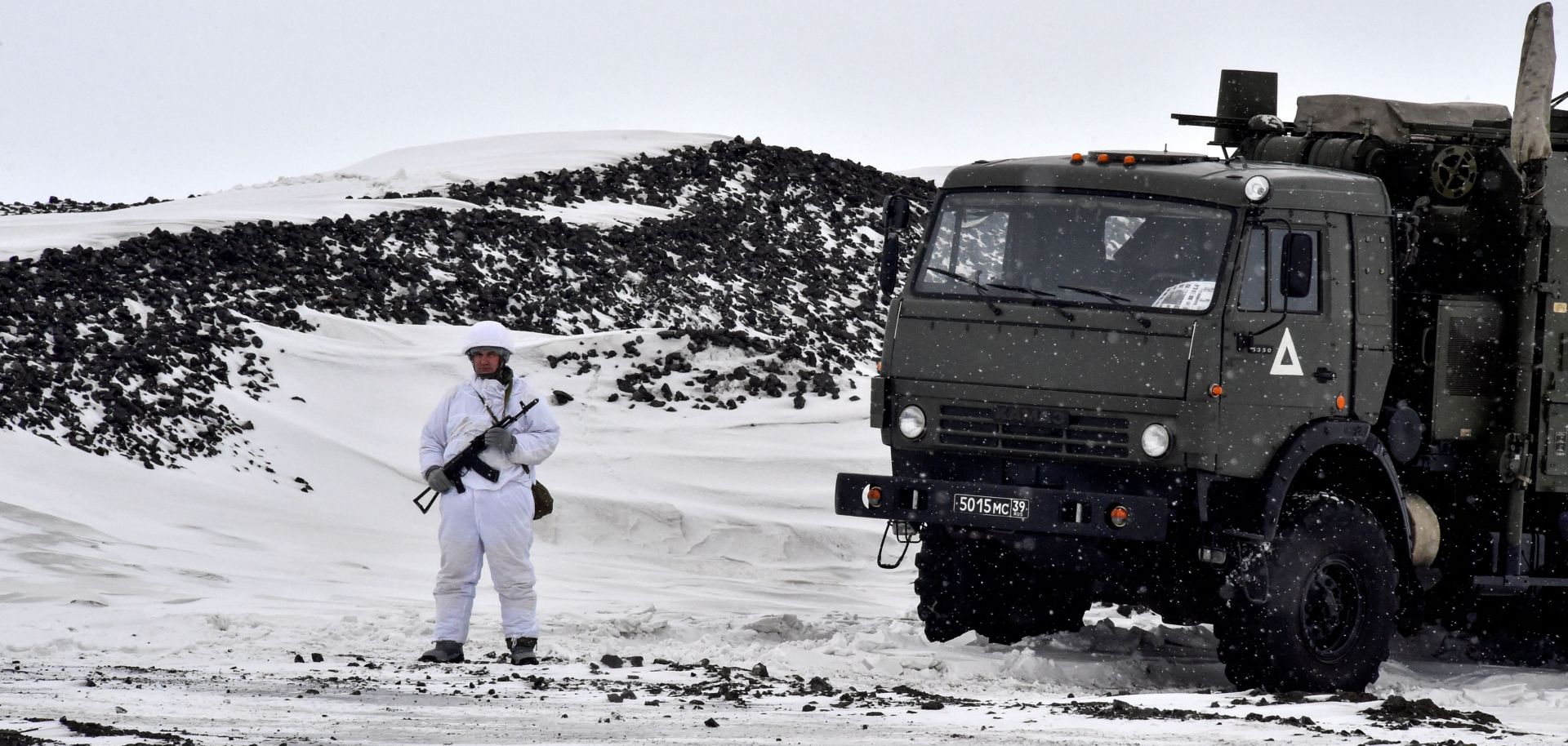
A Russian serviceman stands guard by a military truck on Alexandra Land, the largest island in Russia's Franz Josef Land archipelago in the Arctic Ocean, in May 2021.
The Ukraine invasion has returned NATO's attention to Russia as a strategic threat, which has in turn only fueled Moscow's perception of the Western security bloc as an expansionist force. As a result, the whole of the Russia-NATO contact line has been brought back into play — including in the Arctic, where thawing ice is unlocking a plethora of natural resources and transit routes.
For Russia in particular, new Western sanctions related to Ukraine increase the Arctic's economic and strategic importance. But the added financial strain also increases the complexity of realizing Moscow's ambitious vision for the region.
Tapping Into the Arctic's Wealth
Russia is in the midst of an ambitious 15-year plan to increase the amount of infrastructure, people and economic activity in the Arctic. This plan includes extracting mineral resources and expanding oil and gas production in the region, as well as developing a robust transit corridor along Russia's Arctic frontier.
The West's response to the Ukraine invasion has only reinforced Moscow's need to strengthen its Arctic security, particularly as the Arctic holds much of Russia's resource wealth. As Russia assesses its long-term response to Western sanctions, the strategic oil, gas, and mineral resources in the Arctic will be an important component of its future economic security. Despite bans on Russian oil imports by the United States, Europe has struggled to cut off its Russian energy supplies, providing Moscow with a tool to mitigate efforts to isolate or decouple the Russian economy. Russia's Arctic and Far East production of key minerals, including nickel and palladium, provide similarly limited insulation for Moscow against long-term sanctions, as they remain critical to the global energy transition and high-tech trade.
The Arctic routes may also prove an important link in Russia's supply lines to Asia and beyond, particularly if relations with Europe deteriorate further and potentially threaten rail and road connections from Russia and Belarus to the Continent. Prior to the outbreak of COVID-19, Arctic economic activity made-up roughly 10% of Russia's GDP, and nearly 90% of its natural gas output. In a semi-isolated Russia, this resource base will only grow in economic and strategic significance.
If the trend of Western economic separation from Moscow continues, Russia will become increasingly reliant on the Arctic's energy, mineral and timber resources for national revenue and as a way to mitigate deeper economic isolation. The challenge for Russia is to find the money and technical expertise to develop its Arctic resources fully, while not finding itself overly dependent on China.
Economic Challenges to Russia's Arctic Ambitions
New Western sanctions complicate Russia's plans for the Arctic, which was an already challenging prospect even before the added financial fallout from the COVID-19 pandemic and, more recently, the Ukraine invasion. The sanctions and individual company responses to the war in Ukraine are constraining Russian companies' access to financing and key technologies far beyond those initially imposed following the 2014 annexation of Crimea. The withdrawal of several Western oil companies from Russian Arctic and Far East projects further constrains Russia's operations, and potential Chinese expertise may not be able to quickly replace their Western counterpart's roles and capabilities.
Russia must also contend with the longer-term implications of sanctions and shifting European politics. Europe has not immediately cut its imports of Russian oil and gas. However, this latest crisis involving Russia's Ukraine invasion — coupled with long-term energy transition plans — will drive European countries, key among them Germany, to more readily seek ways to wean off of their over-dependence on Russian supplies. Plans for new liquified natural gas (LNG) terminals and the suspension of the Nord Stream 2 pipeline project between Germany and Russia will incentivize new import sourcing for Europe, though this will take time.
If the political and economic isolation of Russia continues, Moscow will find itself even more dependent on China as a market and investor, solidifying Russia as the weaker partner and raising longer-term tensions between Moscow and Beijing. While Moscow is currently focused on securing its European frontier, China — which sits along Russia's exposed southern and eastern flanks — is also expanding its economic and political influence throughout Central Asia, adding to Moscow's long-term strategic challenges.
NATO's Response in the Arctic
In addition to the economic challenges, Russia faces a more active NATO in the Arctic. Moscow has already spent the last decade reinforcing its Arctic security forces as the warming climate opens up once-frozen transit routes in the region. But while the fighting is far from Russia's northern frontier, the war in Ukraine is also reinforcing the Arctic's strategic significance to Russia's national defense, as Moscow increasingly views NATO activity anywhere as a strategic threat to core Russian interests — a perception that has been reinforced in recent years by a series of agreements among NATO and non-NATO members in the European North, particularly Norway, Finland, Sweden and Denmark.
The Russia-Ukraine war has brought support for NATO membership to a new high in Sweden and Finland — two of the eight countries in the world with territory in the Arctic Circle (with the others including Russia, Canada, the United States, Norway, Denmark and Iceland). It's currently unlikely Finland and Sweden will rapidly shift their semi-neutral stance and join the North Atlantic defense bloc, which would leave Russia as the only non-NATO Arctic state. But their trend toward expanded defense cooperation and planning will still be seen in Moscow as shifting Arctic nation relations from a multipolar format to a nominally bi-polar structure — with Russia on one side, and NATO and its aligned countries on the other.
Regardless of Finland and Sweden's future standing in the Western security alliance, the Ukraine invasion has reawakened NATO to the Russian threat. The Arctic is the shortest route between Russia and North America, making it a key focal point of strategic competition. Russia's not-so-subtle threats of nuclear weapons as a deterrent to NATO intervention in Ukraine have highlighted the Arctic's traditional role as the frontline between potentially opposing nuclear forces, as the region serves as the shortest route for nuclear missiles and nuclear-armed strategic bombers, as well as a hiding place for nuclear missile submarines. In addition to these traditional Cold War systems, the shifting Arctic climate and advances in technology are increasingly bringing surface combatants and land forces to the Atlantic Arctic frontier.
Even prior to Russia's Ukraine invasion, NATO and individual NATO members have stepped up Arctic exercises and training in and around Norway. New U.S. Arctic strategies are also directing new funding, infrastructure and increased training near Russia's Pacific Arctic frontier in Alaska. So while the thawing Arctic offers Russia a new key strategic route to manage far-flung threats from both ends of the Eurasian continent, it also serves as a potential vulnerability by melting the ice wall that has helped shield Russia from invasion and containment.
Implications for the Arctic
Increased attention to and tensions in the Arctic over the next several years have several implications for Russia, Europe and North America:
- The Arctic Council, the primary body for managing regional cooperation and stability, may find itself more politicized as a result of Russia's economic and political isolation. The eight states with territory in the Arctic make up the permanent members of the Arctic Council. Without Russia, the body loses its ability to manage broader Arctic issues, as Russia fronts half of the Arctic coastline. This may open opportunities for ''near-Arctic'' China and others to assert the need for a new Arctic management mechanism that is more inclusive of non-Arctic countries.
- Joint scientific research in the Arctic may also fall victim to growing strategic tension between Russia and the West. This is significant for climate research, but also for research over maritime food stocks. Changes in ocean temperatures are already driving locational changes of key commercial fish and other ocean foodstuffs. Fish do not respect international borders, and weakened Russian-Western scientific cooperation can impact fisheries rights, and contribute to potential clashes over contested fishing grounds. In the South China Sea, such tensions have nearly led to war. Along the Arctic frontier, fisheries can quickly become caught up in strategic competition — impacting livelihoods, food security, and potentially triggering clashes near Norway or the Bering Sea.
- Rising Arctic tensions will bring Greenland back to the forefront, with the United States and NATO seeking expanded access. A nascent independence movement on the island could become integrated into any discussions of an increased military presence or of access to critical minerals in Greenland as a way to ease dependence on other international sources. Complex Greenland/Denmark/U.S. relations provide an opportunity for political interference by Russia or China, each for their own ends.
- As Arctic military training and patrols increase, there is a parallel increase in the risk of accidental confrontations or miscalculations. Russia and NATO have long had communication channels and ways to de-escalate, but these are not always followed or effective. NATO (and more recently Japan) and Russia regularly scramble their own interceptors and fighters to shadow flights of the others' strategic aircraft, but the opening of Arctic waters is adding more surface maritime activity — creating new areas for possible miscalculation, not least because these activities often overlap with commercial fishing and shipping operations.
- A final implication comes from China, a self-proclaimed near-Arctic nation. Beijing sees the Arctic as a key component of its broader strategic connectivity plans. But both its Arctic maritime routes and its rail routes across Eurasia to Europe may be interrupted by European economic restrictions on Russia. China is likely to seek its own Arctic routes, north of Russia's Northern Sea Route, which will increase Chinese surveying and scientific vessels in the Arctic — ships that may serve dual military purposes.
Bringing the Arctic Back Into Focus
Since the end of the Cold War up until about a decade ago, the United States' security focus on Russia and the Arctic took a backseat to more pressing threats. But this has started to change in tandem with the Arctic's increasingly accessible landscape and Russia's increasingly aggressive behavior. Washington and, more recently, its European allies are now seeing the Arctic as an area of increased strategic threat, which is in turn only fueling Moscow's interest in the region. The 2014 Ukraine crisis and Russia's annexation of Crimea triggered a renewed NATO focus on Russia — not just as a neighbor, but once again as a strategic opponent. But it took the full Russian invasion of Ukraine to bring this into sharp focus.
