
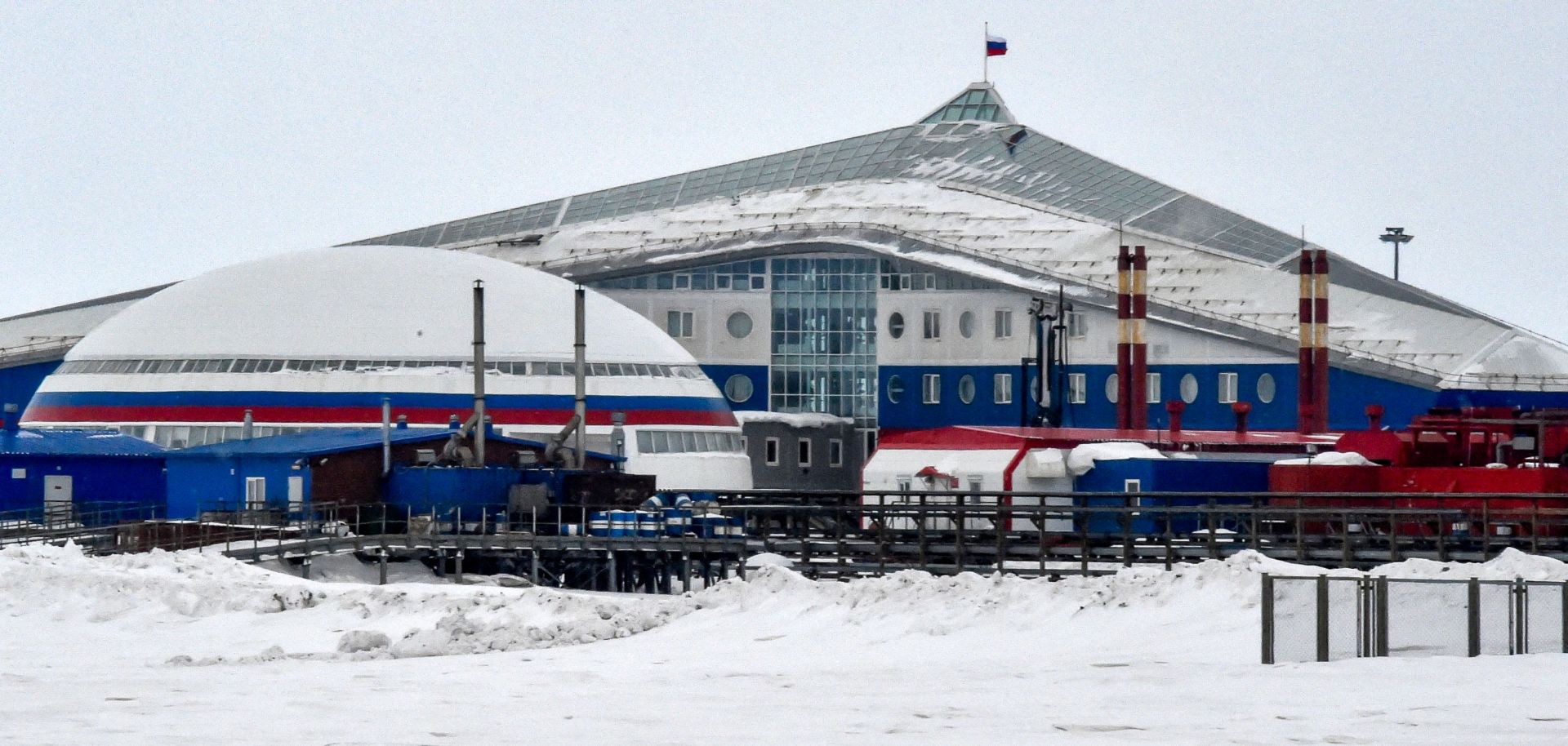
A view of Russia’s northernmost military base on the island of Alexandra Land on May 17, 2021.
Editor’s Note: This is part of an occasional series exploring the geopolitical and strategic implications of climate change.
The U.S. Defense Department is increasingly considering climate change in its assessments of future threats and challenges. In numerous reports, climate change implications are often characterized as “threat multipliers” — that is, elements that exacerbate existing trends or instabilities. But there are aspects of climate change that have even deeper implications by changing either the physical geography of particular spaces or their perceived relative significance. These are the geopolitical impacts, ranging from shifts in critical natural resources to the radical transformation of the Arctic.
Changes in climate patterns alter humanity’s interaction with geography directly and indirectly. There are immediate physical impacts, like shifts in land use, water availability, coastlines and soil stability. And there are also secondary impacts, like technological developments to adapt to or alter the physical environment, changes in migration patterns, or new competition over routes and resources.
National power — whether measured in economic opportunity, human capital or military strength — has long been shaped and influenced by geography. Natural resources, however, are not distributed evenly across the globe, nor is arable land, natural transportation routes or conducive conditions. Geography is not deterministic, but it clearly provides uneven opportunities and challenges around the globe. And today we are seeing climate change potentially alter fundamental geopolitical structures, with the Russian Arctic at the forefront.
A New Arctic Emerges
Perhaps the most immediate and obvious impacts of climate change can be seen in the Arctic. A May report by the Arctic Monitoring and Assessment Programme (AMAP) recognized that the Arctic is warming three times faster than the rest of the globe, even faster than reports by the Intergovernmental Panel on Climate Change (IPCC) only a few years ago. With less ice protecting shorelines, winter storm erosion is eating away at coastal villages. Arctic and near-arctic fish stocks are moving to adapt to changing water temperatures. Arctic fires are becoming more frequent and covering greater areas. Thawing permafrost is undermining existing infrastructure around human settlements, military installations, and critical energy and mineral projects. Russia’s Northern Sea Route (NSR), meanwhile, is opening nearly year-round, with increased access even without icebreakers.The U.S. military has taken note of these impacts on its airstrips, radars and missile defense installations in Alaska. Russia, too, has stepped up the modernization of its Arctic defense facilities, and Moscow, as the new Chair of the Arctic Council, is emphasizing managed resource exploitation in the Arctic.
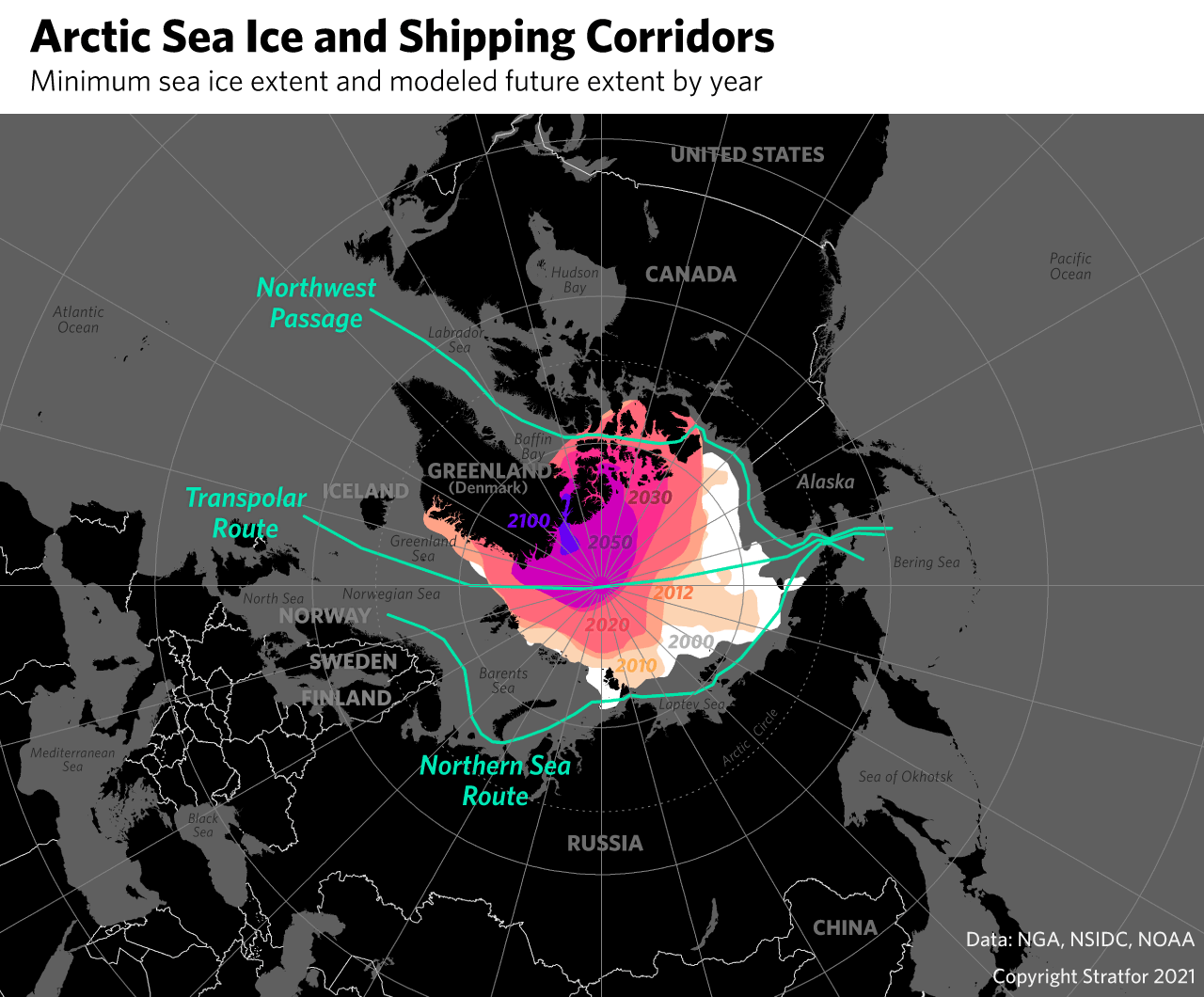
Both countries, along with NATO, are increasing military exercises and naval patrols in the Arctic, both for national security and in recognition of the likely increase in search and rescue and disaster response in much more accessible seas. But beyond these reactive aspects, there is a deeper geostrategic change underway — a fundamental restructuring of Russia’s strategic position.
The Thawing Eurasian Heartland
Modern Western geostrategic thought pays homage to British geographer Sir Halford J. Mackinder’s observations at the turn of the last century on the inherent insularity of a Eurasian “Heartland,” as well as on Mackinder and American geopolitician Nicholas Spykman’s considerations of the competition between traditional continental and maritime powers. Mackinder’s primary observation was that the core heartland of Eurasia was largely impenetrable to sea power, but could serve as a base of resources and manpower that, when brought together under a single power, would then be able to exert its power beyond the continent to the surrounding seas. Spykman emphasized that the clash between maritime powers and continental powers would take place where they met along the coastal periphery, or what he called the Rimland.
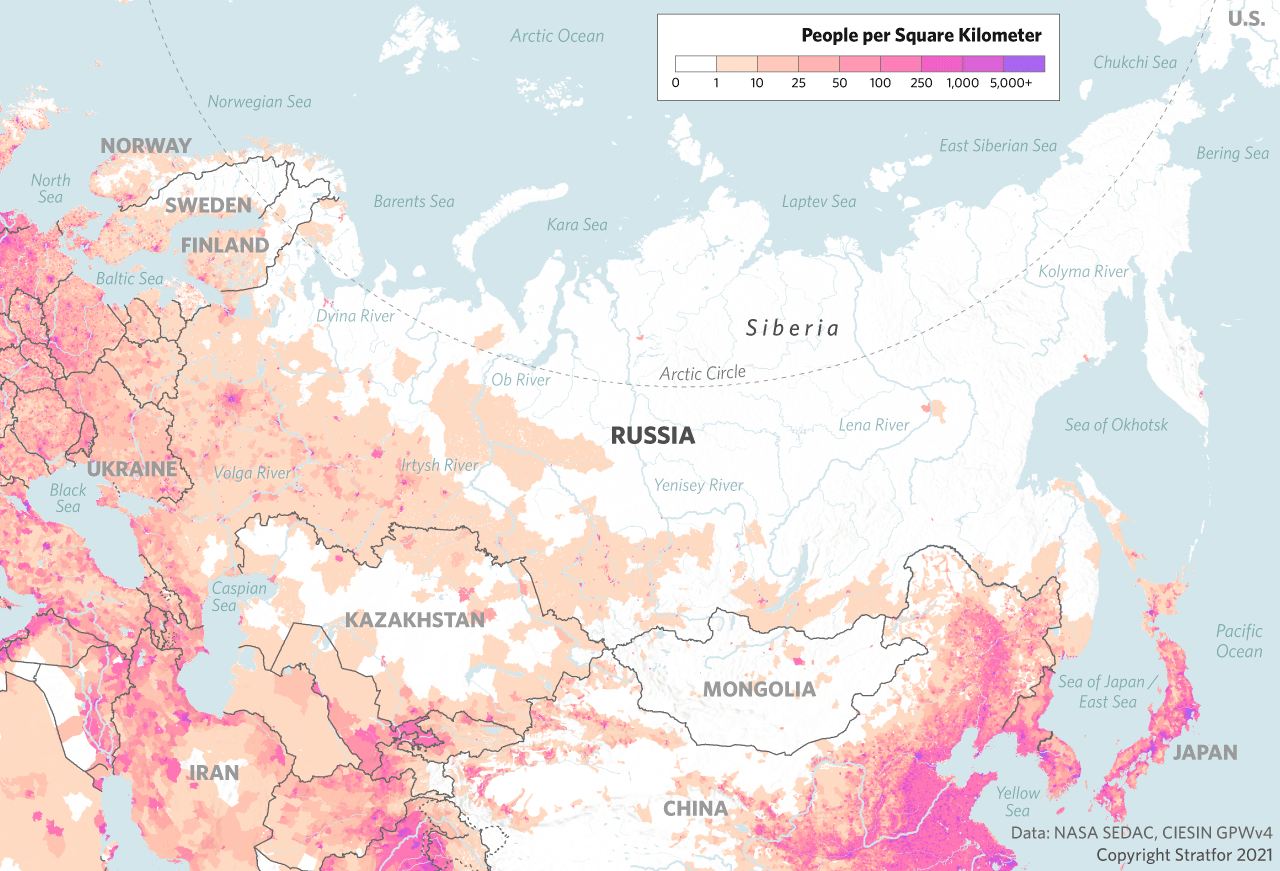
Key to the Eurasian heartland concept was the idea that the region had limited access by sea, but could maintain robust internal lines of communication, particularly with the advent of rail. This heartland was protected by strategic depth (something the French and Germans both discovered at different times in their drives toward Moscow), and was shielded along its entire northern frontier by ice. The rivers of the heartland also drained into inland seas, or into the inaccessible Arctic — limiting their use as internal transit corridors, but also as routes of maritime access and invasion.
These ideas shaped U.S. strategic thinking in its intervention in World War II, as well as its containment of the Soviet Union during the Cold War. And they remain alive today, as the United States sees China’s Belt and Road Initiative as just the latest attempt by a Eurasian continental power to connect Eurasia and Africa and harness its inherent resources and strength.
A Shift in Russia’s Strategic Perspective
Despite the interest in Arctic and Far East resources, Russia has traditionally oriented away from its icy Arctic frontier, pushing either west toward Europe, south toward the Middle East and India, or east toward the Pacific coast. This has included attempts to access alternative sea routes and resources, as Russia’s naval reach is geographically constrained by bottlenecks in the Baltic and Black Seas or by Japan along the Pacific coast.
A more open and less frozen Arctic fundamentally alters Russia’s geography. It provides greater access to critical energy and mineral resources and, most significantly, opens a vast new maritime frontier. Moscow has placed the Arctic at center stage in its future economic development. Russia is investing in the infrastructure necessary to monitor and control the NSR. It has also announced plans for new rail links connecting its Arctic frontier to the core of Russia west of the Urals, and has launched an incentive drive to coax more internal migration into the Arctic and Far East regions.
A Mixed Blessing
Moscow has rapidly rebuilt its long depleted Cold War defense architecture along the Northern frontier, recognizing that access to the seas is not just a benefit, but a potential threat. Despite new efforts, Russia still has a minimal population in the Arctic, a poorly developed transportation infrastructure to link the Russian core to its Arctic frontier, and sees this newly open Northern flank as a strategic vulnerability. Moscow’s attempts to control all shipping through the NSR is but one additional response to this mixed blessing of an open Arctic.
From a geopolitical perspective, a Russia that now has an extensive coastline is a fundamentally different Russia than ever encountered in history. If Moscow is able to connect its Arctic frontier to its traditional core and take advantage of both the resources and the routes, it can begin to mitigate the traditional Western containment strategies, opening the path for a new dynamic in Russian strategic thought.
Rarely does geography change so quickly and so radically across such a broad space. A man-made example would be the opening of the Panama Canal, a transformative geopolitical event that allowed the United States to be not just a trans-continental power, but a two-ocean power. The opening of the Arctic provides similar new strategic opportunities for Russia if it is able to develop the infrastructure along its new maritime frontier. Already Moscow is building transshipment ports at each end of the NSR to better facilitate trans-Arctic transit and establish Russia in control of a key alternative link between Asia and Europe. The warming climate also opens the possibility for shifting land use in the Russian Far East, in addition to expanded resource extraction.
Great Power Competition
But it also creates new risks for Russia by opening maritime access to its competitors and opponents across a long and unprotected coast. Russian and Chinese cooperation in developing Russia’s Arctic energy infrastructure is tainted by differences in views on the use of the NSR. Russia considers the NSR internal waters, subject to Russian control and transit fees, while China considers it international waters, open to free passage. And Beijing is also exploring ways to sail further north, bypassing Russia’s NSR altogether.
China’s growing interest in the Arctic, coupled with Russia’s expanded military facilities, have also triggered responsive attention and actions in Europe and the United States. With the deployment of the F-35 Joint Strike Fighter to supplement the F-22, Alaska is emerging as the largest concentration of fifth-generation fighters in the world. The U.S. Army is also reshaping its Arctic strategy, stepping up Cold Weather training. And the U.S. Navy is slowly resuming Arctic patrols as well. In addition, the United States is stepping up joint bilateral and multilateral training and exercises in Arctic areas with Canada and Europe, as well as with its Pacific partners. Renewed calls to keep the Arctic a “zone of peace” are complicated by the physical realities of climate change in the Arctic, and by national responses.
As attention to the Arctic increases, Russia is faced with a new strategic reality. It must shift its traditional southward focus and secure its newly open northern flank, while also trying to encourage internal population migration and fund infrastructure to facilitate connectivity and resource development. Russia’s relations with the West remain strained, and its strategic partnership with China hides underlying distrust and a growing imbalance of power in Beijing’s favor. Russia’s new need for more robust naval capabilities will compete with its longstanding risks along its extensive land borders. How Moscow manages these competing geopolitical realities will determine whether the opening of the Arctic is a new opportunity for Russia to reshape its future, or a new risk that leaves Moscow vulnerable as the world changes around it.
