
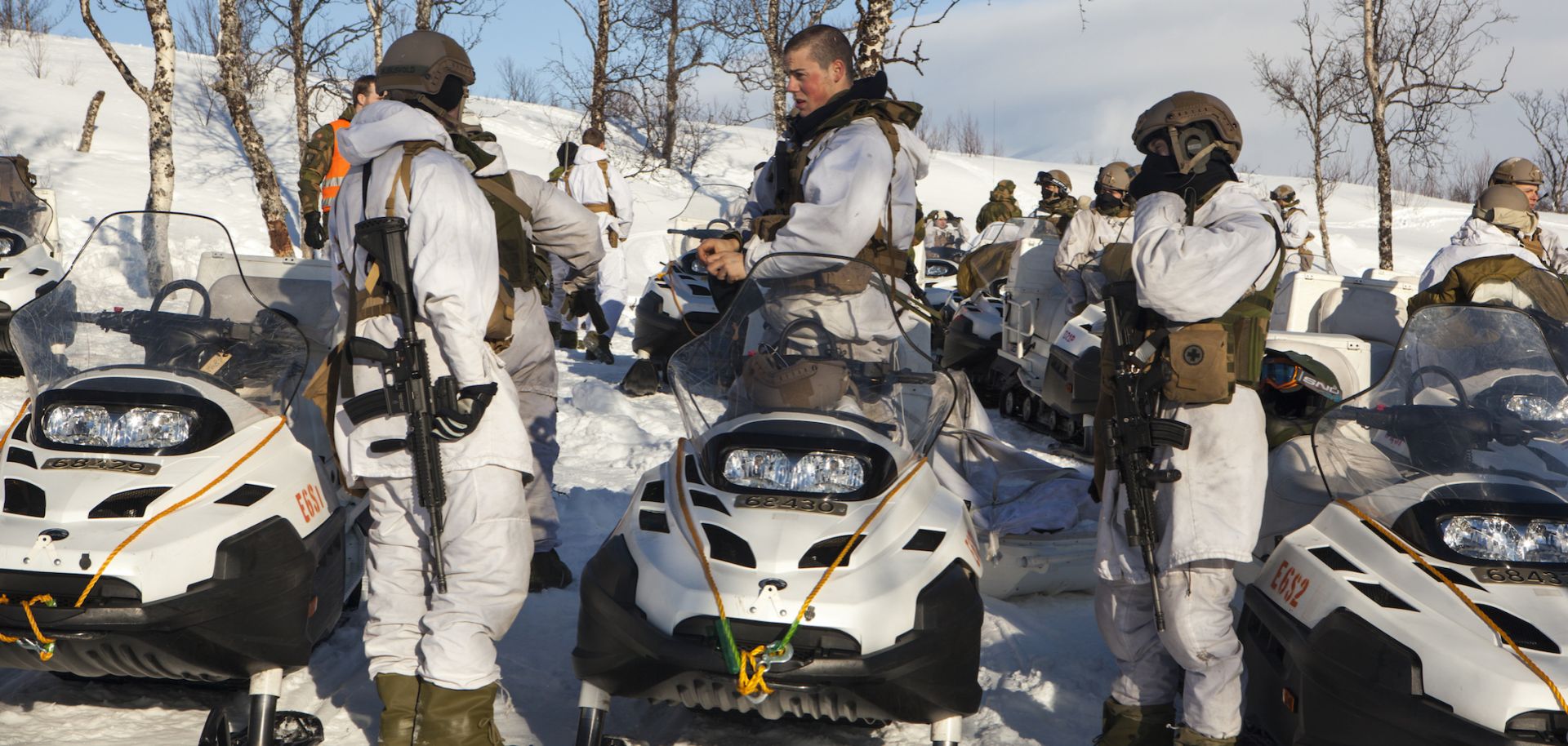
Norwegian army soldiers use snowmobiles for mobility during a military exercise on March 6, 2013, in Skjold, Norway.
The U.S. military is increasing collaboration with Nordic states in response to expanding Russian military and economic activities in the Arctic, pointing to a future of heightened competition with the potential for both strategic and tactical miscommunication or miscalculation. On Feb. 22, four U.S. B-1 bombers arrived for their first-ever deployment to Norway in a move widely seen as a signal to Russia. Five days earlier, the United States agreed with Denmark, Finland, Norway and Sweden to continue its participation in the biennial Arctic Challenge Exercise, one of Europe’s largest tactical air exercises and widely seen as practice to counter potential Russian belligerence, next scheduled for June 2021. The U.S. Army is also preparing to unveil its Arctic strategy in the coming weeks, as the changing climate turns the previously inaccessible region into an increasingly busy zone of military and economic activity — particularly along the Russian frontier.
- Over the past two years, the U.S. Navy, Marine Corps, Air Force and Coast Guard have published documents outlining their Arctic strategies, all of which emphasize the importance of working with regional partners.
- In January, a Norwegian contractor said it will refurbish a large decommissioned Cold War-era submarine base near the strategic northern city of Tromso, with reports suggesting that the U.S. military intends to operate out of the facility. Last year, Norway upgraded existing port facilities in Tromso to accommodate more frequent submarine visits from the United States and other NATO members.
- The United States also has been increasing bilateral military cooperation with non-NATO states Finland and Sweden, both of which have shifted away from decades of careful balance between NATO and Russia amid fears of the latter’s aggression. In early February, U.S. and Finnish air forces trained together on mid-air refueling in the Arctic, building on previous defense agreements to enhance collaboration. In November 2020, U.S. and Swedish forces also conducted large exercises in Sweden designed to prepare for a hypothetical Russian attack.
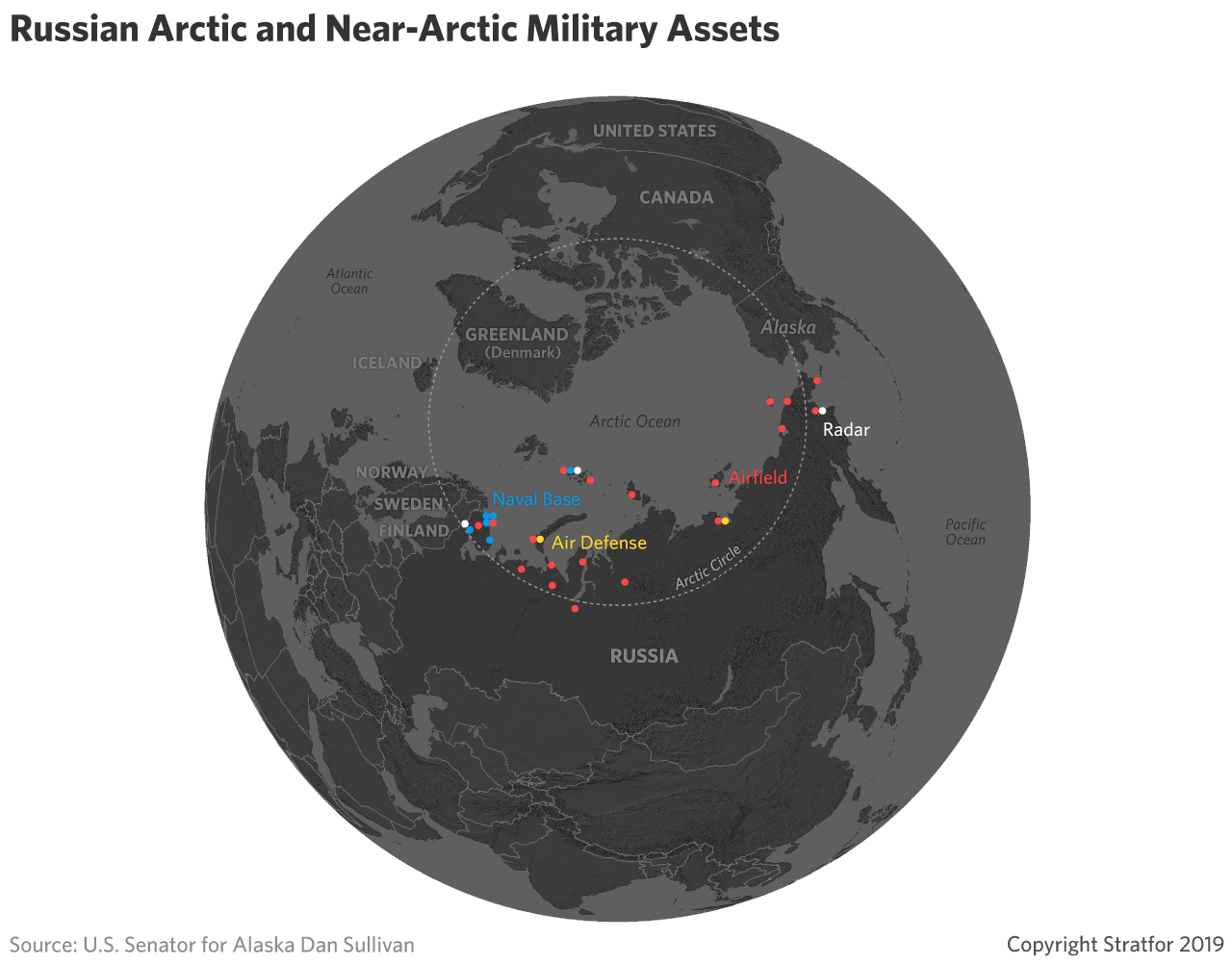
Growing U.S. operations come as Russia prioritizes the Arctic for economic development and strategic defense that Moscow views as essential to its future. As the country with the largest Arctic coastline and claimed territory, Russia is keenly interested in exploiting the economic opportunities of the region’s increasingly extractable resources and usable sea lanes, while simultaneously shoring up its defenses and ability to project power. In March 2020, Russia approved a new 15-year Arctic strategy that restates a previous assessment that the region will be its main resource base for future economic growth and more explicitly outlines its perceived security implications of a warming Arctic. Between 2021-2023, Russia will also chair the Arctic Council, the area’s main intergovernmental forum, enabling it to help shape the agenda for the region.
- The Kremlin is prioritizing investment in the Arctic to extract valuable resources and build supporting infrastructure. On Feb. 1, it reportedly approved six large new state-backed projects and agreed to help defray the costs of construction to help spur more private investment. Also in February, the head of Russia’s state-owned Rosneft energy firm announced that the company’s top priority was exploiting recent large Arctic oil and gas discoveries.
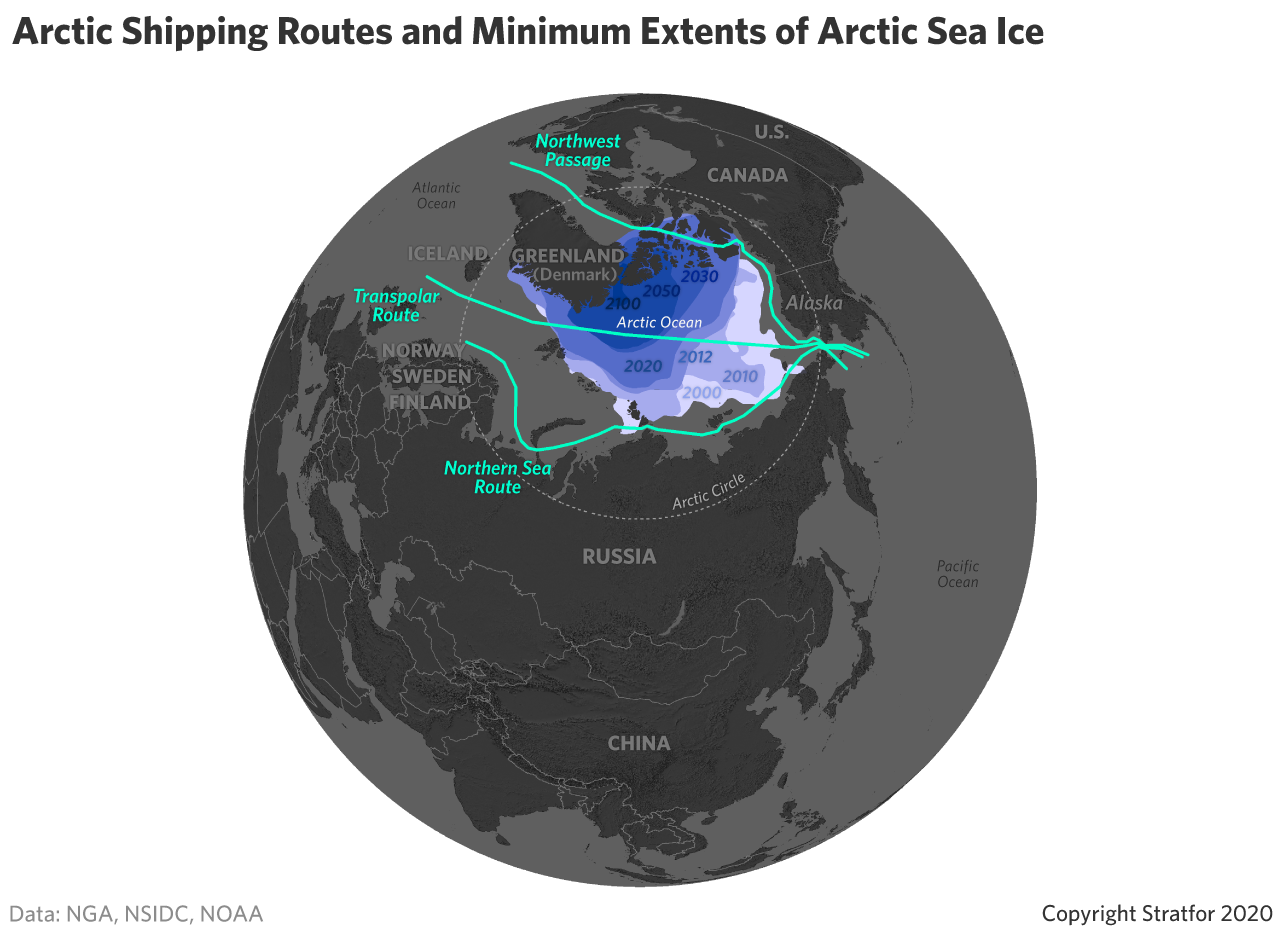
- Russia is promoting the Northern Sea Route (NSR) through the Arctic as a much faster way to connect the Atlantic and Pacific Oceans, which would give an advantage to Russian shippers and earn the country lucrative transit fees for foreign vessels. Earlier this month, three Russian liquified natural gas tankers completed the NSR in the winter for the first time, demonstrating the potential feasibility of year-round transits.
- Broadly, Russia is taking many steps — including modernizing military bases, deploying and testing new hardware, and sending military vessels and aircraft on missions to probe other countries’ defenses — to bolster its Arctic security. On Jan. 1, it formally upgraded the status of its Northern Fleet to give it the same status as the country’s four geographic military districts. This marks the first time a fleet has ever been equal in command to Russia’s military districts, further highlighting the Arctic’s importance to Russian leaders.
Heightened U.S. and Russian activity in the Arctic will raise the risk of confrontation. The two sides normally maintain sufficient deconfliction protocols, but the rapidly increasing number of military and private actors in the challenging environment, not all of whom may be sufficiently acclimated to operating in the complex climate, raises the risk of accidents. The broader deterioration in U.S.-Russian relations also could lead military personnel in the Arctic to assume the worst of the other’s actions or statements, undermining other confidence-building measures. The Arctic Council explicitly excludes military matters from discussion, reducing the space for multilateral diplomacy that could help to de-escalate potential standoffs.
- Increasing private naval activity — including cruise lines, scientific research ships, energy tankers and commercial shipping — is creating more crowded sea lanes in a complex operating environment not accustomed to such activity. In August 2020, the U.S. Coast Guard failed to tell U.S. fishermen that Russia would be conducting military drills in part of their fishing zone, leading to near misses between Russian forces and small fishing boats.
- Likely to coincide with the recent arrival of the U.S. B-1 bombers, Russia sailed a large missile cruiser and issued a notice for missile tests between Feb. 18-24 in waters just north of Norway that are popular for fishing and also fall within the limits of what it perceives to be its historic defensive zone. In the future, a misunderstanding of the exact timing or location of such drills could lead to accidents. A misinterpretation of their intended purpose — particularly if they come during a period of heightened tensions on other matters — could also lead to military escalation.
- Aerial intercepts in the Arctic between U.S. and Russian planes are increasing, raising the risk of miscommunication or miscalculation amid uniquely challenging Arctic operating conditions. Pilots must fly vast distances over water, grapple with extreme weather and temperatures, navigate curvature-of-the-earth problems and contend with losing radio coverage — all of which can make otherwise professional encounters dangerous.
