
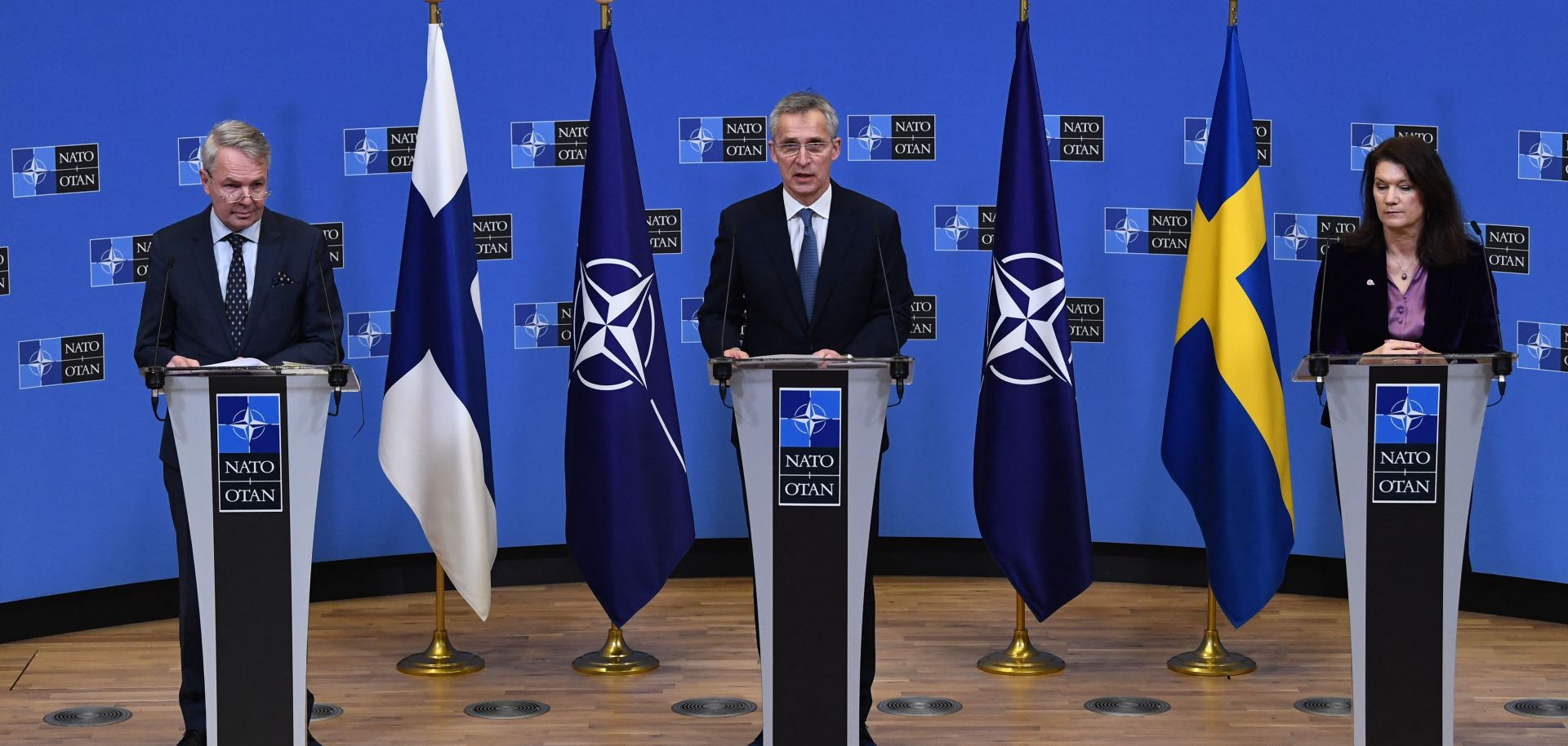
NATO Secretary-General Jens Stoltenberg (center), Finnish Foreign Minister Pekka Haavisto (left) and Swedish Foreign Minister Ann Linde (right) give a press conference at the NATO headquarters in Brussels, Belgium, on Jan. 24, 2022.
While Russia's invasion of Ukraine has reignited discussions in Sweden and Finland about NATO membership, political constraints make both countries more likely to boost cooperation with the Western Security alliance rather than join it, at least in the immediate term. For decades, the issue of joining NATO has been politically charged in Sweden and Finland, two neutral countries that have chosen not to follow most of Europe in entering the military alliance. Broadly speaking, conservative parties in both countries tend to support NATO membership, arguing that it would bring protection against potential Russian aggression, while progressive parties reject the idea for fear it could actually catalyze Russian retaliation. Sweden and Finland's cooperation with NATO is already very close; both countries are members of NATO's Partnership for Peace (PfP) program and participate in the alliance's Partnership Interoperability Initiative (PIP), which means they often contribute to NATO-led operations, missions and exercises. In recent months, however, Russia's threats and the ensuing invasion of Ukraine have relaunched the debate about full membership in the alliance.
- After being involved in some of the major wars in Europe for centuries, Sweden officially became neutral in the early 19th century, a policy it maintains to this day. Though Sweden does not share a land border with Russia, its strategic position in the Baltic Sea and along the Danish Straits (which constrains Russia's room for action in the area) explains why Moscow sees an eventual Swedish membership in the alliance as a threat. After the end of the Cold War, Sweden joined the European Union in 1995.
- Finland shares an 830-mile border with Russia, and their bilateral relationship has fluctuated over time. Finland was a part of the Russian empire in the 19th century but became independent when the empire collapsed after World War I. Russia then invaded Finland during the early stages of World War II and Finland ended up ceding territory to the Soviet Union. During the Cold War, Finland pursued balanced relations between Russia and the West while remaining neutral. But in a way, Finland ended its political neutrality when it joined the European Union in 1995.
- Russia would perceive Sweden and Finland's NATO membership as another eastward move by the alliance that would further encircle it in the Baltic region. It would also intensify NATO-Russia competition in the Arctic, as all Arctic nations aside from Russia would then be members of NATO, further shifting the focus from environmental cooperation to likely more intense strategic competition. On Feb. 25, Russian foreign ministry spokesperson Maria Zakharova warned of ''military and political consequences'' if Sweden or Finland joined NATO and argued both countries ''should not base their security on damaging the security of other countries.''
The Swedish and Finnish governments will keep the option of NATO membership open to signal their autonomy vis-a-vis Russia, but are unlikely to join the alliance in the near future. While the current center-left governments in Sweden and Finland do not intend to join NATO anytime soon, they will constantly signal that the option remains on the table in order to send Russia the message that they will not make major policy choices under pressure from Moscow. While opinion polls currently show that popular support for NATO membership is on the rise in both countries, support could fall again after the Russia-Ukraine war ends. With this in mind, Stockholm and Helsinki will probably refrain from making such an important policy decision based on what could be volatile public opinion. However, if public opinion continues to support NATO membership after the end of the conflict in Ukraine, future Swedish and Finnish governments (especially if they are led by conservative parties) may be inclined to hold referendums on the issue.
- A Demoskop poll published by the Swedish newspaper Aftonbladet on March 4 showed 51% of Swedish voters were in favor of NATO membership, up from 42% in January. An opinion poll published by the Finnish newspaper Yle on Feb. 28 found that 53% of Finnish voters wanted their country to join the military alliance.
- On March 8, Swedish Prime Minister Magdalena Andersson said that her government does not plan to apply for NATO membership, warning that it could destabilize the security situation in the region.
- On March 9, Finnish Prime Minister Sanna Marin said her government will increase consultations with other political parties in the coming months to build a ''consensus'' on the issue of NATO membership.
Even if they don't join NATO, Sweden and Finland will likely increase their military spending and exercises with NATO, assist Ukraine with weapons and funds, and support policies to politically and economically isolate Russia. The war in Ukraine will further cement Sweden and Finland's Western alliances. Stockholm and Helsinki will likely continue supporting EU economic and political sanctions against Russia, as well as policies to reduce the bloc's dependency on Russian energy. Moreover, they will reassess their military doctrines and security priorities — likely resulting in higher defense spending, as well as a greater focus on issues like countering cyberattacks and disinformation campaigns to better protect themselves against unconventional forms of aggression from Russia. Finally, NATO membership will probably be a hot-button issue in the lead-up to both Sweden's general election this September, as well as Finland's general election in April 2023; a victory of conservative parties in either country could eventually pave the way for a referendum on the issue.
- On Feb. 28, Sweden announced that it would send anti-tank launchers and other weapons to Ukraine, breaking Stockholm's longstanding tradition of not sending arms to countries in conflict. That same day, Finland also announced it planned to send weapons to Ukraine.
- On March 10, the Swedish government announced it seeks to increase defense spending from the current 1.3% of GDP to 2%, which is in line with NATO's requirement to member states. However, the government did not announce a timeframe.
