
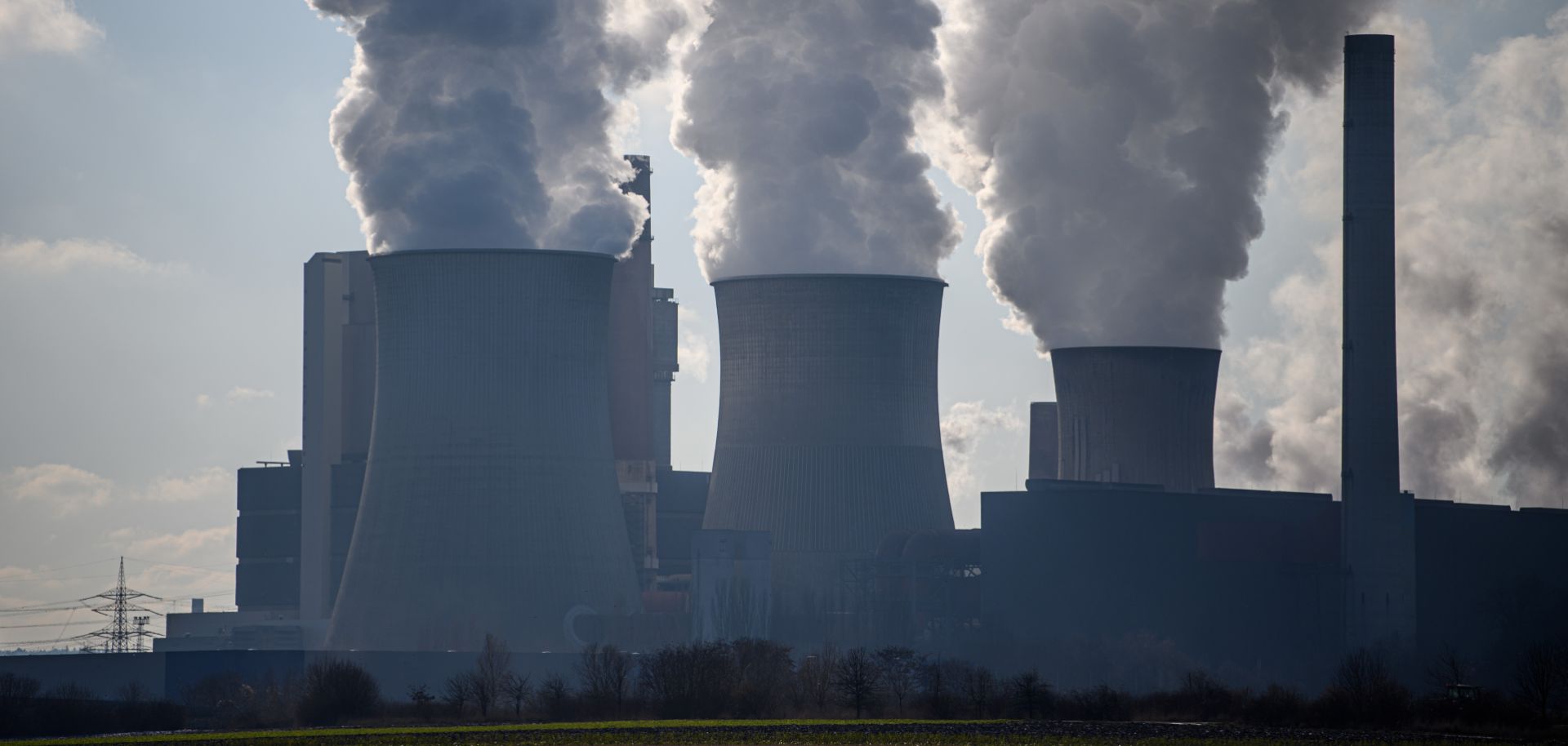
Steam and exhaust rise from a coal-fired power station near Inden, Germany, on Feb. 11, 2021.
The significant commitments and ambitious policies outlined in the International Energy Agency’s (IEA) Net Zero by 2050 Roadmap offer a sobering reality check for governments promising to achieve carbon neutrality within the next 30 years. While they won't implement all, Western countries will likely implement some of the recommendations, painting a grim outlook for oil-producing nations. The IEA released the report on May 18 on the heels of last month’s U.S. climate change summit, where the United States, Japan and others announced stronger commitments to reduce their impact on warming global temperatures. The timing of the Paris-based organization’s report is also aimed at building momentum ahead of the United Nations Climate Change Conference in November.
- The IEA’s modeling suggests that the current plans and commitments are insufficient to reach net-zero emissions by 2050 and mitigate the worst effects of climate change. In the report, the IEA argues that the policies outlined in its previous Stated Policies (STEPS) scenario would still lead to carbon emissions from energy-related and industrial sectors rising from 34 gigatonnes (Gt) in 2020 to 36 Gt in 2030, largely peaking around that amount. The report also says that even if all the governments that have made net-zero carbon pledges met their targets on time and in full, emissions would only fall to 22 Gt by 2050, with global temperatures still rising by around 2.1 degrees celsius.
The IEA’s roadmap lays out more than 400 sector- and technology-focused milestones that need to be reached in order to achieve net-zero emissions within the next 30 years.
- Oil and Gas: No new oil and gas projects approved from 2021 onward in order to cut global oil production by about three-quarters to just 24 million barrels per day by 2050.
- Coal: No new mining deals or extensions on current mining projects approved from 2021 onward.
- Electric Cars: By 2030, electric vehicles need to make up 60% of all new car sales in the world. By 2035, there must be no new sales of internal combustion engine cars, with the hopes of 86% of the global passenger car fleet being electrified by 2050. At least half of all other vehicle classes (including trucks and busses) must also be electric by 2050.
- Steel: The global share of steel production using electric arc furnaces as opposed to more carbon-intensive blast furnaces needs to increases from 24% to 53% by 2025.
- Heating: The global share of heating systems that use heating pumps (in lieu of fossil fuels) needs to increase from 7% to 55% by 2050.
- Power Generation: The global share of power generated by renewable energy (primarily solar and wind) needs to increase from 29% to 88% by 2050, with the remainder being low carbon sources (such as nuclear or carbon capture projects).
- Behavioral Changes: Societies will need to adopt a number of societal changes in order to reduce energy consumption, including keeping international travel at 2019 levels, increasing ride-sharing, increasing air conditioning temperatures during the summer, increasing high-speed rail adoption and reducing maximum driving speed limits to 100 kilometers (or roughly 62 miles) per hour.
- Batteries: Innovation and technological advances in the battery sector must continue to decrease the cost of batteries for transport applications from $130-$155 per kilowatt-hour (kWh) to $75-$90 kWh by 2030, then ultimately to $55-$80 kWh by 2050.
- Overall Innovation: 50% of the decline in global carbon emissions must be driven by the emerging industrial and energy technologies that are currently in the demonstration or prototyping stages. The launch and widespread use of new technologies will be needed in order to hit goals beyond 2030, while more mature technologies will be needed to hit 2030 goals.
Most governments are not in the economic and/or political position to adopt most of the IEA’s policies. But the report is nonetheless likely to trigger stronger commitments from Western countries. Europe will remain a global leader in climate-friendly policies and regulations — particularly countries in Western and Northern Europe. In the United States, President Joe Biden will likely also continue making aggressive long-term commitments on climate change. But his more ambitious proposals — including curbing oil and gas production, phasing out carbon-fueled vehicles, and reducing the role of natural gas in the power sector – are unlikely to gain significant traction without Congress and U.S. states adopting similar policies. Piecemeal progress by the United States thus remains the most likely path ahead, with states like California likely adopting more aggressive strategies at a much quicker pace than states with coal- or oil-reliant economies, like Texas.
The IEA’s report will also provide the West with more ammunition to pressure China to take stronger policies against climate change. China’s promise of carbon neutrality by 2060 lags behind most Western targeted dates. Although China certainly is making progress on transitioning away from coal, Beijing is not likely to set ambitious intermediate targets. And even if they do, the transparency around hitting intermediate targets is likely to be limited, with Chinese officials under pressure to “fudge” numbers so that China hits any intermediate targets.
India and the developing world, meanwhile, will demand more financial assistance in hitting their climate goals, but likely to little avail. India and the developing world are posed to see a significant surge in power needs in the coming years as their citizens gain greater access to electricity, and as their growing populations increase demand for meat, steel and transportation. The expensive and drastic changes that Western countries will need to take will limit their ability to fund transitions elsewhere, though some of the innovation will spill over to help developing countries. The developing world will thus lag far behind the rest of the world in curbing emissions (or at least curbing emissions growth).
Even partial adoption of the IEA’s roadmap by primarily Western countries will result in significant implications for the oil and gas industry — causing global demand for fossil fuels to peak sooner rather than later, if it hasn’t already. OPEC will still be a major exporter of oil, given its status as a low-cost producer. But the group’s overall sales could decline, putting more pressure on major oil-producing countries like Saudi Arabia to hasten economic reform plans. Large international oil companies are likely to increasingly position themselves as technology leaders in investing in the energy transition. But should the IEA succeed in securing more commitments, more companies will need to mirror the strategic shifts that oil firms like BP and Equinor have announced. Activists around the world will also use the IEA report to further pressure energy companies and the banks financing their operations to make more significant changes to their business model in order to accelerate the transition to renewable energy and decelerate climate change.
