
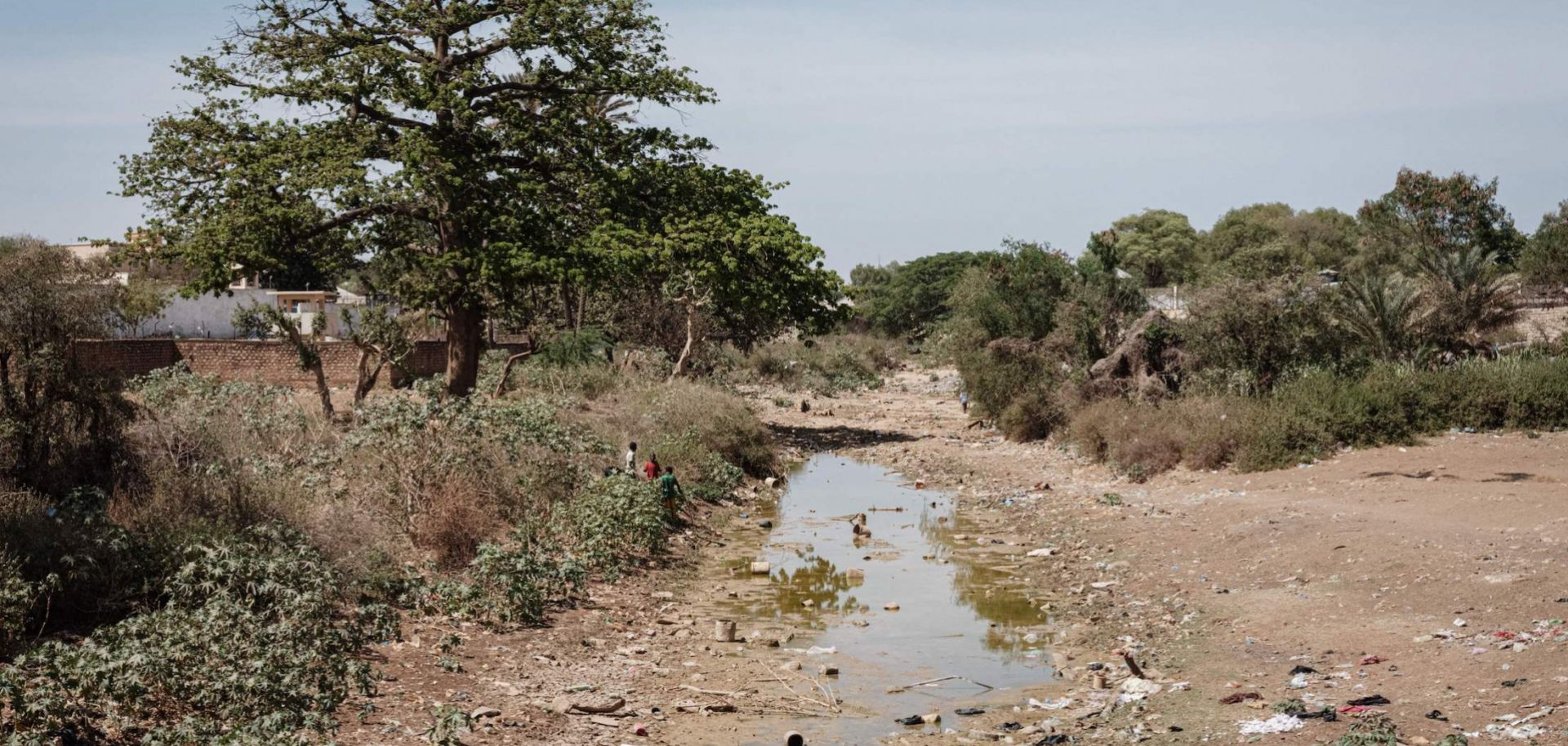
Low water levels are seen at the main river in Baidoa, Somalia, on Feb. 13, 2022, amid a historic drought in the region.
In sub-Saharan Africa, a surge in global commodity prices, inflation and supply shortages — combined with major regional droughts — are increasing food insecurity, which will trigger unrest and could destabilize some governments. Prior to Russia's invasion of Ukraine in February, many Africans were already struggling to find affordable food due to the lingering global economic impact of the COVID-19 pandemic. But the ongoing war in Ukraine and the West's subsequent sanctions campaign against Moscow have only worsened food insecurity across countries in sub-Saharan Africa by exacerbating global inflation and creating more supply shortages. According to a recent U.N. report, 25 of the 69 countries that are currently seeing an increase in hunger due to disruptions in food, energy and finance systems are in Africa. Domestic inflation compounds the effects of global price hikes for basic food supplies like wheat, sorghum, rice, millet and yams, significantly reducing Africans' purchasing power. Environmental crises, meanwhile — increasing the ongoing droughts in the Western Sahel and the Horn of Africa — are also adding to agricultural shortages by reducing farmers' crop yields, which then further increase the prices of scarce commodities.
- The U.N. humanitarian office warned that Kenya and countries in the Horn of Africa (including Somalia, Eritrea, Ethiopia and Djibouti) are facing the worst drought in 40 years, leaving 29 million people in affected areas at severe risk of famine.
- The World Food Program predicts that nearly 22 million Sudanese will face hunger this year, in part due to the fact that in previous years, Sudan imported 35% of its wheat supplies from Russia and Ukraine.
- The price of a gallon of oil in Ghana's Agbogbloshie market, one of the busiest trading hubs in the country, rose from 105 Ghana cedis (about $13) in August 2021 to 400 cedis (around $52) in April 2022.
- Nearly 90% of Kenya's open water sources have dried up, leading to a 70% drop in crop production that is causing acute hunger for 3.5 million people in the country.
Food insecurity has historically been a key driver in political instability in Africa, a trend that the current economic crisis could exacerbate. Multiple factors have historically led to social resistance to central governments in Africa, like high unemployment, economic inequality, political repression and armed conflict. Severe hunger, however, is often a leading cause of extreme political volatility. Indeed, many of those who participated in recent anti-government protests in Burkina Faso, Mali, Niger, Nigeria and Sudan cited hunger and/or an inability to feed their families as a key reason for taking to the streets.
- In 2018, protests over food and fuel prices in Sudan evolved into the political revolution that ultimately ousted the country's long-time authoritarian leader Omar al-Bashir and paved the way for a transitional government.
- Food insecurity and other economic grievances in Kenya helped fuel the massive wave of violence following the country's 2007 election, during which nearly 1,300 people reportedly died.
- In January, a military coup in Burkina Faso ousted former President Roch Marc Christian Kabore. In the weeks leading up to the coup, hundreds of protesters took to the streets nationwide to demand economic relief after price increases resulted in widespread hunger, as well as government accountability for the deteriorating security situation in the country's north.
Riots over food insecurity will risk compounding unrest that could destabilize and, in extreme cases, even topple fragile regimes in sub-Saharan Africa. As food staples become increasingly expensive and harder to find, demonstrations demanding relief are likely to intensify over the next few months across sub-Saharan Africa. The risk of extreme political volatility will be highest in countries that have recently witnessed military coups and/or are battling ongoing insurgencies — including Burkina Faso, the Central African Republic, Ethiopia, Mali, Niger, Somalia and Sudan. Protests against the price of food supplies or lack of access to basic products have the potential to escalate into violence and looting, further undermining the stability of the already fragile governments in these countries. If security forces respond by cracking down on protesters (as they have most recently done in Sudan), a broader movement against the government in question could gain momentum. In countries with less vulnerable central governments (such as Kenya, Nigeria, Tanzania, Ghana and South Africa), food insecurity will still likely result in unrest that could trigger security crackdowns, business disruptions and political uncertainty. Nigeria and Kenya are at particular risk of these factors, as they are both approaching general elections.
