
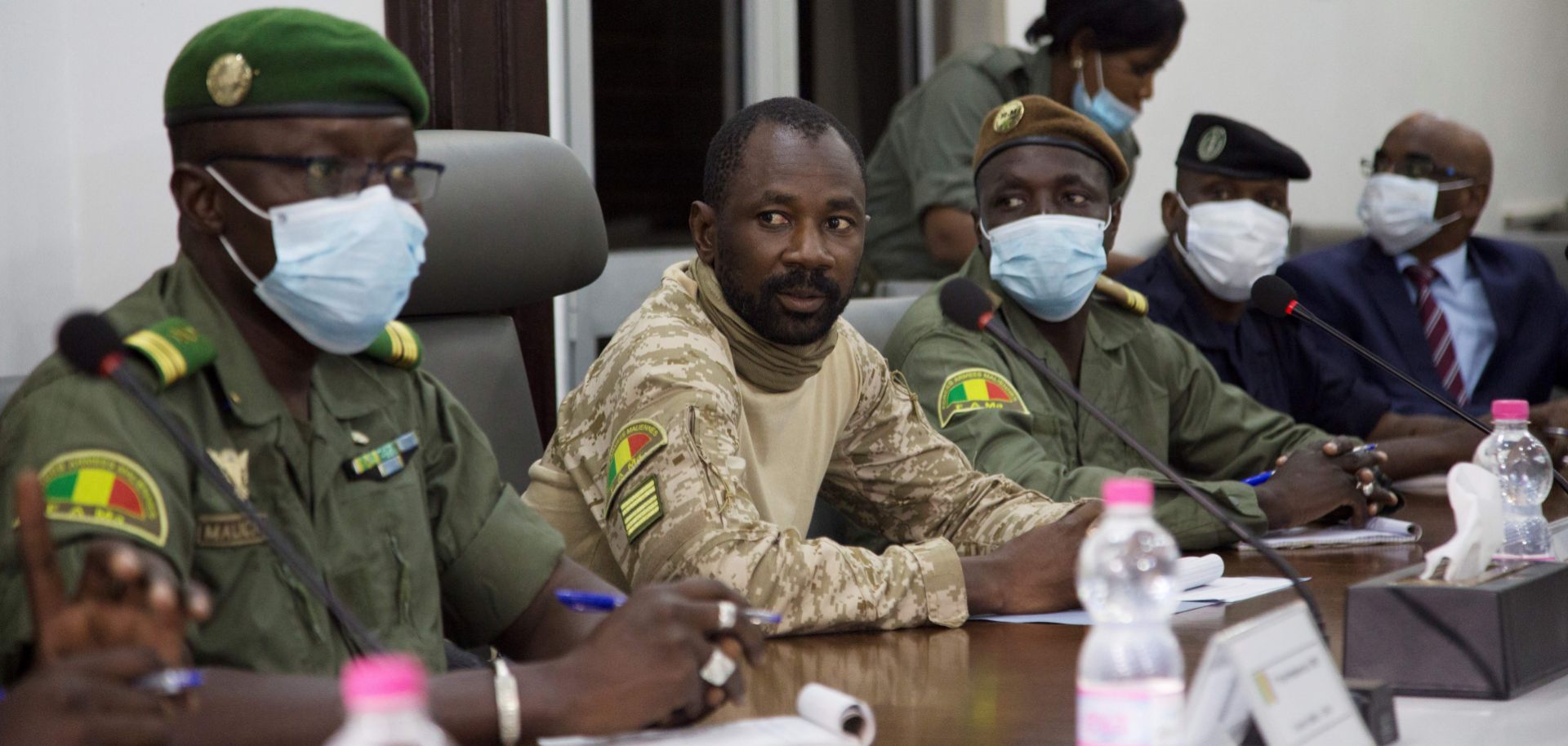
Colonel Assimi Goita (center) sits between other Malian military leaders during a meeting with an Economic Community of West African States (ECOWAS) delegation on Aug. 22, 2020. Goita seized power for the second time in a May 2021 coup.
Mali’s alienation from the Economic Community of West African States (ECOWAS) will likely deepen its reliance on Russia, which will further reduce the likelihood of imminent democratic elections, increase economic hardship and pose risks to ongoing counterterrorism operations in the country. Following Malian officials’ announcement that elections scheduled for February 2022 will be delayed by five years, the Economic Community of West African States (ECOWAS) convened in Accra, Ghana, on Jan. 9 in an emergency session. The regional bloc subsequently announced a slew of sanctions against Mali, including closing borders, severing diplomatic ties, freezing state assets in ECOWAS commercial banks, suspending all non-essential financial transactions and recalling ambassadors from Bamako. A spokesperson for the Malian interim President said that in response, Mali will close its land borders with neighboring ECOWAS states (Burkina Faso, Ivory Coast, Guinea, Niger and Senegal). ECOWAS officials said that they will not lift sanctions unless Malian officials propose an acceptable election timetable.
- The West African Economic and Monetary Union instructed all banks under its umbrella to suspend Mali with immediate effect. As of Jan. 10, the United States and the European Union had not imposed additional sanctions over the election delay.
- Under previous sanctions regimes imposed on Mali after the 2020 coup, ECOWAS suspended the country’s membership in the bloc and also froze assets of transitional authority, imposed travel bans, closed borders and halted financial flows into Mal. Mali’s imports from its two top trade partners, Senegal and Ivory Coast, declined sharply as a result of the measures, leading to fuel and medical shortages in the country.
The ECOWAS sanctions will exacerbate Mali’s isolation from regional states and France amid the ongoing drawdown of French troops from the country and the recent deployment of Russian troops to Timbuktu. A few weeks after France withdrew from its last military base in Mali, located in Timbuktu, a Malian military spokesperson confirmed the presence of Russian troops on Jan. 6. Officials have not given details on the number of Russian security forces present at the base in Timbuktu, but said they were involved in on-site training for recently acquired Russian military equipment. Regional isolation as a result of the sanctions will accelerate Mali’s shift from relying on France to relying on Russia for military and security support, as Moscow does not hold the same expectations for elections and democratic governance as ECOWAS or Paris.
- The Malian government first confirmed the presence of Russian troops in the country on Dec. 25, but Jan. 6 marked the first confirmation of such troops in Timbuktu.
While the Malian transitional government could still propose an amended election timetable with the aim of reversing the ECOWAS sanctions, its current trajectory will lead to an absence of elections, economic hardship and high risks to regional counterterrorism operations. The introduction of ECOWAS sanctions, in addition to reduced reliance on France for security support, will significantly reduce pressure on the Malian transitional government to hold democratic elections by severely weakening the relationships that provided incentives to do so. Russian influence will very likely aim to promote increased stability independent of a democratic transition, although capacity constraints and longstanding insurgency threats will likely prevent success. In Mali, the added economic distress brought on by the ECOWAS sanctions will compound popular discontent with the continuation of the transitional authority beyond its original mandate, which will likely result in decreased imports and subsequent shortages of basic goods. No longer constrained by partnerships with regional democracies or France, Malian President Assimi Goita — who seized power for the second time in a May 2021 coup — will have little incentive not to respond to unrest with security crackdowns. Political and economic backsliding will likely also increase risks to counterterrorism operations in Mali. If the Russian military presence expands to include the introduction of Russian paramilitary groups like Wagner, and should those groups deploy indiscriminate force against civilians (which Wagner has a reputation of doing in countries like the Central African Republic), it could drive militant recruitment and undermine existing counter-insurgency missions in Mali and the region as a whole.
- Mali’s top imports are refined petroleum products, cotton and packaged medicaments (medical products used to treat or prevent disease).
- The United Nations High Commissioner for Human Rights released a report on Oct. 27 detailing abuses committed by Wagner security forces in the Central African Republic, including arbitrary detention, torture, disappearances, summary executions and sexual violence.
