
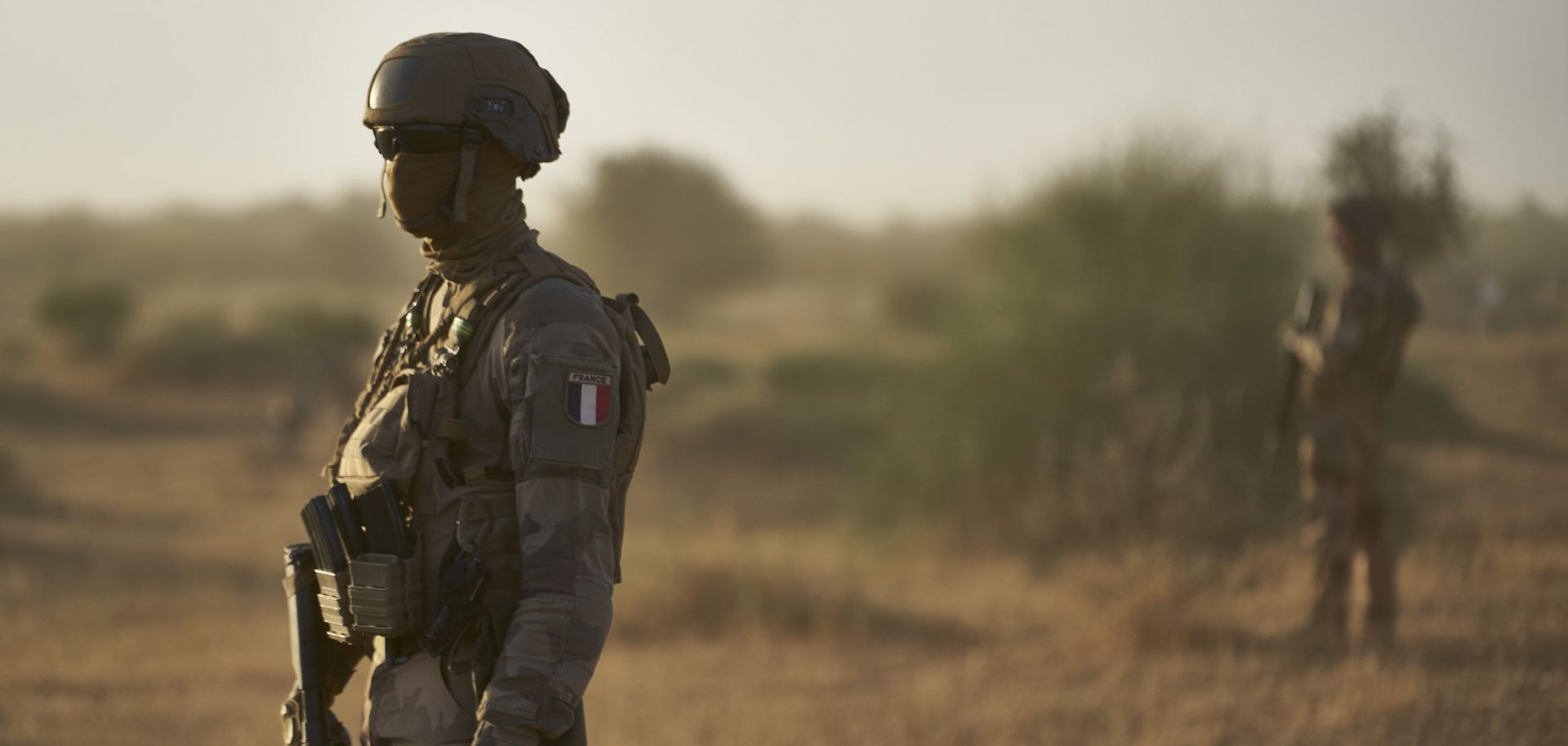
French soldiers monitor an area along Burkina Faso’s border with Mali and Niger on Nov. 10, 2019.
France is seeking to reduce its military commitments in the Sahel region of sub-Saharan Africa, but its failure to instill political stability will impede Paris’ ability to do so without worsening the region’s deteriorating security situation. France hopes to shift the military burden to regional countries and other European countries. Any reduction in French operations, however, will risk aiding the geographic expansion of militants in the Sahel by damaging counterterrorism efforts in the region. France’s desire to develop an exit strategy may eventually give Mali and Burkina Faso the political cover that they need to entertain negotiations with certain jihadist and insurgent elements.
After weeks of speculation that he would announce a drawdown of troops in the Sahel, French President Emmanual Macron announced during the Feb. 15-16 Group of Five (G5) Sahel Force summit that he would hold off on making a decision until after the summer. Macron’s timing is probably linked to policy reviews ahead of next year’s presidential election. French popular support for the intervention in the Sahel — now in its ninth year — fell below 50% for the first time in a January poll conducted by the French Institute of Public Opinion.
- The leader of France’s National Rally party and Macron’s likely 2022 challenger, Marine Le Pen, has also criticized Macron’s Sahel strategy and has called for France to more aggressively shift the burden onto local and European counterparts.
Macron’s decision follows a year of successful regional operations against jihadist leaders, suggesting that he wishes to capitalize on that success to reorient French commitments. In January 2020, France and the countries in the G5 Sahel Force promised more resources against insurgent and jihadist groups, prompting France to commit an additional 600 troops to the region. The new deployments and resources resulted in increased airstrikes and other operations against militants active in the Sahel over the past year. Macron announced in January 2021 that “results obtained by our forces in the Sahel...will allow us to adjust our effort,” fueling speculation that a drawdown of at least the new troops deployed in February 2020 was possible.
- French forces killed the leader of al Qaeda in the Maghreb (AQIM) in June, as well as a senior leader in al Qaeda’s Sahel branch Jama'at Nusrat al-Islam wal-Muslimin (JNIM) in November.
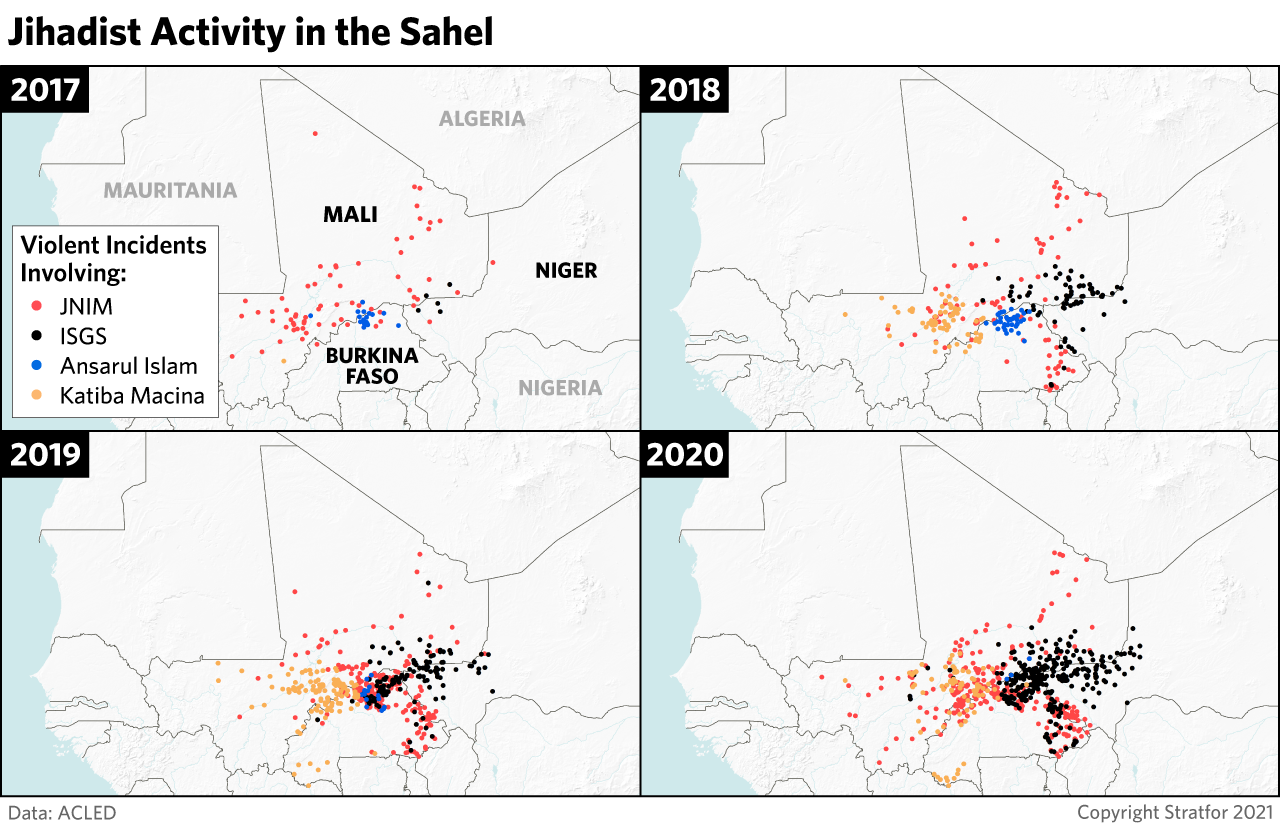
But success against jihadist targets has not resulted in a reduction of the communal violence, creating additional security challenges for other peacekeeping missions in the Sahel. France’s counterterrorism operations preclude action to address intercommunal violence, which the region’s weak local governments have struggled to address amid rising militia activity. As local forces take over more military operations, they will continue — just as they have over the last year — to exacerbate communal tensions and lead to more violence.
- According to data compiled by the Armed Conflict Location & Event Data Project (ACLED, Sahel countries saw between 180 and 193 attacks against civilians in each quarter of 2020 after the February increase in France’s deployments. In 2019, there were between 158 and 200 attacks each quarter.
- Katiba Macina, a group under JNIM, is expanding their footprint outside its traditional base of operations in central Mali. The group now has an active cell in southern Burkina Faso along the Burkinabe-Ivorian border and is attempting to move into western Mali. Katiba Macina’s expansion likely prompted the head of France’s Directorate-General for External Security (DGSE) to announce in February that JNIM had been holding meetings to plan an expansion into coastal West Africa.
- Security in the Liptako Gourma region — which encompasses the tri-border area of Burkina Faso, Mali and Niger — remains fragile. In February, G5 Sahel participant Chad announced that it was sending 1000 troops to the region.
- The U.N. Multidimensional Integrated Stabilization Mission in Mali (MINUSMA) is now also conducting operations in central Mali in addition to the north. MINUSMA's overall resources and deployments, however, have not increased and there are no similar U.N. missions in other Sahel countries.
Growing frustration and resentment of French deployments and the Sahel’s deteriorating security are weakening France’s broader Sahel stabilization strategy by reducing popular support for French-backed governments in the region. The Sahel’s chronic instability stems from weak governance and negligence toward several marginalized communities. Indeed, most of the region’s jihadist groups, including JNIM, have grown out of insurgent movements that are ethnically or regionally based. France’s intervention in the region has been criticized for overly focusing on counterterrorism efforts and not on backing more inclusive governments that can ensure the delivery of basic goods to their populations with increased institutional capacity outside their militaries. The continued lack of effective governance, transparency and accountability in Niger, Mali and Burkina Faso has also undermined stabilization efforts in more rural areas, like the Liptako Gourma region.
- Macron has called for a “civil surge” in Niger, Mali and Burkina Faso to boost governance, education and the delivery of basic services. But financial, geographic and security constraints continue to impede such efforts.
- In Mali, complaints about France’s role in the country were a key focus of the protests that ultimately ousted President Ibrahim Keita in August, resulting in the country’s second coup in the last decade. The ongoing protest movement is now becoming increasingly at odds with Mali’s transitional government as well over the dominance of the military.
- Burkina Faso was also unable to hold general elections last year due to security concerns across the country.
Paris seeks to address these dynamics by shifting some of its terrorism commitments in Mali to other European countries under the France-led Takuba Task Force, but support for this initiative will probably be tepid. Additional European deployments to aid the Malian Army would also enable France to refocus its regional counterterrorism efforts to more dynamic growth spots for jihadist activity, particularly the Liptako Gourma region. But as other countries get more directly involved, their troops will find themselves in harm’s way, which could lead to some being killed in action. This would risk weakening the long-term political resolve of European countries' commitment to the Takuba Task Force, even if it helps pave the way for France itself to reduce its deployment.
- The Takuba Task Force includes 11 European countries aimed at aiding the Malian Armed Forces in coordination with regional partners and other international actors. Since the military task force was first announced in 2020, Swedish and Estonian forces have arrived in Mali, with other European contingents set to follow. The task force has a mandate of three years.
Amid jihadists’ expanding geographic presence, the shift in France’s strategy will raise the risk of increased militant activity in West Africa. Since France’s 2013 intervention, jihadist activity in northern Mali has slowly but surely continued to spread southward, which will likely continue. But while the risk in West Africa is rising, countries like Senegal, Ivory Coast, Benin, Ghana and Togo are unlikely to experience the near-constant threat of violence that their northern neighbors are seeing. Infrequent attacks, however, are possible.
- In June, militants believed to be members of JNIM/Katiba Macina also attacked an Ivorian border post, which would mark the first terrorist attack in Ivory Coast since 2016.
Regional governments seeking to curb rising violence will probably enter negotiations with certain jihadist elements, which France may support as part of a broader exit strategy. But such talks would unlikely reduce violence, given the fractured nature of the insurgent landscape and residual institutional weaknesses among Sahelian governments. The Malian government has been trying to open up talks with certain elements of jihadist groups for more than a year. But France has so far opposed such talks and, in some cases, its counterterrorism efforts have undermined the possibility of local government outreach. Burkina Faso has also proposed talks, although its policy has not progressed as far as Mali’s.
- In February, Mali’s interim prime minister unveiled an action plan for the transitional government that would create a body tasked specifically with negotiating with jihadists. That same month, Burkina Faso’s prime minister said that his government was also open to talks with “those responsible for terrorist attacks.”
- In early 2020, JNIM said that it would entertain potential talks with Mali, but only if foreign forces were expelled, which is currently a non-starter. JNIM’s Tuareg and Fulani factions that have grown out of local insurgencies are likely to be more receptive to negotiations compared with other groups, like the Islamic State in the Greater Sahara, which have not even mentioned a willingness to enter such talks.
- France’s November killing of Bah ag Moussa, however, will make coordinating talks between Mali and JNIM’s Tuareg faction more difficult. Ag Moussa was a high-ranking military leader in JNIM as well as a high-profile Tuareg nationalist who defected from the Malian military in 2012. His death will thus almost certainly complicate Bamako and Paris’ outreach to Tuareg groups of all sorts, not just jihadists.
A dramatic increase in terrorist activity and/or the collapse of another government in the Sahel could eventually force France’s current or future government to scale back up its military commitments in the region. Paris’ support of governments in power in the Sahel is unlikely to change anytime soon, meaning the high levels of political turmoil that saw coups in Niger, Mali and Burkina Faso over the last 11 years are unlikely to change either. As France’s broader stabilization strategy continues to create the conditions for communal, insurgent and jihadist violence, a reduction in France’s deployments could thus very well result in those groups expanding and once again becoming a threat that draws Paris back into Niger, Mali and Burkina Faso.
