
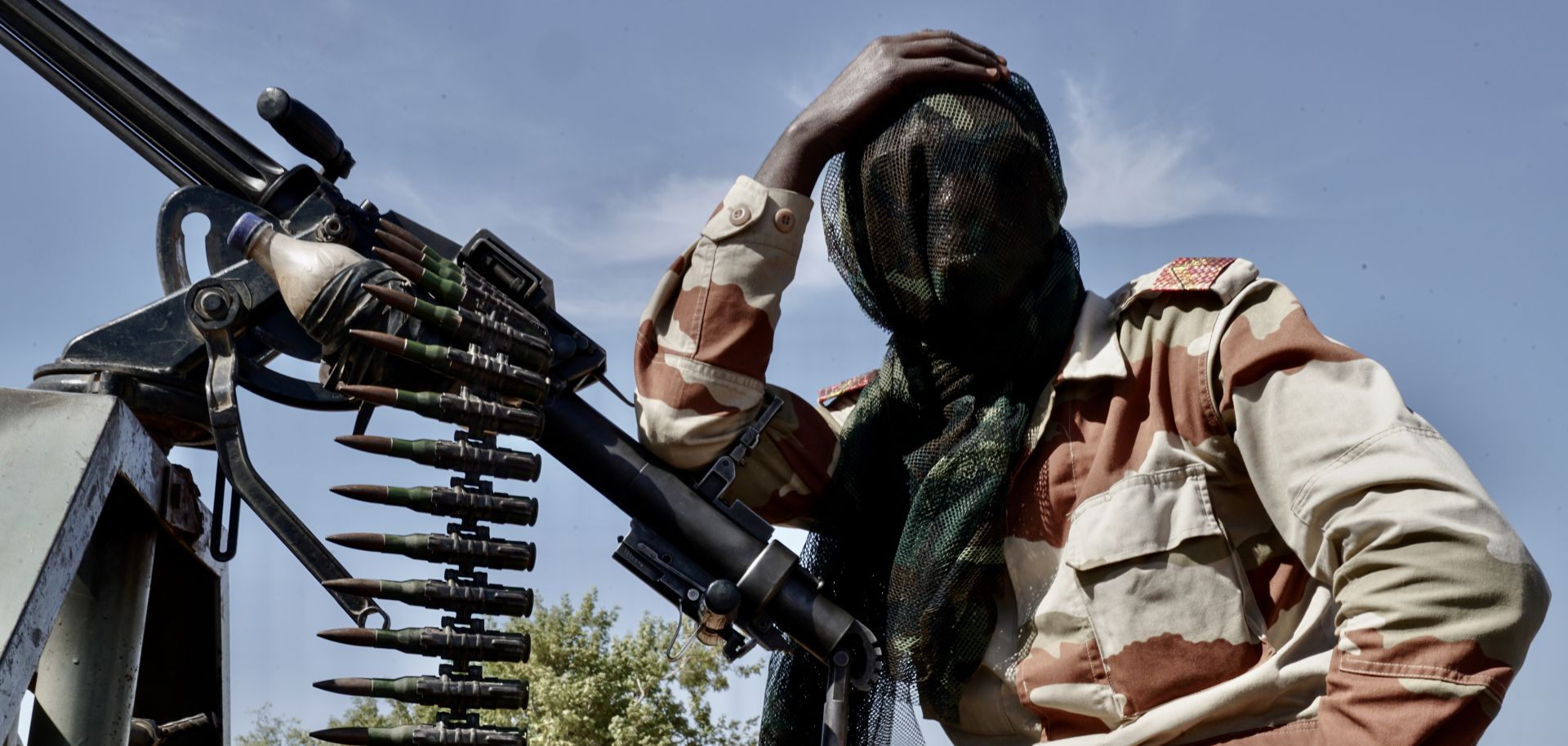
A soldier keeps guard near the Nigerian border in Maradi, Niger.
Editor's Note: This security-focused assessment is one of many such analyses found at Stratfor Threat Lens, a unique protective intelligence product designed with corporate security leaders in mind. Threat Lens enables industry professionals and organizations to anticipate, identify, measure and mitigate emerging threats to people, assets and intellectual property the world over. Threat Lens is the only unified solution that analyzes and forecasts security risk from a holistic perspective, bringing all the most relevant global insights into a single, interactive threat dashboard.
Recent political upheaval in Mali and the Ivory Coast threatens to compound intensifying instability in the Sahel and could spill over into other West African countries.
- In Mali, large-scale protests in Bamako began in opposition to corruption, controversial election results and the government's inability to quell the resurgence of militant activity. These dramatically escalated following a deadly crackdown by security forces that prompted the opposition to demand the resignation of President Ibrahim Boubacar Keïta. Though protesters' demands remain unmet, demonstrations have ebbed and flowed.
- In Burkina Faso, militant activity began spilling over from Mali in 2017 to northern parts of the country but soon spread throughout Burkina Faso, destabilizing the country and creating a new base for militant attacks into neighboring countries like Benin and the Ivory Coast. Attacks, kidnappings and other insurgency operations have killed thousands, while the U.N. High Commissioner for Refugees said the 921,000 displaced persons in Burkina Faso represent a 92 percent increase since 2019.
- In Niger, militant attacks killed more people in the first six months of 2020 than in all of 2019. The country faces spillover violence from two fronts: from insurgents based in Mali and Burkina Faso in its west, and from insurgents based in Nigeria to its southeast.
- The sudden death of Amadou Gon Coulibaly, the Ivory Coast's prime minister and the ruling coalition's presidential candidate, increased uncertainty about upcoming elections in October and decreased the chances it would experience its first-ever democratic transition of power without violence.
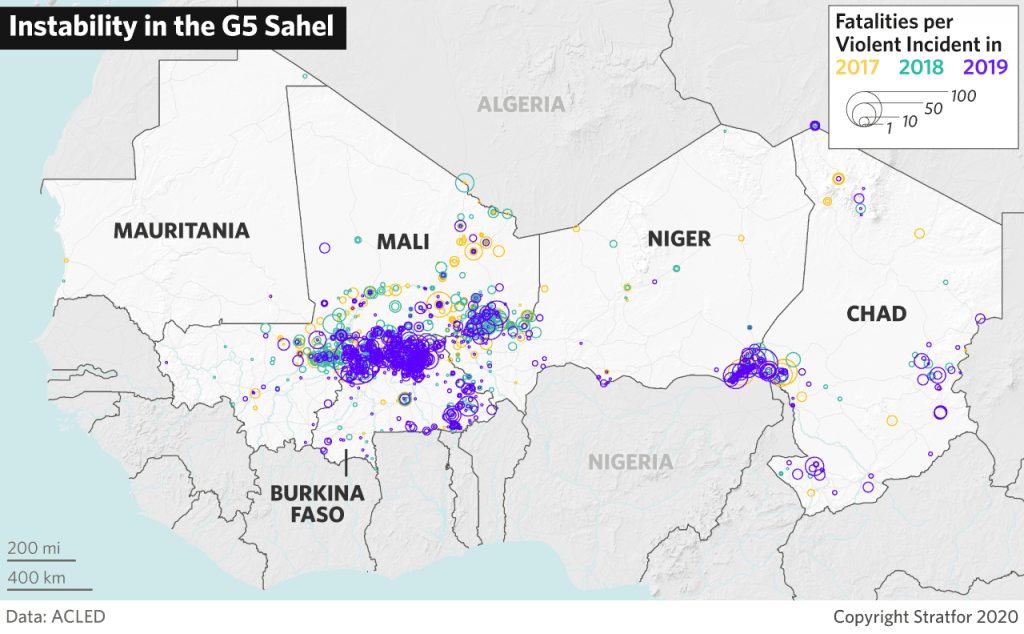
Structural weaknesses in these governments in the Sahel will leave them vulnerable to bouts of political unrest, insurgent and terrorist activity, and other disruptions. Endemic corruption, abuses committed by various security forces and the COVID-19 pandemic have compounded the adverse impacts of the insurgency.
- Transparency International has ranked these governments low; out of 180 countries on the Corruption Perceptions Index, Mali ranked 130, Burkina Faso 85 and Niger 120. These governments have shown no willingness or ability to implement structural reforms to solve these problems or address unrest in the near future.
- Abuses by government security forces or allied militias in Mali and Niger against civilians further undermine the trust of local populations in their governments. In June, Amnesty International accused soldiers in Mali, Burkina Faso and Niger of killing or disappearing over 200 people, while Human Rights Watch warned July 1 that jihadist groups use these atrocities as a recruiting tool.
- The outbreak of the COVID-19 pandemic undermined the effectiveness of security forces by diverting time, manpower and resources from fighting these groups and toward containing the virus. The U.N. peacekeeping chief warned June 5 that militants were exploiting the impact of COVID-19 to expand the scale and scope of their attacks.
As instability in the Sahel continues to grow, jihadist groups will further undermine the security of these countries and pose an increasing threat to coastal West African countries. Several cross-border attacks into coastal West Africa and precautionary measures taken by authorities underscore the risk that militant activity, which first spilled over from Mali into Burkina Faso, will spill over even more. The Armed Conflict Location and Event Data Project indicated that the number of violent events in the Sahel linked to these militants ballooned from 147 in mid-2017 to 999 in mid-2020. The ever-worsening situation will pose a potential threat to personnel and facilities in these countries, while successful attacks will undermine economic outlooks already clouded by COVID-19.
- Jihadist militants have previously managed to attack economic hubs in coastal West Africa, and have called for additional attacks. The most notable example came when al Qaeda in the Islamic Maghreb attacked the Grand-Bassam Resort in the Ivory Coast in 2016, an attack that severely undermined that country's tourism industry.
- The primary threat will remain along these country's northern borders given the proximity to militant basis in Burkina Faso and Mali. There have already been rare spillover attacks in Benin (including a May 2019 incident in which two French tourists were kidnapped) as well as the Ivory Coast, which in June 2020 suffered its first jihadist-linked attack since 2016.
- Ivory Coast, which may be more vulnerable due to recent political upheaval, established a military zone on its northern border with Burkina Faso, while Senegal built a new military camp on its border with Mali. Anecdotal evidence suggests that countries like Ghana, Togo and Benin have also ramped up security measures along their northern borders.
These groups pose a substantial threat to countries in the region, but do not yet pose a threat of transnational attacks against countries such as the United States, Europe or the Middle East. There are multiple reasons the Sahel will not become another hub for transnational attacks similar to Syria or Iraq, while the groups themselves have not shown the intent or capability to launch attacks against targets farther afield.
- The Sahel does not have the same historic and religious significance to draw the levels of foreign fighters from Europe, the Middle East and elsewhere Syria and Iraq attracted in the mid-2010s during the height of the Islamic State's territorial control. This deprives the groups of foreign fighters who can connect them to networks in their host countries to carry out such attacks.
- While the COVID-19 pandemic has not stopped the groups from conducting operations in the Sahel, restrictions on movement due to COVID-19 have constrained their activities outside the region.
- While nominally under the Islamic State and al Qaeda global banners, the militant groups remain focused on conducting operations, establishing connections and establishing dominance in the Sahel rather than projecting power and influence elsewhere — something likely to remain the case for the foreseeable future.
