
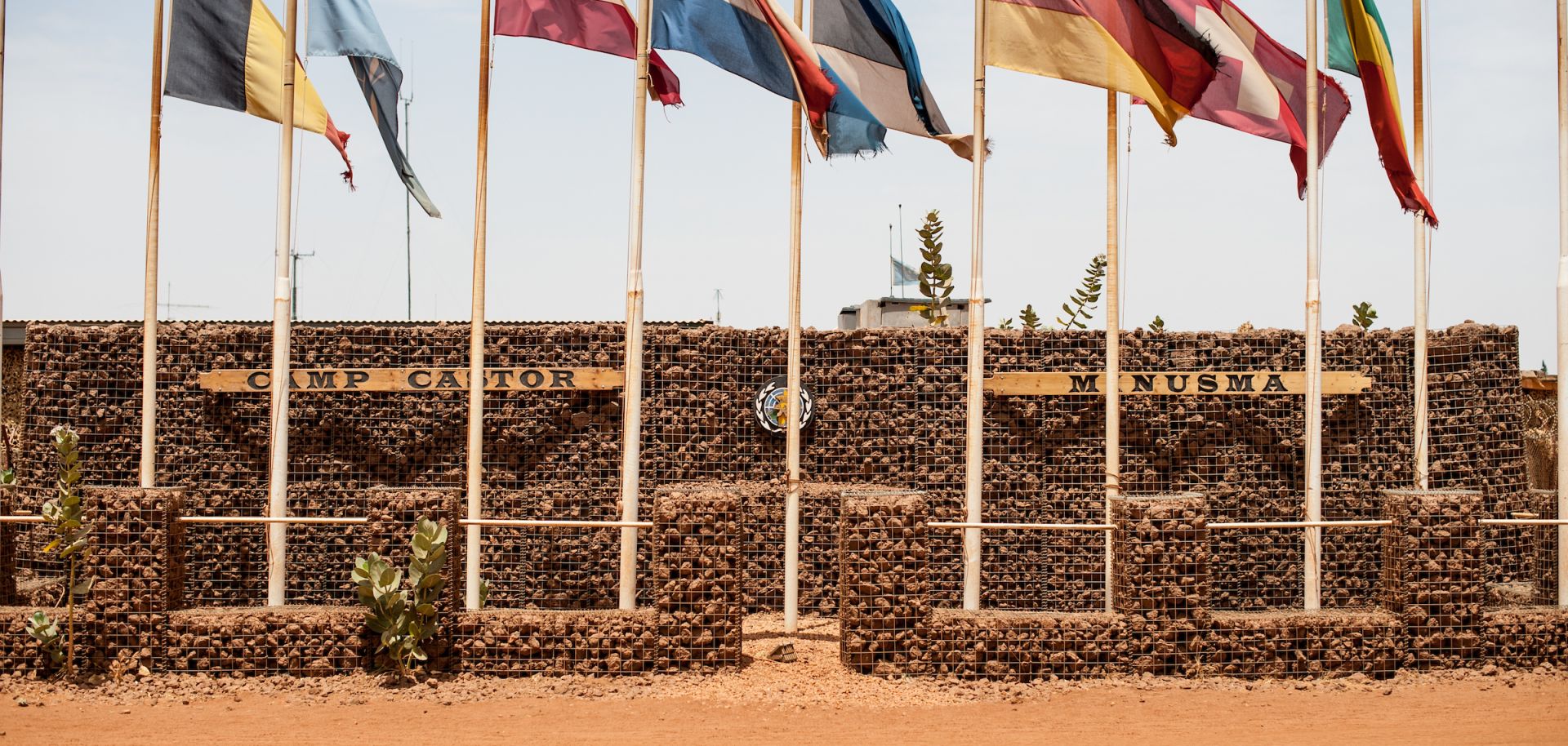
Western efforts in the Sahel, like the U.N. mission in Mali, are unlikely to wane anytime soon, but neither are they likely to expand in the face of growing militancy. This will open opportunities for Russia to expand its footprint in the Sahel.
Editor's Note: This assessment is part of a series of analyses supporting Stratfor's 2020 Annual Forecast. These assessments are designed to provide more context and in-depth analysis of key developments over the next quarter and throughout the year.
Western reluctance to increase its commitment to security in the militancy-plagued Sahel creates opportunities for Russia there. As part of its broader diplomatic offensive in Africa, Moscow already has been working to upgrade its military relationship with the traditionally French-aligned states of the Sahel, former colonies of France. For Russia, a greater security role in the Sahel, a region of West Africa at the southern end of the Sahara, could mean supplying military equipment and services — such as the deployment of private military forces or training by the Russian military proper — in exchange for minerals extracted locally.
But while Moscow can offer local governments supplementary capabilities in the form of arms, training and direct military support, Russia is unlikely to supplant the role played by the larger, more deeply rooted French-led Western efforts in the region. And depending on how far any new Russian involvement extends, its new activities could prove difficult to coordinate with existing Western security operations.
Sahel Militancy and Possible Russian Intervention
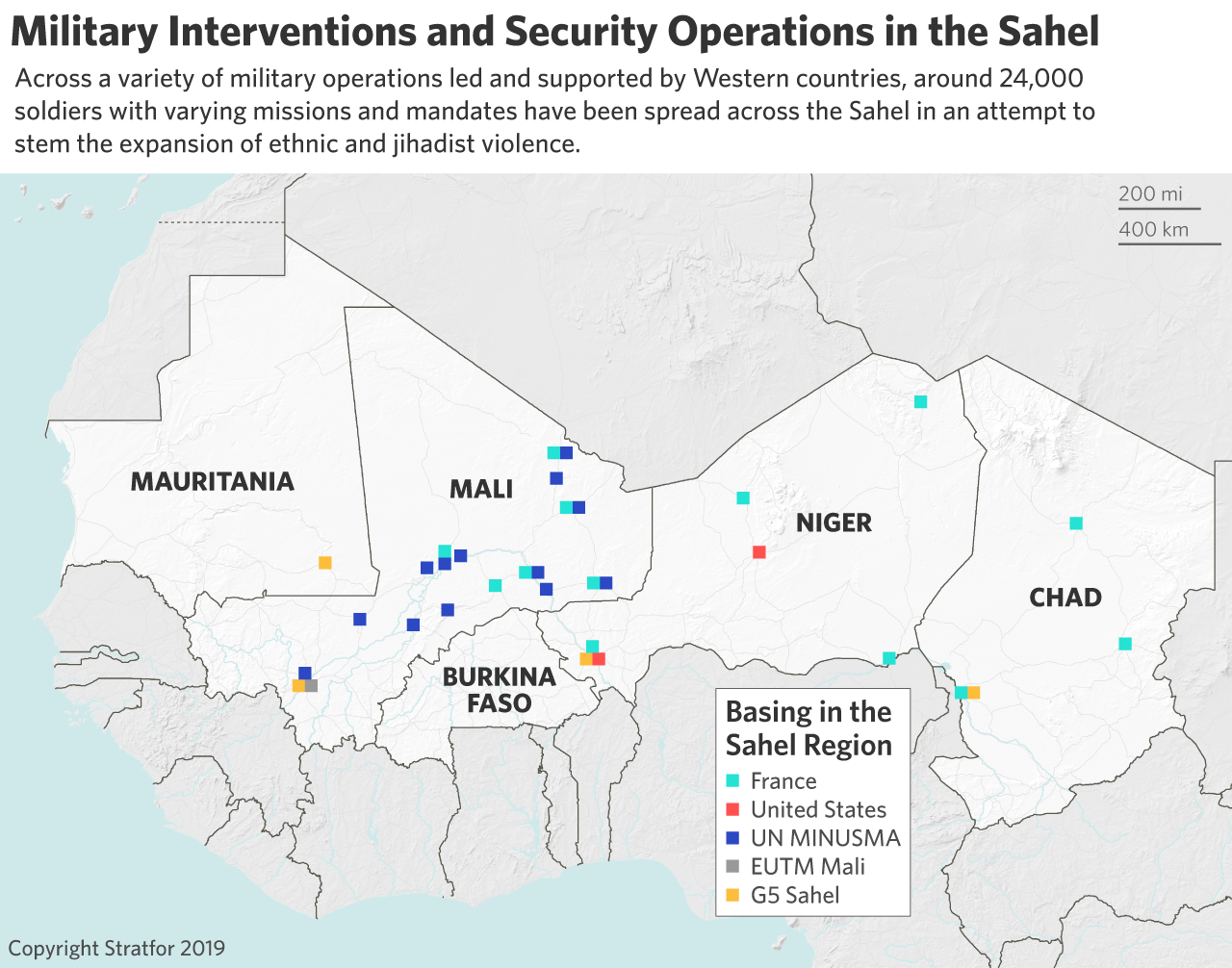
Western efforts spearheaded by the French Operation Barkhane have failed to stop the expansion of ethnic and jihadist militancy in the Sahel. International and regional coalitions have sought to reestablish governance in rural areas of the Sahel through deploying nearly 24,000 troops in various missions across the region, including Operation Barkhane, the U.N. Multidimensional Integrated Stabilization Mission in Mali (MINUSMA), the G5 Sahel force, the EU Training Mission in Mali and U.S. counterterrorism efforts. While these Western and Western-backed efforts in the Sahel are unlikely to be scaled back significantly in the immediate future, neither are they likely to be significantly boosted in the near term.
And without additional efforts, militant activity in Sahel won't be reduced — in fact, it will probably increase, like it did in 2019. The lack of progress against militants will enhance tensions between foreign intervening powers and frustrated local governments. Opposition politicians, some politicians from ruling parties and a scattering of other civilian organizations in countries like Mali and Niger want French forces to leave, while French President Emmanuel Macron has pressured local governments to do more following the death of 13 French soldiers in Mali on Nov. 25.
Russia will try to exploit the situation. Moscow has recently sought closer security ties with a number of African states, has existing military cooperation agreements with several key countries in the Sahel and has expressed its willingness to support the locals' fight against militancy. But the extent of Russian engagement will depend upon how much access local governments will give it. Russia's role in the Sahel would likely not amount to a show of force on the scale of current Western operations there. Instead, a much more limited, pragmatic approach would better suit Moscow's needs. Initial Russian involvement would take the form of increased collaboration, most likely consisting of training local armed forces (competing with existing EU, French and U.S. efforts), and sales of military equipment. As in other theaters, such activity — or more direct engagement in the conflict — could include the deployment of Russian private military forces such as the well-known Wagner Group.
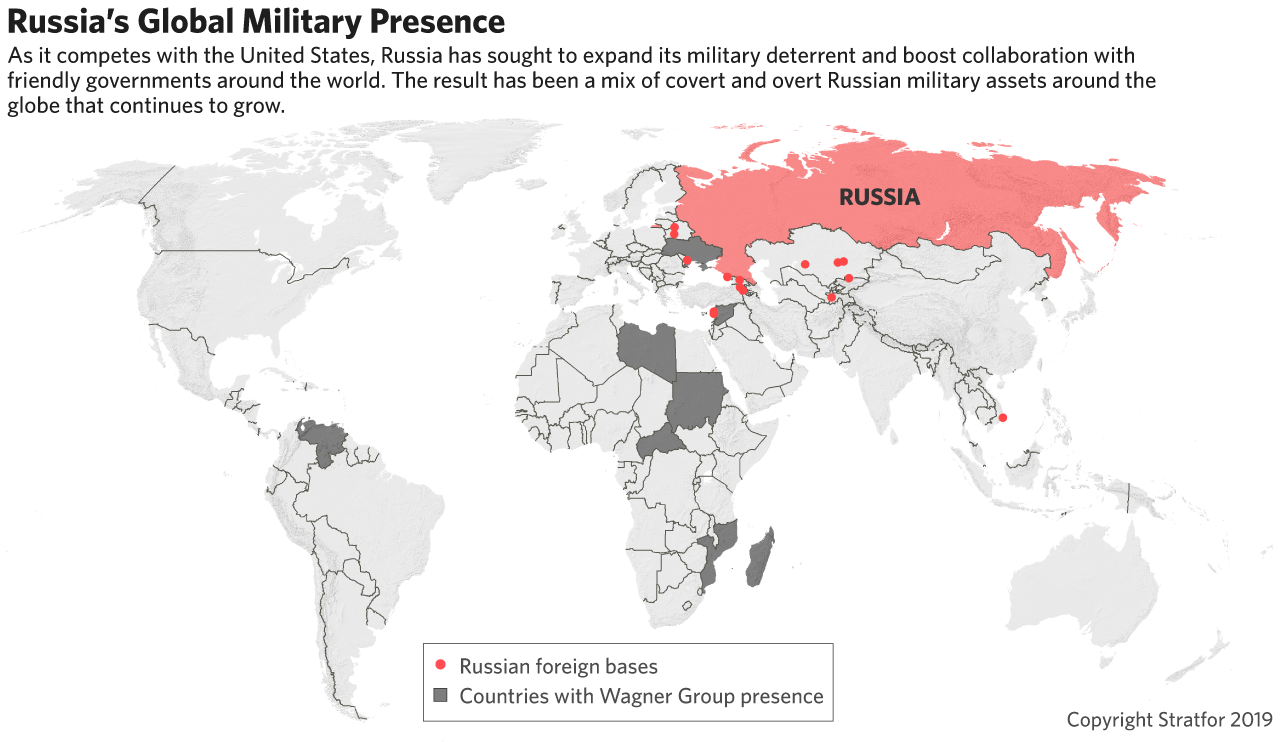
Moscow would likely seek a creative way to fund such operations, like those it has adopted elsewhere, with Russian weaponry, training and combat services perhaps offered in exchange for access to mineral resources. Such deals fit the foreign policy strategy Russia has developed due to Western sanctions, which have left the Russian economy in dire need of new markets.
For Moscow, entry into the Sahel thus allows it to pull more African states into its sphere of influence and could open opportunities for its mining industry in a region with known gold and uranium reserves. While the Sahel states probably won't prove an enormous source of wealth for Russia, they would still provide some financial support to its defense industry, an important Russian aim. Russian entry into the Sahel would also put European and U.S. relationships in that region under pressure, something Moscow could leverage in its broader geopolitical competition with the West.
Paving the Way for a Russian Role
While Russian military personnel, whether overt or covert, have yet to appear in the Sahel, Moscow has been working on agreements and business relationships paving the way for their arrival with several local governments. For example, Mali and Russia signed a military cooperation agreement this year that envisions the training of military specialists along with support in peacekeeping operations in the fight against terrorism. Russian Defense Minister Sergei Shoigu has stated that Russia is willing to contribute to the normalization of the security situation in Mali, though exactly how has not been revealed. A closer Russian military relationship with Bamako is not unprecedented: Following the country's independence in 1960, Mali initially gravitated toward the Soviet sphere of influence. It even hosted Russian strategic bombers before a coup in 1968 brought a new government to power that aligned Mali more closely with France.
More recently, Russia has been providing the Malian government with arms, though an important sale of combat helicopters has been hung up since 2016 over payment issues. In neighboring Burkina Faso, a similar military cooperation agreement was reached in 2018. So far, no actual training of the Burkinabe military by Russian forces has occurred, but Russia does offer training in many other fields. Thousands of Burkinabe students have enjoyed higher education in Russia under previous agreements in agriculture, economics and education. These ties were explored further during the 2019 Russia-Africa summit in Sochi, and could well yield actual military training under a broader regional effort by Moscow. Burkina Faso also hosts Russian mining companies active in the country's gold sector, which accounts for about 75 percent of the West African country's total exports. These mines, operated by Russia's Nordgold, are in areas that have become increasingly vulnerable to jihadist militants, which could give Russia further incentive to deploy a private military presence in the country.
Russia has also been expanding its mining interests in Niger, where Russia's Rosatom appears to be seeking a role in uranium mining as the French company Orano (formerly Areva) is seeking to reduce its activities there. Russia and Niger have also closely cooperated on a number of other projects, including the construction of an oil pipeline and railways, as well as on the recently announced sale of 12 Mi-35 combat helicopters. As Niamey feels the pressure from both the Boko Haram militancy in northeastern Nigeria and the expansion of jihadist militants from Mali, it has good reason to seek more benefits from its 2016 military cooperation agreement with Moscow. But since Niger is also working closely with the French and U.S. military, as in other Sahel countries, bringing in Russia will be complicated.
What Sahel Governments Want
For Sahel governments, Russian military support could provide additional military capacity, but it is unlikely to be any substitute for the current Western interventions. Still, a Russian role would help Sahel governments avoid excessive dependence on France and its allies, something they fear given their history of being subordinated to French interests.
The ideal outcome for Sahel governments would involve assistance from both Russian and Western forces. There is some precedent for such an outcome in one of the first Russian military forays into Africa under its Africa strategy: In the Central African Republic, Russia has deployed private military contractors from the Wagner Group to train the country's armed forces and protect its mining interests. These forces have gained a key role advising and protecting the presidency and coordinating between the government and rebel forces. A European Union mission to train government forces, a 10,000-strong U.N. peacekeeping force (MINUSCA) and a unilateral intervention by French military forces at Bangui airport all share this space with the Russians.
The ability of Western and Russian efforts to coexist in the Sahel will largely depend upon the scale of the Russian role. If Russian forces are primarily training, advising and equipping local armed forces, coexistence would be less challenging. But if the Russian role were to expand to combat operations against ethnic and jihadist militants, coordinating its activities with French and other Western forces would become much more complicated. This reality will limit the extent to which local governments can allow Russia to enter the Sahel.
