
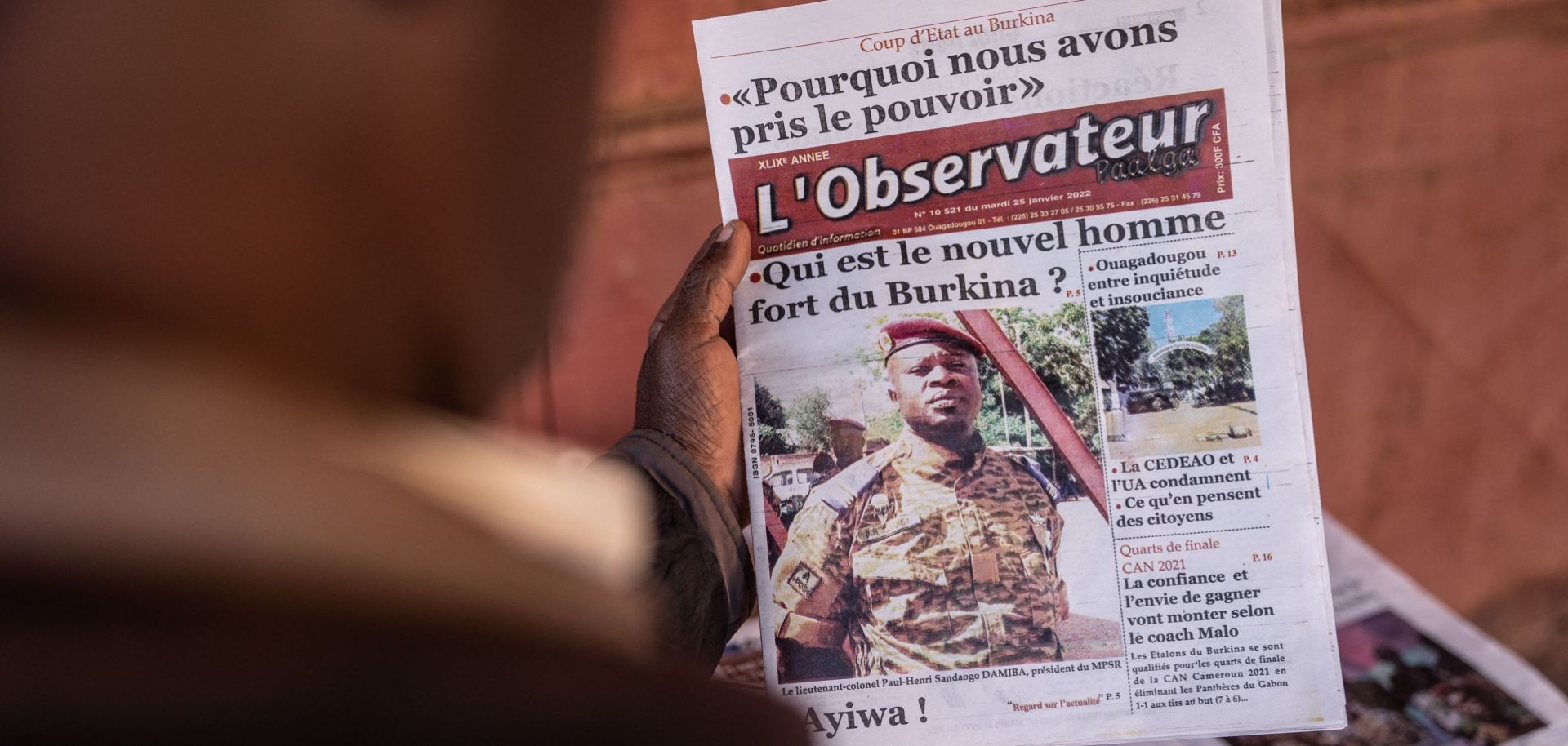
A photo of Lt. Col. Paul Henri Sandaogo Damiba, leader of Burkina Faso’s recent military coup, is seen on the front page of a newspaper in Ouagadougou on Jan. 25, 2022.
West Africa’s latest coup risks further eroding the security situation in northern Burkina Faso and may prompt international sanctions that would damage the country's trade-reliant economy. In a televised address on Jan. 24, members of the Burkinabe military announced they had deposed President Roch Marc Christian Kabore following heavy gunfire outside the presidential residence and reports that soldiers had detained the president at a military camp. In addition to ousting Kabore, military authorities suspended Burkina Faso’s constitution, dissolved the government and the National Assembly, and closed the West African country’s borders. The leader of the coup is Lt. Col. Paul Henri Sandaogo Damiba, who presented himself in the broadcast announcement as the president of a group calling itself the "Patriotic Movement for Safeguard and Restoration" (or MPSR, in its French-language acronym), which Damiba said includes all sections of the army. An MPSR spokesperson said the coup was necessary due to the Kabore administration’s alleged mishandling of the worsening security environment in northern Burkina Faso, including providing insufficient support to Burkinabe soldiers fighting Islamist militants in the region. MPSR said it would propose a timeline for a return to constitutional rule after consulting “various sections of the nation.” More than 1,000 people gathered in the country’s capital of Ouagadougou on Jan. 25 in support of the coup.
- MPSR presented a letter of resignation allegedly signed by Kabore, though the deposed president’s whereabouts remain unknown. The last known public communication from Kabore is a Twitter message he posted the evening of Jan. 23 in which he congratulated Burkina Faso’s national soccer team on a major win.
The military coup follows months of rising public anger with the Kabore government over its perceived mismanagement of Burkina Faso’s ongoing security crisis. The Burkinabe military has been struggling to quell increasing Islamist militant activity in the north, where insurgents have launched several mass attacks and have seized large swaths of territory. Before the Jan. 24 coup, Kabore faced repeated calls to step down. He attempted to pacify these calls by firing the prime minister in November, which then triggered the dissolution of the government in November. But anti-government protests nonetheless persisted through January.
- The Kabore administration arrested eleven soldiers on Jan. 12 for allegedly plotting a coup. Security forces also arrested dozens of protesters on Jan. 22 who participated in a banned demonstration against the government.
- Jihadist militants attacked a Burkinabe outpost in Inata on Nov. 14, killing 49 military policemen and four civilians. Following the massacre, reports emerged that the troops had been without food rations for two weeks, further inflaming public anger.
- Since 2015, armed groups have killed an estimated 2,000 people in Burkina Faso and displaced approximately 1.4 million.
The coup — which is West Africa’s fourth in the past 18 months — also comes despite strong international pressure to maintain constitutional rule. The Economic Community of West African States (ECOWAS), the African Union, the United Nations and the G5 Group of Sahel Nations have all condemned the military takeover in Burkina Faso and have demanded that Kabore be released. Following the recent military takeover in neighboring Guinea and the two coups in Mali, these regional and international bodies have called on West African leaders to handle governance challenges via constitutionally sanctioned processes.
- On Jan. 9, ECOWAS severed its diplomatic ties with Mali after the country’s military leaders (who seized power for the second time in a May 2021 coup) announced a five-year delay to elections originally scheduled for February 2022. Mali’s state assets in ECOWAS commercial banks have also been frozen, along with all of the country’s non-essential financial transactions with the bloc.
- ECOWAS also suspended Guinea’s membership following its military coup in September.
ECOWAS’ response to the coup will depend on how its relationship with Burkina Faso’s new military leaders unfolds in the coming days and weeks. Cognisant of the recent precedents set by Mali and Guinea (neither country has returned to civilian rule) and the potential for coups in other member states, ECOWAS faces increased pressure to steer Burkina Faso back toward democratic governance, and will likely decide whether to impose sanctions based on Dambira and MSRP’s stance on elections and a return to civilian rule. If Burkina Faso’s coup leaders display an unwillingness to engage in talks over a transition back to civilian rule, ECOWAS is more likely to threaten sanctions and insist on the reinstatement of Kabore as president. But if MSRP leaders commit to an election timeline that ECOWAS deems acceptable (along with concrete steps toward holding those elections), the West African bloc may soften its response to the coup.
- The Ivorian information minister announced on Jan. 26 that ECOWAS will hold an extraordinary summit on Jan. 28 to discuss the evolving crises in Mali and Burkina Faso.
Sweeping ECOWAS sanctions would be particularly damaging to Burkina Faso’s economy, which is heavily dependent on trade with its West African neighbors. The fallout from Mali’s alienation from ECOWAS has since led to widespread shortages of goods and increased prices in the country. Burkina Faso is likely to experience similar economic disruptions if ECOWAS is not satisfied with the MSRP’s actions and decides to implement sanctions that block trade of non-essential goods with its West African neighbors.
- The majority of Burkina Faso’s goods are imported to and exported from ports in Ivory Coast, Togo, Ghana and Benin (all of which are ECOWAS member states).
- ECOWAS members Ivory Coast and Ghana together accounted for roughly $800 million of the nearly $4 billion worth of goods Burkina Faso imported in 2019. Burkina Faso also imported about $300 million worth of goods from France.
- Burkina Faso’s top five imports are (in order) refined petroleum, delivery trucks, packaged medicaments (medical products used to treat or prevent disease), electricity, and planes/helicopters.
The coup also risks deepening the ongoing security crisis in the north, as a strained relationship between Burkinabe leadership and France could frustrate ongoing counterterrorism operations. Burkinabe security forces are already stretched to capacity. While new national leadership may lead to a change in tactics against insurgent groups, the practical constraints facing the Burkinabe forces — including funding, personnel and resources — will remain the same. This means that Ouagadougou will remain reliant on its European partners, namely France, in its fight against insurgent groups. As the focus of French Operation Barkhane shifts from northern Mali to the tri-border area between southern Mali, Niger and Burkina Faso, lack of coordination could create an opening for increased militant activity. Even a temporary easing of pressure on insurgent groups could result in increased terrorist and insurgent threats in Burkina Faso, as well as Mali, Niger and Benin.
- There is no evidence that Russia was involved in the recent coup in Burkina Faso. However, Moscow’s recent incursion into Mali and growing involvement in the overall Sahelian conflict — along with growing pro-Russia, anti-French popular sentiment in Burkina Faso and the region — suggest that Russia could capitalize on a breakdown of relations between France and Burkina Faso, should it occur.
