
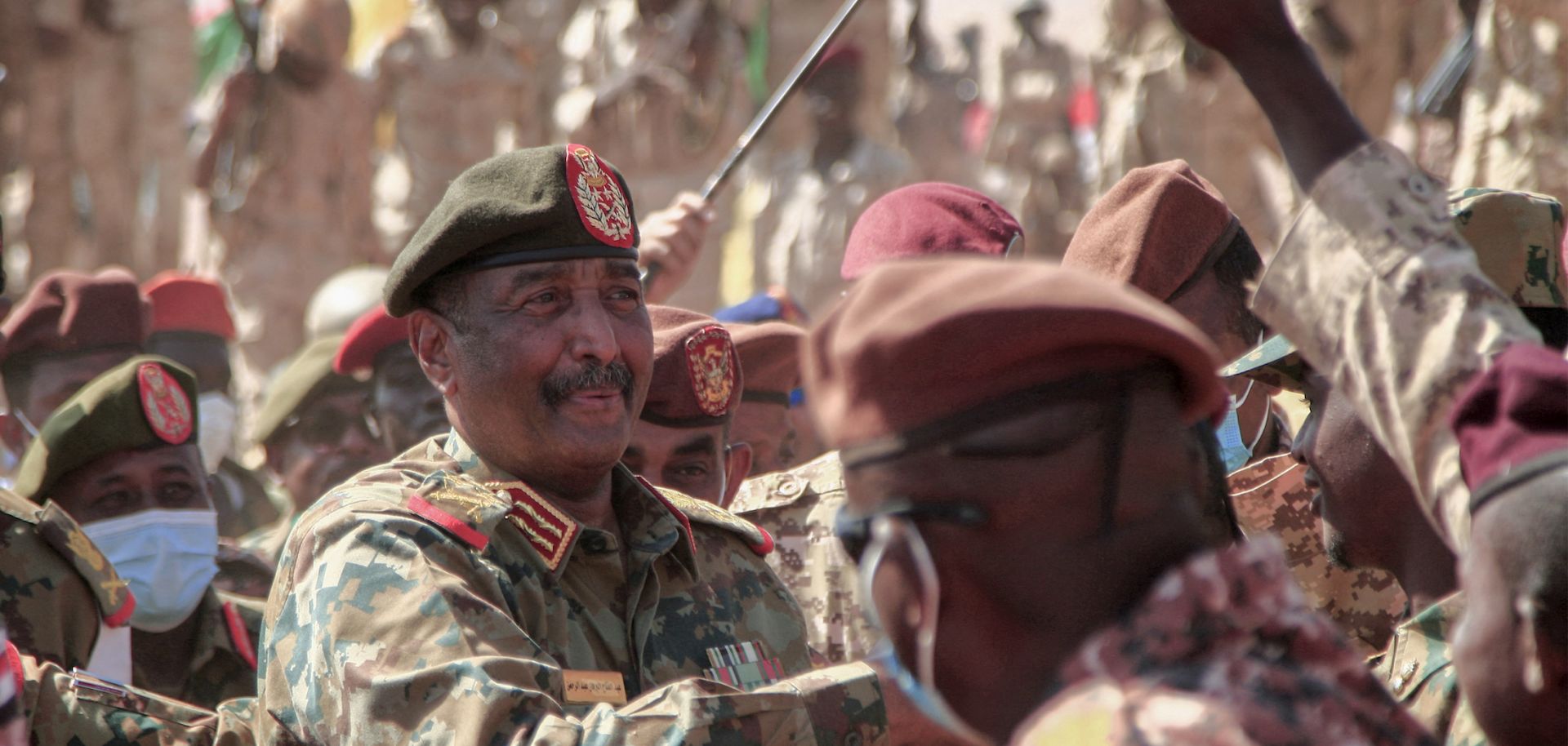
Sudanese Gen. Abdel Fattah al-Burhan on Dec. 8, 2021, in the Maaqil area of northern Nile River state.
The Sudanese junta's proposal for a new transitional government will likely meet strong resistance from pro-democracy groups and, if passed, accelerate Sudan's isolation from the West and further economic decline. In early April, Sudan's military junta and aligned factions proposed a deal to form a new transitional government that would cement military control until 2023 elections. According to Sudanese politicians aligned with the junta who spoke to Reuters, the proposal elevates the military as the "institutional authority" and "overseer of the transition" by conferring executive powers on army leadership and bypassing civilian groups with which it previously shared authority. According to the same anonymous sources, the proposal enjoys support from several political parties aligned with the military, former rebels who are also signatories of the 2020 Juba Peace Agreement, and tribal and religious leaders. General Fattah al-Burhan, leader of the October 2021 coup that ended the power-sharing arrangement between the military and the Forces of Freedom and Change Coalition (FFC), is currently seeking to increase support for the proposal with Sudan's two largest traditional political parties, the Democratic Unionist Party and the Umma Party. So far, disparate factions of both parties have made statements indicating they may support the proposal.
- The deal includes some steps that the military junta already indicated it would take, like the appointment of a technocratic Cabinet and parliament and the nomination of a judiciary and election commission.
- Additionally, the deal says that the junta will release political prisoners as a confidence-building measure. Human rights groups estimate that the junta holds hundreds of political prisoners, including FFC leaders.
- The week of April 4, Burhan met with Democratic Unionist Party leadership in Cairo following a party conference intended to unite disparate factions.
Despite repression from security forces, economic challenges, and high temperatures, pro-democracy protests continue nationwide. If passed, the proposal would override a constitutional pact instituted after the 2019 revolution against former Sudanese President Omar al-Bashir, which stipulated that civilians and the military share power during transitional periods. The Sudanese pro-democracy movement's highly effective organizational tactics and success in toppling al-Bashir make it particularly resilient. Since the October coup, a military crackdown on the thousands of protesters demonstrating against the junta has resulted in 93 deaths and thousands of injuries. Local reporters and human rights organizations frequently document instances of excessive violence, sexual assault and the use of military-grade weapons against unarmed civilians. Global increases in food prices in combination with shortages of fuel, wheat, medical supplies and, in some extreme cases, water, mean that the Sudanese standard of living has plummeted over recent months. In recent weeks, extreme heat, including temperatures reaching 42 degrees Celsius (107.6 degrees Fahrenheit), has been an additional hurdle for protesters. Despite these challenges, thousands of Sudanese continue to resist the military junta, exemplified by the recent "earthquake of April 6" protests to commemorate the third anniversary of the fall of al-Bashir and their ongoing refusal to submit to military rule.
- The March 21 shooting and death of a 17-year-old protester, Babiker al-Rashid, caused a renewed surge of support for the pro-democracy movement. Thousands of demonstrators participated in marches throughout the country April 6 and April 11.
- Inflation is nearing 250% and the price of imported basic commodities like wheat and fuel has risen by more than 30% since January 2020, according to The National. The World Food Program estimates that 40% of the Sudanese population will face acute food insecurity by the end of 2022 if nothing changes.
If the military junta passes its proposal, protests and security crackdowns will likely intensify in the short term, while consolidated military power will likely mean greater isolation from the West and an accelerated economic crisis in the medium to long term. Despite claims by pro-democracy groups that the junta's proposal has no popular support, the reality is that the military has a near-monopoly on political power and may enact the deal without the constitutionally required approval from disparate political factions and the citizenry. In a Feb. 16 opinion piece, Sudanese Justice Minister Nasredeen Abdulbari concluded that ambiguity in the August 2019 Constitutional Charter for the Transitional Period undermined the transition to civilian rule and continues to plague Sudanese constitutional law. The military junta may use legal ambiguity to justify the absence of democratic processes. If the deal is implemented, Sudan will very likely experience pro-democracy protests of greater intensity and frequency, leading to increased violence and potential looting as security forces will probably crack down. Potential fracturing within the security establishment itself, most notably involving the infamous Rapid Support Forces led by Gen. Mohamed Hamdan Dagalo allegedly responsible for extensive war crimes in Darfur and violence against protesters, could add to the violence. In the medium to long term, consolidation of military power via a newly appointed transitional government will likely pave the way for unfair elections, continued and even greater financial ostracization by the West, and the potential withdrawal of the United Nations mission. These forces would very likely accelerate economic collapse, worsen food insecurity and lead to increased refugee flows across Sudanese borders.
- The Sudanese Professionals Association, which led many anti-Bashir protests, warned April 6 that the dissolved National Congress Party (also an anti-Bashir, pro-democracy group) had begun to hold meetings again and reorganize.
- The United States and several European countries have said that a civilian-led government is a key condition for restoring billions of dollars in international economic aid suspended after the October 2021 coup.
- External partners like the United Arab Emirates and Egypt will very likely assist the junta. A stable Sudan is in the best interest of the Gulf states' Bashir-era investments, while Egypt shares Sudan's opposition to the Grand Ethiopian Renaissance Dam. (Egypt also fears instability in Sudan could prompt a surge of Sudanese immigrants heading north and conflict on Egypt's southern border.) Support from Gulf countries and Egypt, however, will not compensate for the losses in foreign aid from Western sources.
- The U.N. mission in Sudan is supposed to support a democratic transition, but increased isolation and hostility toward the West could result in the expulsion of the United Nations. On April 1, al-Burhan threatened to expel the head of the U.N. peace-support mission for allegedly lying to the U.N. Security Council about the junta's "progress" toward peace and security.
