
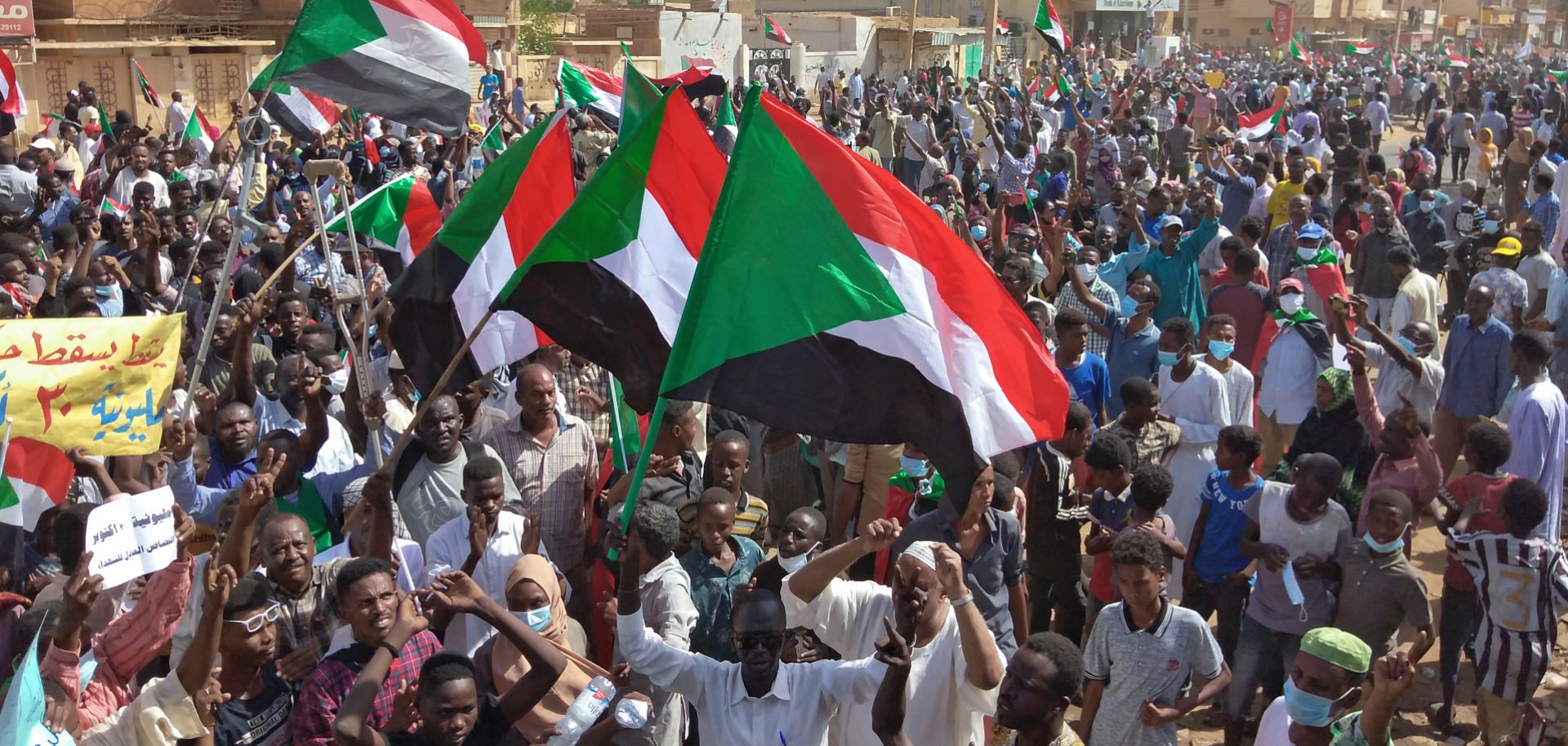
Sudanese anti-coup protesters gather in the streets of Omdurman on Oct. 30, 2021.
In Sudan, a combination of widespread protests, stalled negotiations with the country’s deposed civilian leaders and unrelenting international pressure will limit the military’s options for post-coup governance, opening the door to a political compromise. On Oct. 30, hundreds of thousands of Sudanese citizens took to the streets in Khartoum and Omdurman to rally against last week’s military coup. Many of the protesters carried photos of deposed Prime Minister Abdalla Hamdok, who has become the face of the national movement for democracy after he was arrested by security forces on Oct. 25. The demonstrations have been ongoing since the news of the takeover broke and show no signs of abating.
- Sudan’s military continues to deny the use of live rounds against protesters, despite videos circulating on social media of security forces firing on civilians in Khartoum and Omdurman.
- Protesters have been using barricades to prevent military forces from entering neighborhoods in Khartoum and Omdurman. Civilian groups have so far not resorted to significant violence in the streets.
At this point, coup leader General Abdel-Fattah Burhan is likely to appoint a technocratic government. But the identities of cabinet members will depend on Hamdok’s willingness to negotiate, which he has so far refused to do. A U.N. delegation is currently mediating between members of the deposed civilian transitional government and military leaders over a proposal for a three-person honorary council in which Hamdok would have full executive powers and appoint a cabinet of technocrats. General Burhan is motivated to include Hamdok in a new cabinet because it would give credibility to Burhan’s own governance structure. But despite Burhan’s sustained attempts to engage in dialogue, Hamdok has refused to resume his role and continue negotiations unless the detained civilian cabinet members are released and Sudan returns to the pre-coup power-sharing agreement.
- In October 2020, Sudan’s transitional government signed a peace deal with some of the country’s main rebel groups. The pact, formally known as the Juba Agreement for Peace in Sudan, established a power-sharing mechanism between civilian, military and some rebel leaders to facilitate the transition to full civilian rule until national elections are held.
Without Hamdok’s backing, such a technocratic government is unlikely to sufficiently quell protesters’ demands of a transition to full civilian rule. Until Burhan reinstates a civilian government, pro-democracy groups — including the Sudanese Professionals Association, which organized the mass protests between 2018-2019 that ultimately ousted al-Bashir — have pledged to make Sudan “ungovernable” by staging continued strikes and other demonstrations. Faced with such an ultimatum, Burhan will be forced to either acquiesce or impose a broader, more aggressive crackdown that would likely result in violence and loss of life. Even military force, however, may not suppress the pro-democracy movement to the extent that police and military forces can establish order.
As the likelihood of violence rises the longer that protests rage on, Burhan will also face increased pressure from the West to reinstate Sudan’s democratic transition, as well as a growing risk of fissures emerging within his security forces. In addition to the United Nations, the United States, European Union and several other Western states and institutions have called for Burhan to step down and reinstall the transitional Hamdok-led government. Historical friction between Burhan’s Sudanese Armed Forces (SAF) and Sudan’s paramilitary Rapid Support Forces (RSF), led by Mohammed Hamdan Delago (“Hemedi”), could prove to be another barrier to a protracted crackdown on civilian leaders and protesters as well. While so far the security forces appear to remain united in their opposition to the civilian government, competition between Burhan and Hemedi and their respective forces may lead to a breakdown in state security forces.
- Shortly after taking power, Burhan released imprisoned allies of Sudan’s former authoritarian leader Omar al-Bashir, who was ousted in 2019 and was indicted by the International Criminal Court (ICC) over allegations of war crimes committed between 2009-2010. This has since fueled speculation that Burhan staged the coup in part out of fear he, too, would be indicted by the ICC for war crimes once the transition to civilian rule was complete.
With his back against the wall, Burhan will likely ultimately reach a settlement with civilian leaders. But the timeline, associated concessions and composition of Sudan’s next government remain unclear. For many Sudanese citizens, the recent coup has shown that the military-civilian coalition installed in the wake of al-Bashir’s ousting failed to protect their right to have a voice in government. Given this failure, the pro-democracy movement may demand that the military hand all of its governing power to a civilian transitional government until the next elections are held. The October 2020 power-sharing agreement also mandates that the transitional government include former rebel leaders who supported the military coup, which Hamdok and his allies are almost sure to reject given the coup showed the deal didn’t prevent Burhan from seizing power as well. Burhan, on the other hand, cannot afford to form a transitional government without the support of rebel groups like the Justice and Equality Movement (JEM) or the Sudan Liberation Movement-Minawi (SLM-M), further limiting his negotiating position.
- On Oct. 26, Burhan announced elections will be held in June 2023, which is earlier than was expected under the previous transitional government.
