
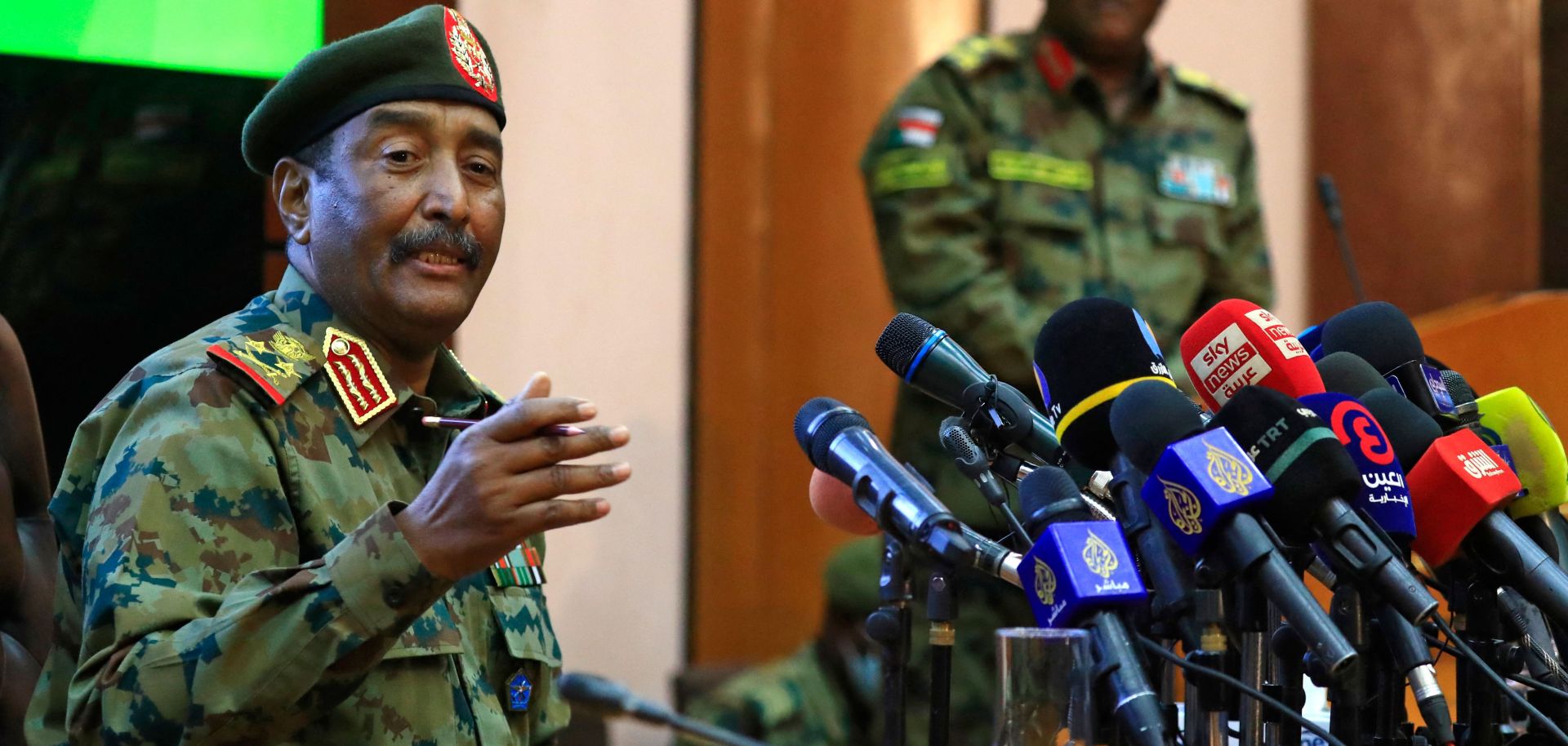
Sudan's military chief, General Abdel-Fattah Burhan, speaks during a press conference in Khartoum on Oct. 26, 2021.
To put Sudan’s democratic shift back on track, Western governments and institutions will pressure the military, led by General Abdel-Fattah Burhan, to relinquish control to another civilian transitional government. But Burhan’s support from Arab Gulf states will complicate the West’s efforts and delay the resolution of the coup. Following the Oct. 25 military coup, Western powers and international institutions responded with strong condemnation and fiscal consequences, while Sudan’s regional neighbors and Arab Gulf states answered with modest calls for de-escalation.
- The United States suspended $700 million in aid and U.S. Secretary of State Antony Blinken demanded the release of Prime Minister Abdullah Hamdok and civilian cabinet members.
- On Oct. 27, the World Bank announced the suspension of all aid to Sudan. Currently, the World Bank maintains a $2.3 billion portfolio across a range of sectors in the country.
- The African Union suspended Sudan’s membership and the Intergovernmental Authority on Development (an international non-governmental authority in the Horn of Africa) condemned the military’s actions.
- Turkey and Qatar expressed “concern” over the coup and called for de-escalation.
- Saudi Arabia appealed for restraint and unity among “all political components” in Sudan.
All of Sudan’s foreign partners want to see a stable transition, but they have different visions for how that transition should transpire. Turkey and Qatar, two of Sudan’s regional partners, have previously tolerated civilian-led governments, so long as they can enforce stability. Turkey and Qatar thus have less of a stake in assuring the success of the military regime if it merely creates instability. By contrast, the United Arab Emirates, Saudi Arabia and Egypt — whose leaders all have closer personal ties with General Burhan — are generally more sympathetic to military governments, viewing strong top-down leadership as crucial to maintain stability. Western governments and institutions, meanwhile — as evidenced by their immediate condemnation of the recent coup — are unwilling to support a military regime, especially when so many Sudanese citizens continue to show support for their country's democratic transition. The United States has invested millions of dollars and a decade of diplomacy in shoring up Sudan as a partner against terrorism and illicit finance activity, which only adds to the West's resolve to facilitate democratic norms.
- Burhan and the head of Sudan’s paramilitary Rapid Support Forces, Mohamed Hamdan Degalo (“Hemedi”), both have strong ties with Saudi Arabia after fighting together against Houthi rebels in Yemen in 2015.
- As Sudan’s northern neighbor, Egypt is particularly invested in the outcome of the coup, given the risk of any instability spilling over its 793-mile (1,276-kilometer) border with Sudan.
- The regional conflict over the Great Ethiopian Renaissance Dam, from which Sudan and Egypt are downstream and have aligned their interests against Ethiopia, will also compel Cairo to remain on good terms with Khartoum. In addition, General Burhan completed several years of military training in Egypt and maintains close relationships with many high-ranking Egyptian officials.
Competing economic interests in Sudan further guarantee international pressure toward divergent political outcomes. The West’s economic involvement in Sudan’s democratic transition is focused on debt relief and normalization with financial institutions. But the swift cancellation of funds following the recent coup indicates this aid is contingent on the appearance of civilian governance in Sudan. Qatar and the United Arab Emirates have also invested in Sudanese infrastructure and agricultural projects. While they can’t make up for the losses in Western debt relief to Sudan if the military regime remains in place beyond a transitional period, these Arab Gulf states can back the Sudanese Central Bank with funds to help address Sudan’s liquidity crisis and offer discounted fuel products.
- Qatar and the United Arab Emirates both hold broad swaths of Sudanese agricultural land to protect against food shortages.
- In June 2021, the World Bank announced that it, in partnership with the International Monetary Fund, would provide Sudan with more than $50 billion to implement poverty reduction reforms.
These divergent interests among Sudan’s external partners will continue to thwart a clear international response to the coup and may prolong a decisive outcome that invites instability. As the aftermath of the coup unfolds in the coming weeks, Sudan’s military could crack down on pro-democracy protesters and, barring a highly unlikely international intervention, proceed as the self-appointed guardians of the transitional government as Burhan outlined in his Oct. 25 post-coup statement. On the other extreme of the spectrum, internal pressure from pro-democracy protesters and external pressure from the international community (namely the West) could also prompt Burhan to backtrack, perhaps reinstituting civilian leaders in cabinet positions. But while foreign countries’ competing interests in Sudan certainly play into the military’s calculus, neither support from Arab Gulf states nor economic and rhetorical condemnation from Western institutions will alone be enough to tip the scales in a decisive manner. Instead, it is far more likely that external influences complicate and delay internally-determined outcomes.
- Western governments will continue to impose economic and diplomatic penalties, but are also incentivized to try to salvage their relationship with the Sudanese government in the event that the military regime stays in power longer than a brief transitional period.
- Arab Gulf states have already offered tacit approval for the coup, but will keep their commitments to the Sudanese military private until it’s clear that the military will maintain power for the near future.
