
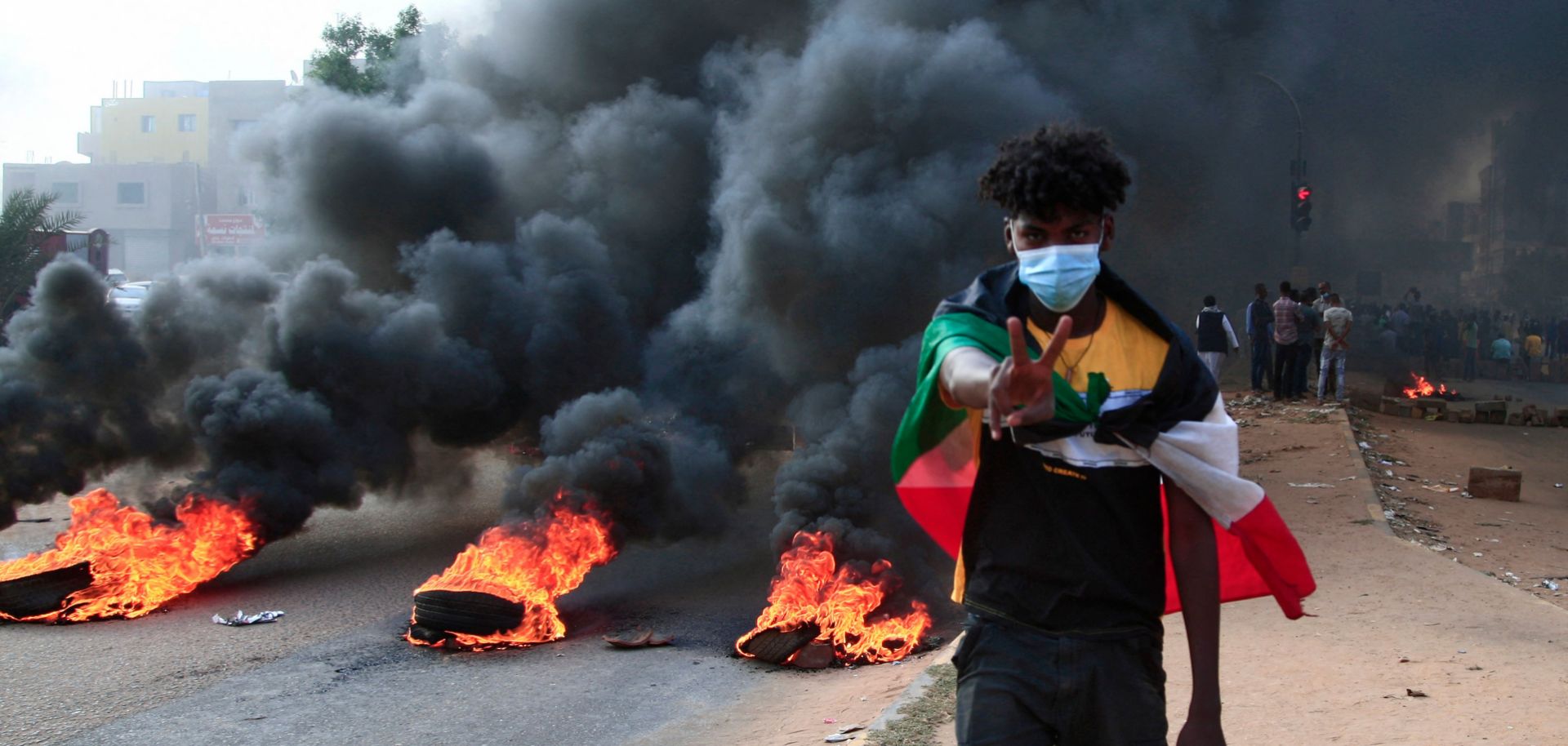
A protester draped with Sudan’s national flag stands in front of burning tires during a demonstration in Khartoum on Oct. 25, 2021.
A military coup in Sudan could jeopardize the Northeast African country's transition to democracy by spurring unrest and impeding Khartoum's efforts to achieve debt relief. Sudanese Prime Minister Abdalla Hamdok was arrested by security forces in the early morning of Oct. 25 as part of an apparent military takeover of the country’s transitional government. In a televised public address broadcast this afternoon, the head of the military, Gen. Abdel-Fattah Burhan, declared a state of emergency and announced that he was dissolving the joint civilian and military government, which was established in 2019 after the ousting of Sudan’s longtime authoritarian leader Omar al-Bashir. Burhan said political infighting had forced him to intervene in the interest of the Sudanese people. He also pledged to appoint another technocratic government coalition to lead Sudan to democratic elections in July 2023, which is a significantly shorter timeline than the 39-month commitment put forth by the 2019 Constitutional Declaration. Invoking rhetoric from the 2019 revolution, the civilian government ministry called on the people of Sudan to stand up against the power grab. Professional organizations in the country have also called for widespread strikes, including doctors’ groups in Khartoum hospitals. Thousands have since taken to the streets in Khartoum and Omdurman, with many burning tires and carrying the Sudanese flag. So far, 80 people have reportedly been injured in the protests, including from gunshot wounds amid emerging reports of military forces firing into crowds.
- The military has reportedly cut off internet access since this morning’s arrests, making it difficult for journalists to send reports about what’s happening on the ground. But army troops and the paramilitary forces stationed throughout the cities of Khartoum and Omdurman have allegedly closed major roads and bridges, including the highway to the airport in Khartoum.
- International observers have condemned Hamdok’s arrest and the transitional government’s dissolvement. EU Foreign Policy Chief Joseph Borrell called on security forces to end the internet blackout and immediately release the prime minister and the other detained cabinet members.
- The 2018-19 Sudanese revolution ousted al-Bashir, who ruled the country for over 30 years and has been indicted by the International Criminal Court for war crimes. Following a popular uprising in which millions of Sudanese participated in nonviolent protests, al-Bashir’s regime was replaced with an alliance between a technocratic civilian cabinet and a sovereign council overseen by the military.
The coup follows months of escalating tensions between Sudan’s military and civilian government officials. Tensions between Hamdok and Burhan flared after a faction of the military loyal to deposed President al-Bashir unsuccessfully attempted to seize control of the transitional government in September, with both leaders accusing one another of failing to implement the policies necessary to hold democratic elections and transition to full civilian rule. Hamdok, in particular, accused military leaders of failing to purge the ranks of al-Bashir loyalists and implement adequate reforms, while Burhan accused civilian leaders of declining to deliver basic goods and services to the Sudanese people. Rising fuel, water and food prices, along with wheat and medicine shortages, have only further deteriorated the political situation in recent weeks.
- Some opponents of the coup have reported on social media that military leaders first received tacit approval for the takeover from Egypt, Israel, Saudi Arabia and the United Arab Emirates. These governments are likely supportive of a stable, military-led Sudan in order to preserve existing geopolitical and economic alliances and regional security.
The military takeover could trigger months of violent unrest in Sudan, threatening the country’s transition to civilian rule and, in turn, its access to international financial aid. International donors have repeatedly warned that financial support — on which Sudan is dependent — is contingent on a peaceful transition to civilian rule. As a result, the coup risks worsening the humanitarian crisis in Sudan if the international community withdraws financial support. While Gen. Burhan has repeatedly expressed his commitment to a civilian-led government, the factionalism within the military and the extreme measures to which the armed forces have gone to maintain control over the transition suggest that military leaders are unprepared to cede power to in the near future. While military leaders will probably appoint a new technocratic civilian government to oversee the transition, they will most likely select officials who are willing to grant the military continued influence, even after elections are held. Given Sudan’s political history, however, pro-democracy coalitions are almost certain to staunchly resist military rule via continued demonstrations, sit-ins and strikes. At this stage, it is unclear whether the appointment of a new civilian government and an accelerated timeline will be enough to appease Sudanese pro-democracy groups. Depending on how willing the military is to impose a violent crackdown (and so far, reports of police firing into crowds is a solid indication that a crackdown is currently taking place), sustained opposition to the military takeover could mean months of violent demonstrations, reminiscent of the 2019 protests against al-Bashir. If the military chooses to pursue a negotiated settlement to end unrest (as was the case in 2019), the formation of a new civilian-military transitional coalition will likely run into the same problems of factionalism that plagued the old one, and Burhan’s promise of July 2023 elections may again prove empty.
