
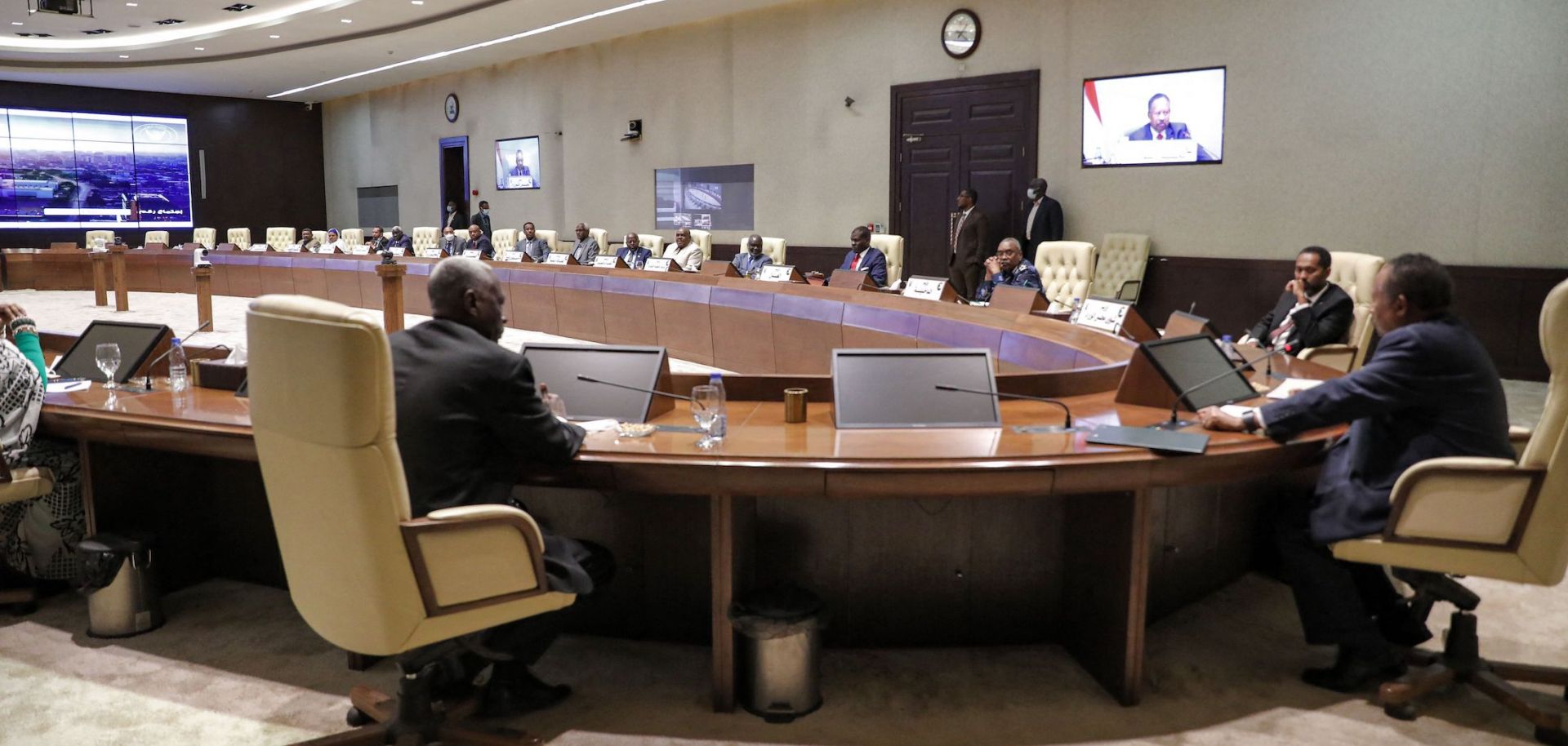
Sudanese Prime Minister Prime Minister Abdalla Hamdok (right) chairs a cabinet meeting in Khartoum on Sept. 21, 2021, in the wake of a failed coup attempt earlier that day.
The aftermath of an attempted coup will exacerbate tensions between Sudan’s rival civilian and military leaders — postponing the Northeast African country’s transition to full civilian rule, while increasing the risk of violence and thwarting much-needed foreign financial aid. On Sept. 21, the Sudanese transitional government blocked an attempted coup in which officials used military tanks to block the bridge between Khartoum and Omdurman that spans across the Nile River. Prime Minister Abdalla Hamdok said that the coup attempt was quickly controlled and that over 21 officers had been arrested. The coup attempt comes as public displeasure with the interim government is on the rise, largely due to its failure to implement promised institutional reforms and provide basic goods and services.
- In the days directly following the coup attempt, hundreds of people marched in the Sudanese states of Al Jazirah, North Kordofan, and Gedaref to condemn the attempted takeover. In response to remarks by army leaders that continued military rule was necessary to protect against future coup attempts, demonstrators also set fire to an armored vehicle in Sudan’s centrally-located capital city of Khartoum on Sept. 23.
- The Sudanese Professionals Association, a group that was instrumental in ousting the country’s former authoritarian leader Omar al Bashir in 2019, has called for protests on Sept. 30 to demand that the transitional government establish the institutions promised by revolutionary leaders.
The coup attempt has exposed deep divisions between Sudan’s military and civilian leaders that will stymie efforts to integrate disparate factions into new governance structures. Prime Minister Hamdok publicly attributed the coup to members of the military loyal to deposed leader al Bashir and Islamist groups operating in eastern Sudan, calling for sweeping security reforms and increased civilian oversight of the military’s business ventures. Meanwhile, Sudan's Sovereign Council Chief General Abdel Fattah al-Burhan and his deputy, General Mohamad Hamdan Degalo, accused the civilian government of setting the stage for the coup attempt by failing to provide the Sudanese people with basic goods and services.
- General Degalo sharply criticized Sudan’s civilian leaders and accused them of focusing on jockeying for positions of power instead of governing. Those civilian officials, however, have previously levied the same criticism against Degalo.
- The Rapid Support Forces (RSF), a paramilitary group led by Degalo and often connected with Arab Janjaweed militias, has not yet merged with the Sudanese military despite international and domestic pressure to do so. Degalo appears to be concerned about maintaining his power base as the civilian government continues to push for military reforms. Al Bashir established the RSF in 2013 as a means of countering the Sudanese army, making the paramilitary group of particular interest to the Hamdok coalition.
This escalating civil-military strife, compounded by lack of paramilitary integration and economic hardship, damages Sudan’s chances of successfully transitioning to a permanent government under full civilian rule. The competing forces within the transition, largely divided by civil-military alliances, have so far not united in preparation for 2024 elections. Deeming itself the “protector of the revolution,” al-Burhan’s military council has signaled it won’t be sidelined, even when faced with mass protests in the east. In seeking to use the attempted coup to justify military reform, Hamdok’s civilian coalition is revealing fear that the transition will not take place as scheduled. If these divisions persist, the elections are all but sure to be delayed, raising the risk of mass protests and military-police crackdowns. Tensions between the two sides were somewhat eased on Sept. 27 when each side publicly announced a willingness to work with the other, with al-Burhan also vowing to support upcoming elections and ensure the military remained non-partisan. But disputes between Sudan’s civil and military leaders will likely rise again amid conflicting international development interests, particularly in regard to Port Sudan, as well as austerity measures that result in additional economic hardship for the Sudanese people. The longer that each side vies for executive power, the longer sustained peace will elude Sudan.
- Since Sept. 17, eastern Sudan has seen ongoing demonstrations against a deal between the government and rebel groups, as well as a series of economic reforms required for Sudan to participate in an International Monetary Fund (IMF) debt relief package. On Sept. 27, tensions between the transitional government and the Beja ethnic group were mitigated by a deal to allow the passage of oil through Bashayer Port, which protesters had been blocking.
Growing political tensions in Khartoum, combined with the ongoing threat of violence across the country, will damage Sudan’s efforts to attract international investment and debt relief. Following the 2019 coup that ended al Bashir’s 26-year reign, wealthy Arab Gulf states and Western powers launched development projects in Sudan in an effort to help ensure the country’s long-term economic growth. The United Arab Emirates, for one, has allied with Sudan’s Transitional Military Council to facilitate its investment in agricultural and maritime projects, while the Hamdok-led civilian government has sought investment from European countries. In June, the World Bank and IMF also approved Sudan for debt relief under the Enhanced Heavily Indebted Poor Countries (HIPC) Initiative, which requires several austerity measures, including subsidy reductions and implementation of Sudan’s Poverty Reduction Strategy for at least one year. Barring a full-scale civil war in the country, Sudan’s leaders will seek to maintain the IMF program, which is currently estimated to reduce the country’s national debt from about $50 billion to $6 billion over the next three years. But ongoing unrest and discontent with austerity measures will make the implementation of benchmarks exceedingly difficult, which will likely delay the program’s completion point beyond 2024.
- Activists have accused the Dubai-based DP World of intentionally destabilizing ethnic relations in Port Sudan in an attempt to wrestle contracts from regional industry players, like the International Container Terminal Service.
- Germany, with the support of the Hamdok coalition, organized the 2019 Friends of Sudan Initiative to build international support for the country’s transition to civilian rule and spur investment. Following the 2019 coup, Germany was among the first to lift economic sanctions on Sudan and went so far as to grant Khartoum 80 million euros in financial aid. Hamburg Port Consulting, a global transport and logistics firm, also has several ongoing projects in Port Sudan.
