
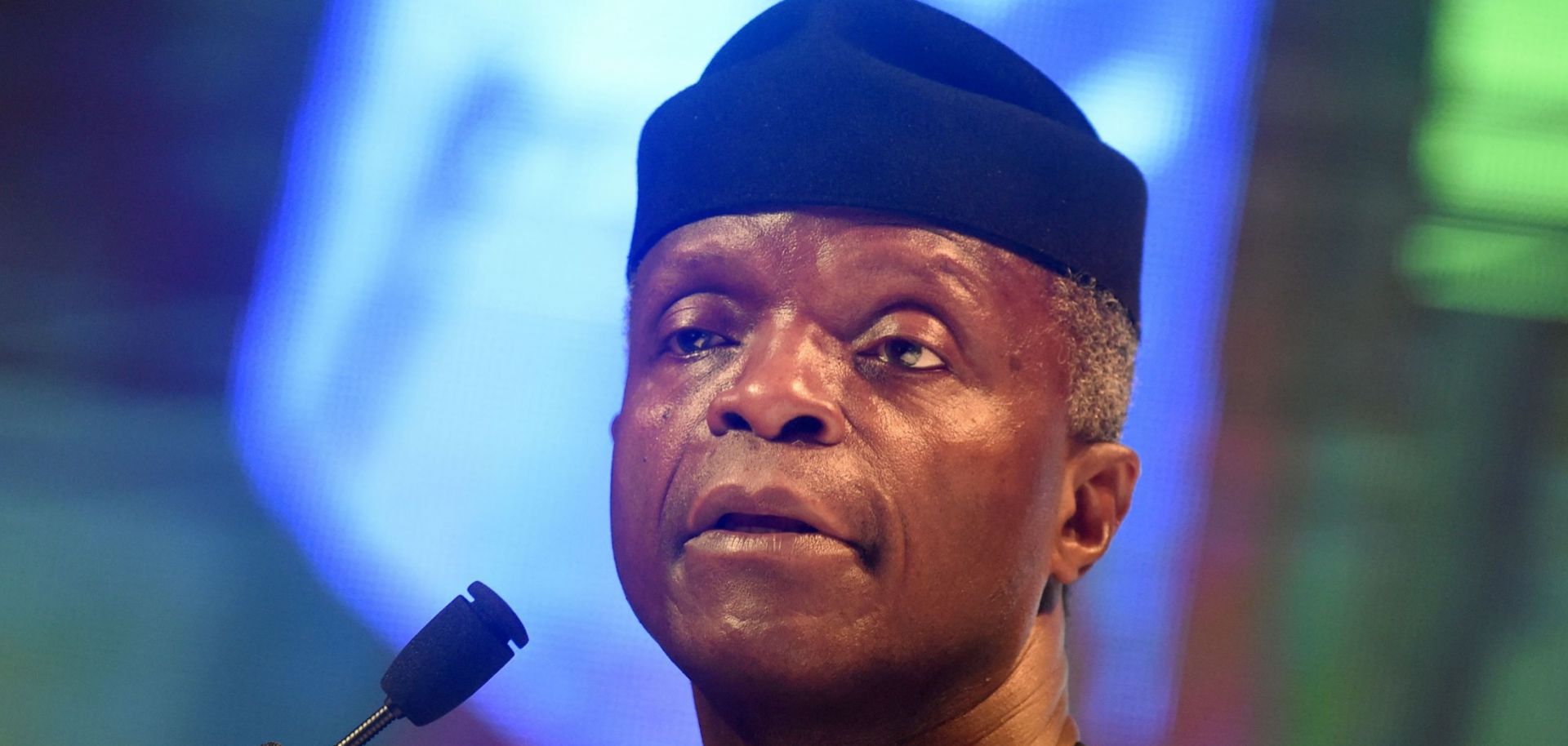
Nigerian Vice President Yemi Osinbajo on July 27, 2019, in Abuja.
Growing disputes within Nigeria's governing party will drive political, social and security volatility in the run-up to the country's presidential election in February 2023, and could undermine economic growth. Nigerian Vice President Yemi Osinbajo on April 10 announced his presidential bid, joining six other members of the ruling All Progressives Congress (APC) and many others in the packed race. In his announcement, Osinbajo positioned himself as the candidate who will continue the progress made under President Muhammadu Buhari, though support for Buhari is low across the country in part due to rising security threats. The ruling party will hold party primaries in May, which will reveal Osinbajo's support within the APC.
- During his April 10 announcement, Osinbajo pledged to continue Buhari's progress toward infrastructure development, economic growth and establishing greater security in the north. (Buhari critics frequently point to worsening security and violence in Nigeria's northern states as evidence of his inadequate response to criminal gangs and jihadism.)
Osinbajo is unlikely to win the presidency due to a lack of nationwide support. Osinbajo hails from Ogun state in Nigeria's southwest, which he and his supporters portray as advantageous to the APC as the party negotiates Nigeria's practice of rotating the home regions presidents come from. Buhari was born and began his political career in the northwest region. Under the informal power-sharing agreement among Nigeria's main political players, the 2023 president should be from the south-south, or at the very least, from one of the three southern states. But despite being a southerner, Osinbajo has weak support in Ogun, in addition to no established structure of support across the country or significant reliable alliances within the APC. These factors limit his odds of mounting a successful campaign even if Buhari names him his successor. (Whether the Nigerian president would so designate Osinbajo remains unclear.)
- Nigeria's two main political parties, the APC and the Peoples Democratic Party (PDP), since the country's transition from military to civilian rule in 1999 have practiced what is known as "presidential zoning" to ensure equal regional access to power. Under the zoning rules, all parties agree to split their presidential ticket (president and vice president) between the country's north and south and rotate the region of origin of the president between the country's six zones. In recent years, zoning the presidency between north and south has become more important than rotating between each of the country's six regions, as the parties have at times struggled to find viable candidates from a specific region.
Osinbajo's entrance into the presidential race alone will heighten political rivalries, and could contribute to an increase in defections from the ruling party, harming the APC's chances of retaining the presidency and contributing to potential unrest. Osinbajo's rivalry with Bola Tinubu, the former governor of Lagos, longtime APC "godfather" and current presidential candidate, will likely intensify APC infighting. In Nigeria's volatile political environment, this will likely lead to demonstrations with a high chance of violent escalation. This risk is heightened by Nigeria's dire economic circumstances brought on by shortages and high prices of food and fuel, skyrocketing inflation, failures to deliver services, and longstanding unemployment and inequality. Politicians, including Osinbajo and Tinubu, will continue to stoke rage against their opponents by capitalizing on economic grievances. Additionally, the more crowded the presidential field becomes, the more likely candidates are to switch sides. While Osinbajo and Tinubu's ties to the APC are likely too strong to permit them to credibly jump ship and still win the presidency, other members of the APC, like Transportation Minister Rotimi Amaechi, who announced his candidacy April 9, may join the PDP. Should several presidential candidates flip from the APC to the PDP, the APC's odds of holding onto power will drop. This possibility will increase political tensions, potentially leading to private political alliances, corrupt agreements and criminal activity that will increase the volatility of Nigeria's politics and economy over the next year, hindering the country's emergence from its COVID-related recession.
- High global commodity prices and increasing inflation worsened by the Russian invasion of Ukraine have led to severe food shortages and price increases in Nigeria, significantly reducing the standard of living. Prices on many food staples have increased more than 100% in a matter of weeks. For example, a bag of yams in Lagos averaged 1,200 naira (about $2.90) on March 16 and currently averages 2,500 naira, according to data from the Nigerian Tribune.
- Nigeria experienced its second nationwide blackout in three weeks April 9 when the power grid failed, leaving much of the country in the dark for several days.
