
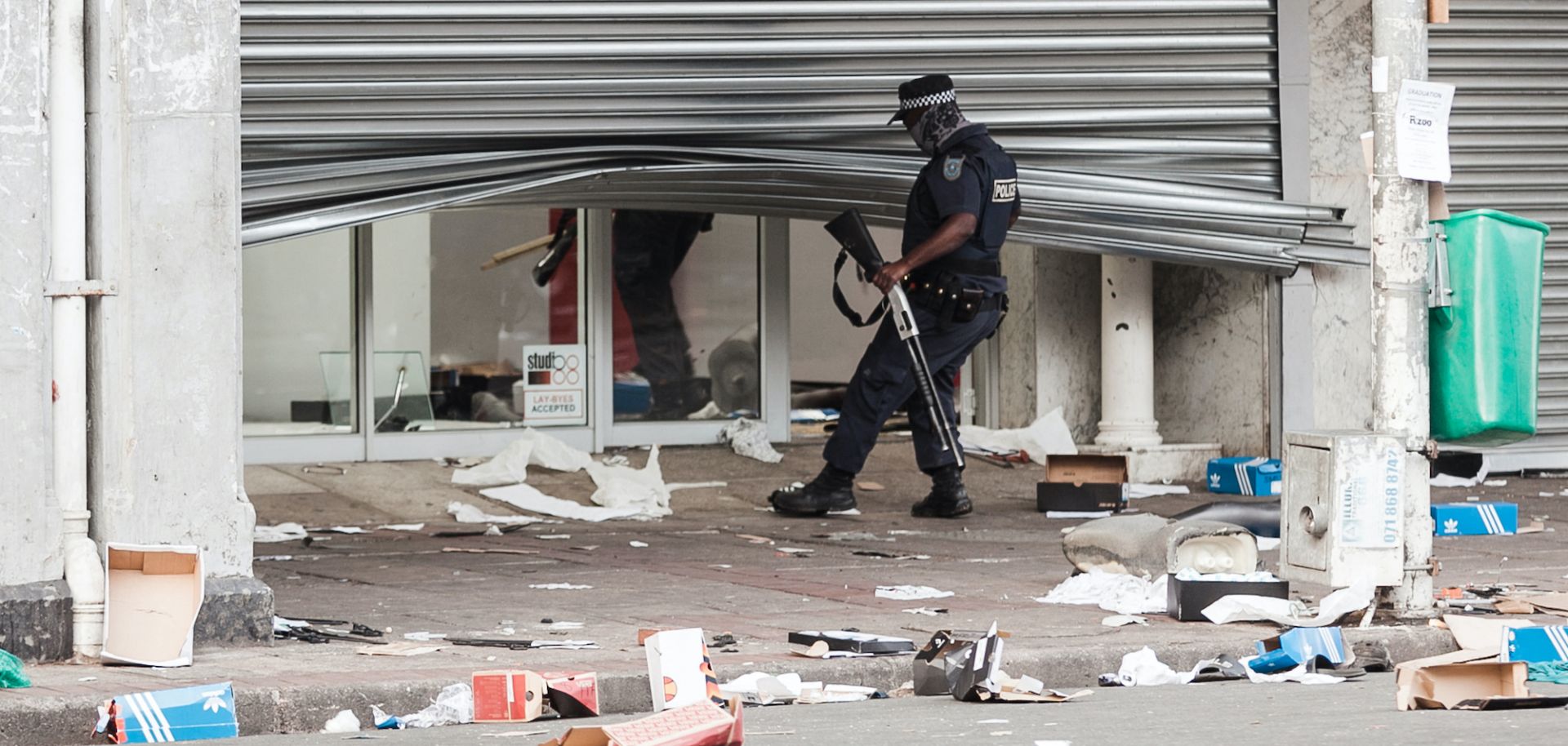
A police officer scans a looted retail store in central Durban, South Africa, on July 11, 2021.
In South Africa, the deployment of military troops will help contain the immediate turmoil following former President Jacob Zuma’s controversial arrest. But a larger security presence on the ground will also risk triggering additional clashes with Zuma’s supporters, which would only reinforce their perception that his detainment was politically motivated. On July 12, the South African National Defence Force (SANDF) announced the deployment of troops to the provinces of Gauteng and KwaZulu-Natal to contain the widespread unrest, which has so far resulted in six deaths and more than 200 arrests. In the days following Zuma’s July 7 arrest, looting and vandalism have been most prominent in the city of Durban in KwaZulu-Natal, home to Zuma and his ethnic Zulu supporters. The disorder has caused some basic services, like medical centers, to suspend or limit operations. Such disruptions come as South Africa is grappling with a third major COVID-19 wave, and the police’s struggle to contain the unrest may lead to more people trying to challenge the country’s lockdown measures.
Future dates on Zuma’s legal calendar will likely prompt more disturbances, even after the current situation is contained. Zuma is facing multiple charges and each will feature dozens of court dates as they move through the investigation, trial and sentencing phases. Those dates will all carry the risk of prompting more unrest, which in turn could lead to more riots and opportunistic looting even after the current situation is contained. KwaZulu-Natal and its largest city of Durban, home to sub-Saharan Africa’s largest container port, will remain the most at risk — particularly if judges and trials rule against the former president, which appears likely.
- On June 29, Zuma was sentenced to 18 months in prison for contempt of court after he failed to appear before the Zonda Commission, which is investigating corruption during his presidential term between 2009 and 2018.
- In a separate case, Zuma pleaded not guilty in May in a trial involving a $5 billion 1999 arms deal when he was South Africa’s deputy president. That trial will also resume on July 19.
South Africa’s corruption cases against Zuma will prove to be another litmus test for President Cyril Ramaphosa’s anti-corruption agenda and the independence of the South African judiciary. Zuma’s influence remains prominent in the ruling African National Congress (ANC), which has seen its election performance slide in recent years amid the country’s sluggish economic challenges and political gridlock. Ramaphosa and the Zonda Commission have been trying to root out systemic corruption in the ANC as a way to reverse or slow the party’s splintering before it becomes an existential threat to its dominant position in the South African political system. But Zuma and his supporters in the ANC, including the party’s suspended secretary-general Ace Magashule, view Ramaphosa’s corruption campaign as being politically motivated. They argue that the corruption charges against Zuma, in particular, are aimed to dismantle the former president’s support base within the ANC as a way for Ramaphosa and his allies to consolidate their own power base. They also argue that Ramaphosa is merely using his corruption campaign as a way to divert public attention away from the country’s ongoing economic and COVID-19 crises ahead of scheduled October municipal elections.
- Ramaphosa has instituted new party rules forcing any politician accused of corruption to step aside from their duties if they are accused of corruption. This rule led to Magashule, Zuma’s top ally in the ANC’s ruling executive committee, being suspended as the party’s secretary-general following his 2020 arrest over corruption charges.
- During a July 12 virtual court hearing, Zuma's lawyers asked a judge to reverse his sentence. Should his arrest continue to be upheld, Zuma will likely eventually appear before the Zondo Commission.
