
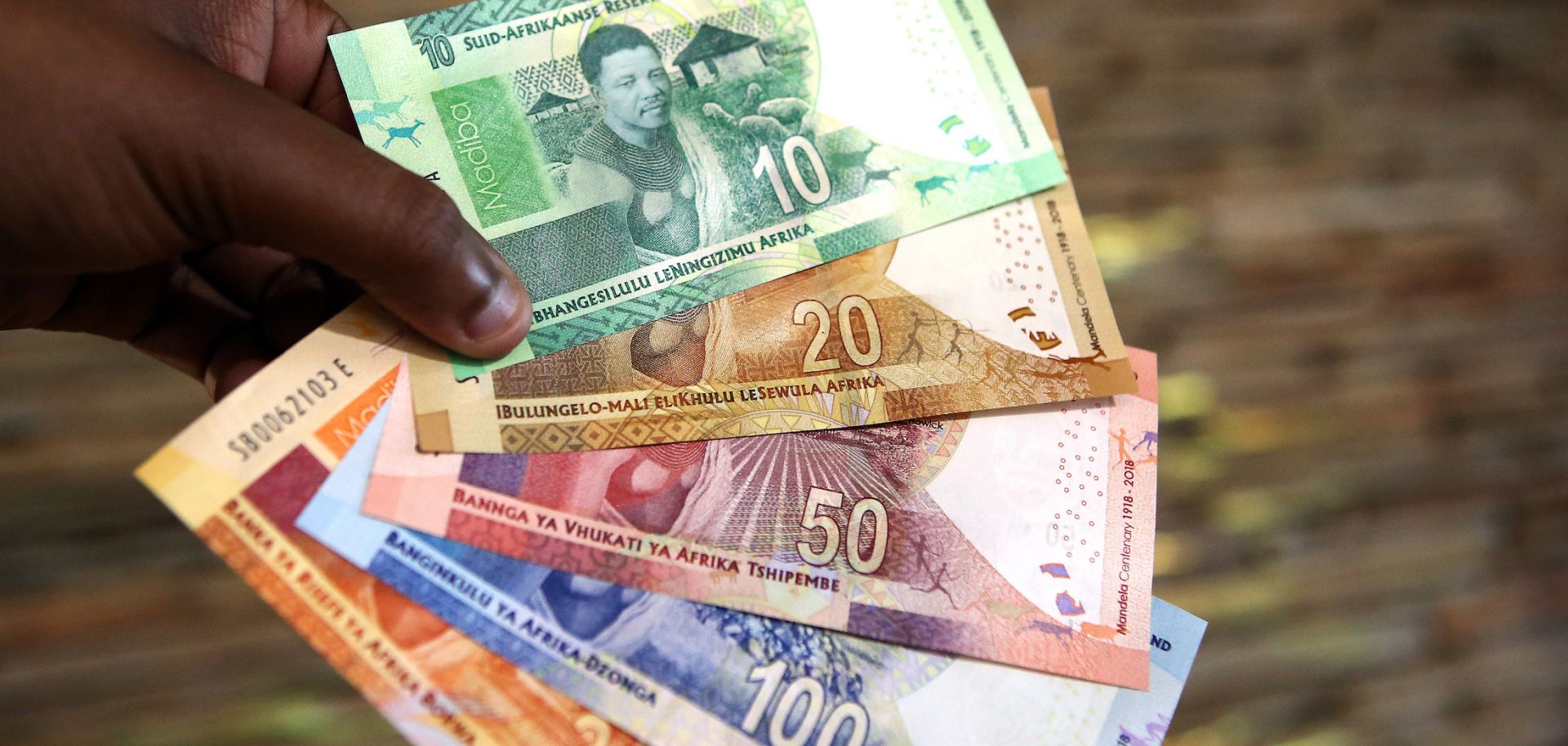
A man holds new South African banknotes of the South African rand on July 13, 2018, in Pretoria, South Africa.
Domestic political and financial constraints will thwart South Africa’s new economic recovery plan, prolonging the country’s five-year financial crisis while exacerbating its current levels of inequality and poverty. In an Oct. 15 speech to parliament, South African President Cyril Ramaphosa unveiled his government’s Economic Reconstruction and Recovery Plan, which ambitiously targets an average of 3 percent GDP growth over the next decade — a level South Africa has not seen since 2011. The plan seeks to meet that goal by implementing structural reforms, boosting infrastructure investment and reducing bureaucratic red tape. Critically, however, the plan does not abandon the government’s strategy of fiscal consolidation over the medium term. Key aspects of South Africa’s recovery plan include:
- Creation of a $6 billion fund for investment into infrastructure, with the goal of attracting another $60 billion of private investment.
- Boosting power generation capacity to solve the country’s power crisis by 2022 by stabilizing the state-owned utility company Eskom and signing more deals with independent power producers.
- Promoting domestic investment in manufacturing to reduce South Africa’s reliance on imports through reforms and tax incentives.
- Launching a new employment stimulus plan that aims to quickly create 800,000 jobs.
- Introducing structural reforms related to state-owned enterprises (SOEs,) barriers to regional trade, easing the difficulty of business, inequality gaps and economic inclusion, land opportunities, and education and beneficiation in the mining sector.
Addressing the economic impediments to South Africa’s growth will prove difficult given the global economic reality and Pretoria’s unsustainable fiscal policies. There have been fears over ballooning public debt due to the country’s persistent fiscal deficits and rising public wage bill, as well as the massive debt levels harbored by the utility company Eskom and other state-owned enterprises. Other economic challenges include South Africa’s over-reliance on mining exports, power availability gaps and regulatory constraints.
- Prior to the COVID-19 pandemic, South Africa’s economy was already in a recession, recording negative GDP growth in six of the nine quarters between the first quarters of 2018 and 2020.
- South Africa reported an annualized 51 percent decline in GDP in the second quarter of 2020.
- The International Monetary Fund expects South Africa’s economy to shrink by 8 percent in 2020 and only grow by 3 percent in 2021.
- Finance Minister Tito Mboweni is slated to give an updated outlook on South Africa’s state finances on Oct. 28.
- On Oct. 7, the South African Reserve Bank said that further interest rate cuts to boost monetary stimulus is unlikely and that rates “will move somewhat higher in future.”
South Africa’s economic recovery from COVID-19 will last several years, as the backing of pro-poor economic initiatives by both the ruling African National Congress (ANC) and South Africa’s powerful unions further blunts Ramaphosa’s pro-business agenda. Internal divisions within the ANC means that progress on the structural reforms and economic liberalization measures needed to meet the president’s growth targets will again be slow and stunted, just as they were following the launch of Ramaphosa’s first economic rejuvenation plan in 2018. Although the IMF expects South Africa to grow at 3 percent in 2021, this is based largely on the fact that Pretoria is unlikely to reintroduce the severe nationwide shutdown it did earlier this year. After the initial rebound from the steep drop in economic activity, however, South Africa’s economic growth will likely fall closer to the 1 percent level that has become the standard over the last decade due the lack of progress on needed economic reforms.
- The lack of reforms related to fiscal sustainability means that South Africa will fail to meet its debt consolidation targets. As economic growth remains stagnant, Pretoria may even be forced to abandon debt consolidation entirely.
- The slow reforms over governance and independence to South Africa’s SOEs mean these firms will remain inefficient. As a result, many SOEs, including Eskom, will struggle to return to profitability and will need additional financial support from the government.
- Investment into the power sector will fail to eradicate the power gap by 2022, leading Eskom to continue falling behind demand growth. This will hamper South Africa’s ability to fulfill Ramaphosa’s goals in boosting investment and output of electricity-intensive sectors, including mining beneficiation and manufacturing.
- Infrastructure development goals will require significant private sector investment that will likely fall short due to profitability concerns.
- South African mining companies, meanwhile, will be hit by both low commodity prices amid the prolonged global economic recession due to COVID-19, along with rising costs related to transportation and infrastructure, labor demands, declining quality of ore and rising energy prices.
