
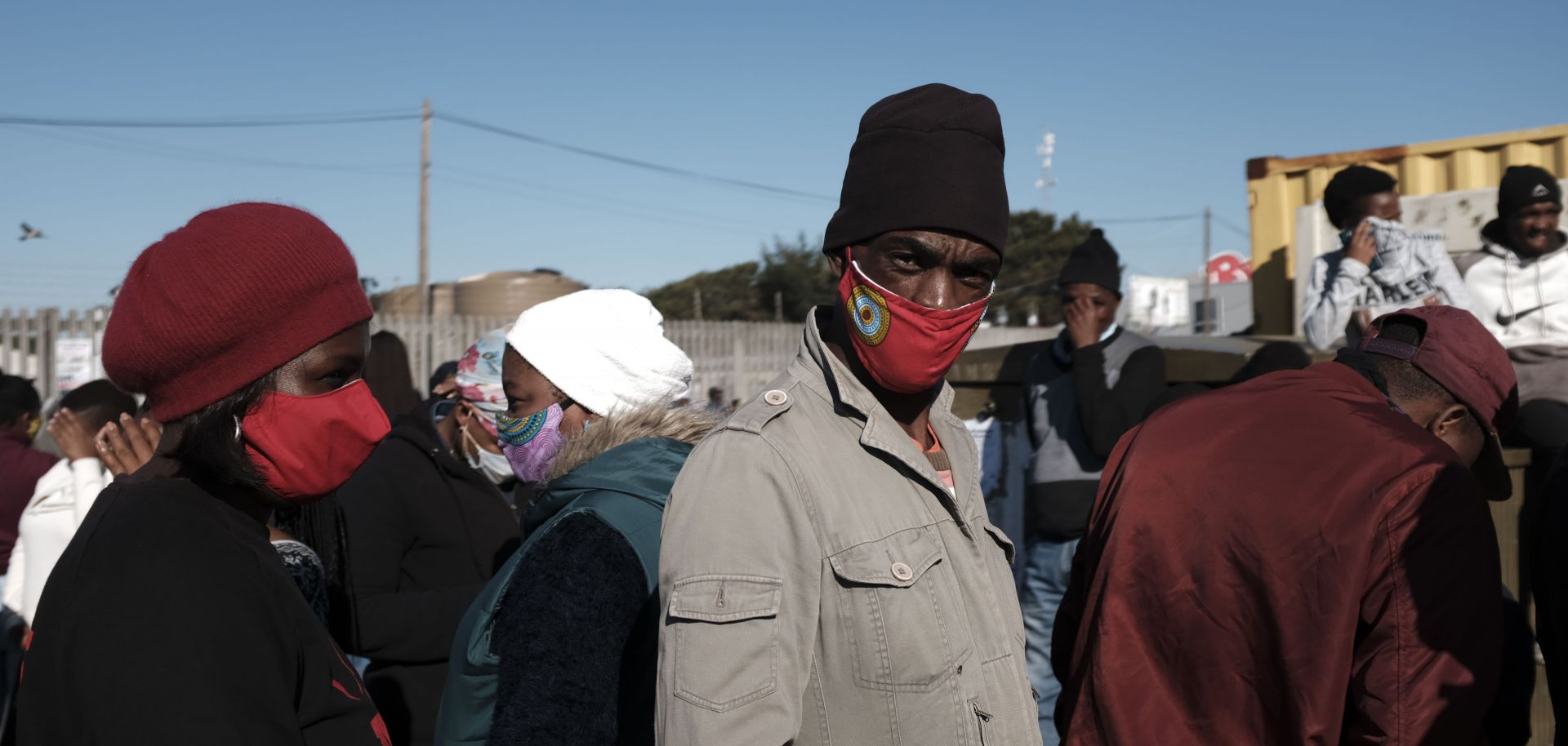
People stand in line to receive grant payments from the South African Social Security Agency (SASSA) in Khayelitsha, a township located near Cape Town, on May 4, 2020.
South Africa will likely miss its recently adjusted budget targets as the country’s escalating COVID-19 outbreak delays much-needed austerity measures, leaving its economy in shambles for at least another five years. President Cyril Ramaphosa and his pro-business allies in the ruling African National Congress (ANC) party had planned to rein in government spending and the country's sky-high debt levels over the next three years. But South Africa's likely extended health and economic crisis could make that goal politically untenable, given that any budget cuts and potential layoffs would most acutely affect the ANC's support base of labor unions and their poorer Black constituents.
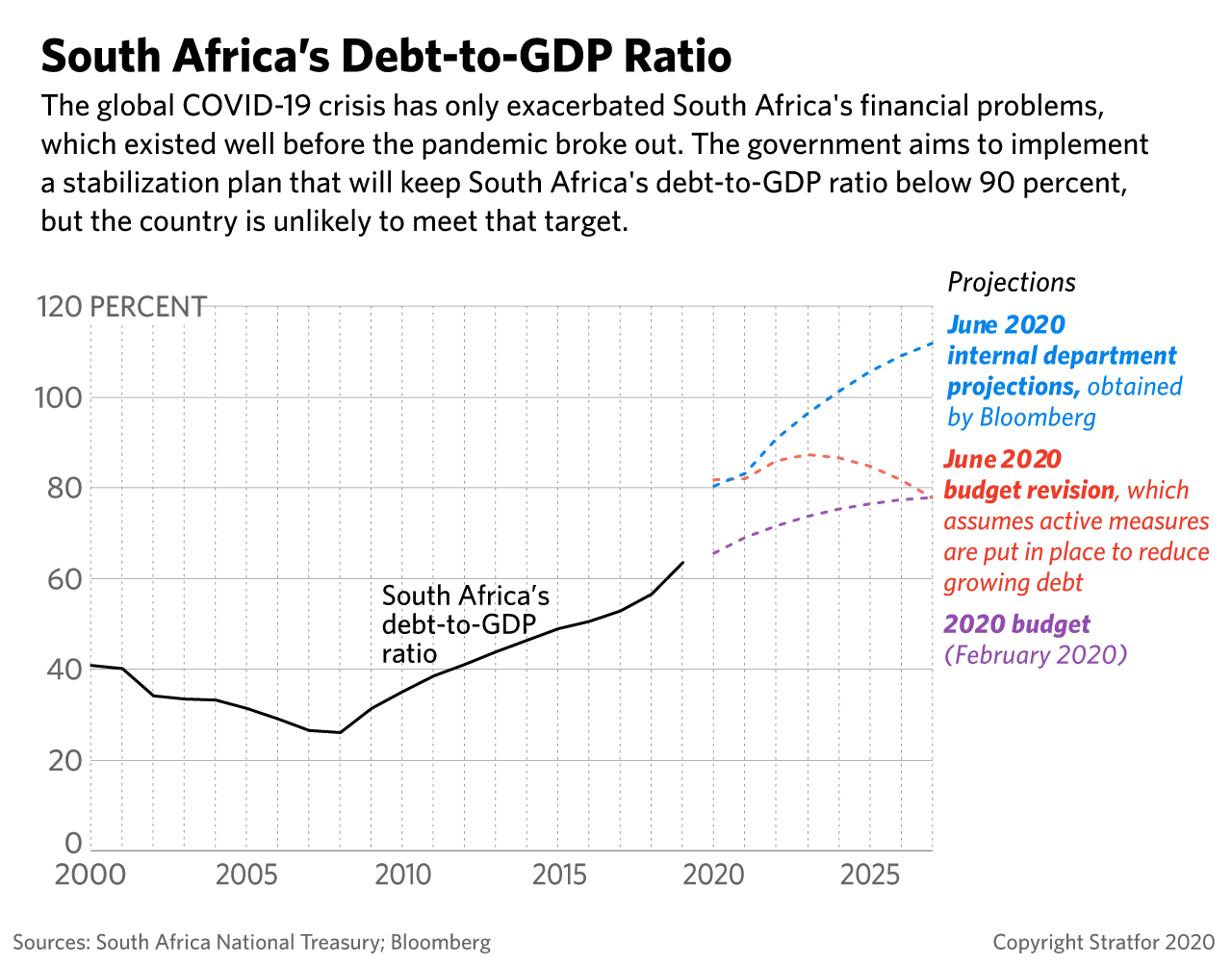
- On June 24, South Africa released an updated budget in light of the COVID-19 crisis. South Africa's treasury is now expecting a 7.2 percent contraction in GDP in 2020 and that its consolidated budget deficit will reach 15.7 percent of GDP. The treasury also increased its expected debt-to-GDP ratio by the end of this fiscal year by 16.2 percentage points to 81.8 percent.
- The government plans to adopt an "active approach" to consolidate its finances and have its debt-to-GDP ratio peak at 87.4 percent in fiscal year 2024, but internal estimates leaked on June 20 show South Africa's debt-to-GDP ratio reaching 96.4 percent by FY 2024, and continuing to increase throughout the rest of the decade.
- According to the updated budget, South Africa is now expecting its ten-year GDP growth between 2014 to 2024 to total just 3.9 percent (or 0.4 percent on an annualized basis). This is far below South Africa's roughly 1.3 percent population growth rate, highlighting a decade-worth of negative GDP growth per capita.
- Despite Pretoria's fiscal stimulus efforts, total government spending this year is still only set to increase by 2.4 percent over its originally planned budget.
The adjustment to the budget comes as the COVID-19 crisis and the government's failed response plan continue to drive South Africa's already debt-ridden economy deeper into recession.
- Prior to the pandemic, South Africa was already projected to have another year of dismal economic growth. The South African economy, which officially entered a recession in March 2020, has recorded growth rates below 1.0 percent for three of the past four years.
- To jump-start its economy, South Africa had planned to launch an austerity push over the next three years to balance its budget. But the additional spending needed to keep its economy from complete collapse amid the COVID-19 crisis has largely dashed those plans.
- On June 24, Finance Minister Tito Mboweni said his staff planned to present the International Monetary Fund (IMF)'s executive board with a request for a $4.2 billion loan. But a full-blown financial assistance package that includes IMF-mandated economic reforms is unlikely, given the deep-seated concerns about neo-colonialism and reforms that undercut the ruling ANC party's support base.
If the country continues to see a surge of COVID-19 infections, Pretoria may be forced to paint an even bleaker economic outlook in its next budget update, which is expected later this year.
- South Africa has emerged as one of the world's hotspots for COVID-19, with the country's cases now totaling over 151,000 as of July 1. The number of new daily cases is still increasing, making the potential for more economically disruptive shutdowns to contain the spread possible.
- Such an extended crisis would reduce tax revenue significantly by continuing to stymy business activity and consumer spending. This would, in turn, further strain government revenue, which is already expected to contract 18.3 percent year-on-year.
- The need for South Africa to funnel resources toward health services and other areas of the economy to manage the pandemic will likely impede the government's ability to fund bailouts for the country's embattled state-owned enterprises, such as Eskom.
- As Pretoria focuses on short-term crisis management, significant structural reforms needed to boost the country's long-term economic growth potential, including those aimed at resolving the country's labor market inefficiencies and bloated SOEs, will likely be delayed as well.
South Africa's ongoing economic struggles could ultimately jeopardize President Cyril Ramaphosa's political future by straining the ANC's political alliances with labor unions, whose poorer Black members will be most impacted by any spending cuts.
- Both the health and financial impacts of South Africa's COVID-19 outbreak have disproportionately affected the country's Black population. Only 10 percent of Black South Africans have access to health insurance plans, forcing most to rely on the public health care system. Many also work in industries such as mining where organized labor movements are prominent, and where remote working is often not an option, raising their risk of exposure to the virus.
- The government's inability to address its economic and social challenges will drive a wedge between current ANC leaders, who hail from Ramaphosa's more pro-business wing, and its constituencies and political allies.
- Pushback from the ANC's factions backing pro-poor growth measures will further hinder the Ramaphosa administration's ability to implement effective austerity measures, such as those to the labor market and the SOE sector.
- The need to soften the blow of such spending cuts on its more vulnerable support base will compel the ANC to instead enact pro-poor growth spending measures, which will only lengthen South Africa's financial crisis beyond the government's projections by driving the country deeper into debt.
- Within this context, Ramaphosa may face the same fate of South Africa's last two presidents, who were recalled in the midst of serving their second terms, especially if the ANC performs poorly in 2021 municipal elections.
