
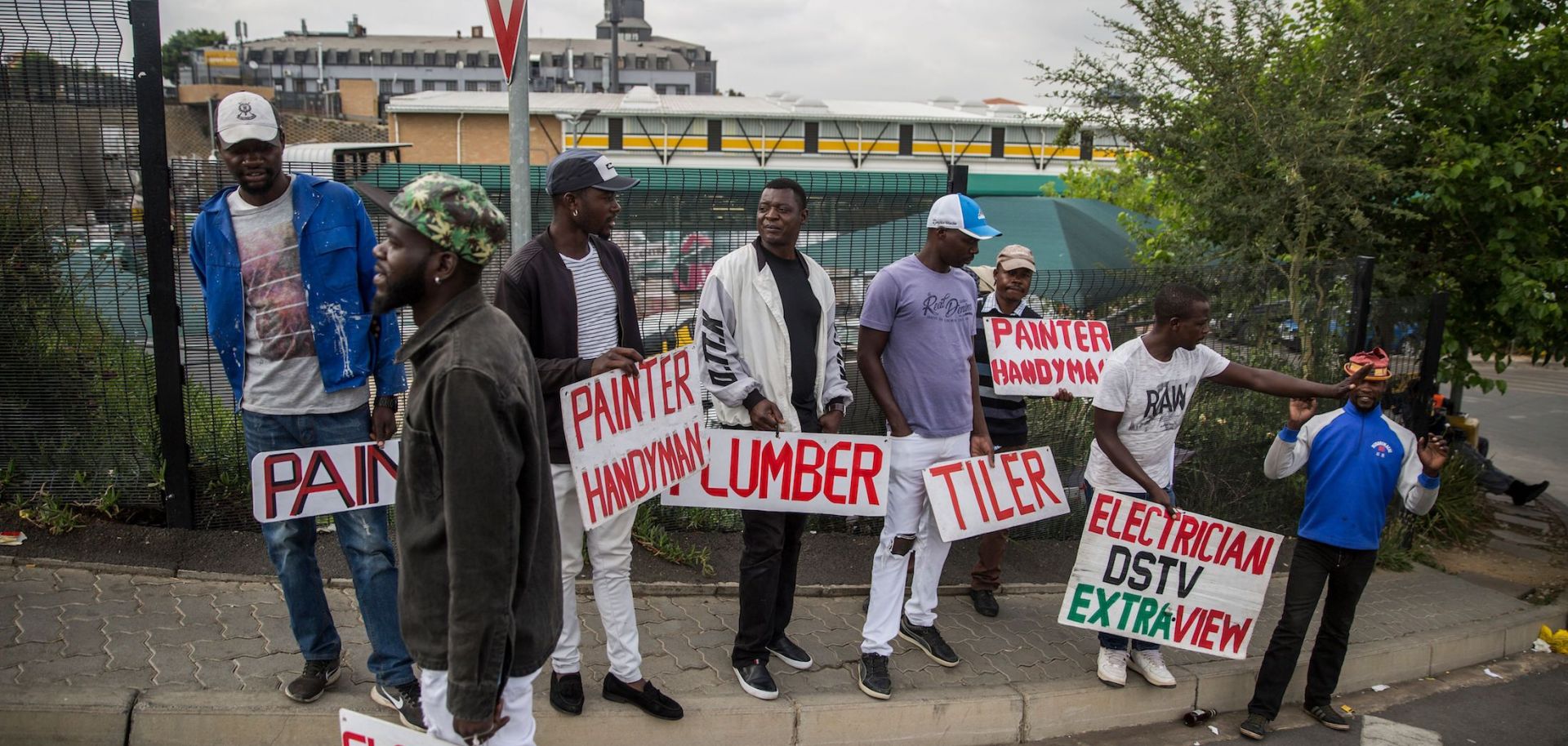
Unemployed builders, tilers and plumbers seeking employment stand on the side of a road in Johannesburg soliciting for jobs. The government has revised South Africa's already grim economic outlook downward in its budget review for the 2020 fiscal year.
South Africa’s newest budget review paints a bleak picture for the country’s economy over the next three years. The budget plan for the 2020 fiscal year, unveiled Feb. 26, projects economic growth over the next three years of just 0.9 percent, 1.3 percent and 1.6 percent, respectively – and this may be optimistic, compared with the International Monetary Fund's projections. The new budget dramatically alters South African expectations in terms of fiscal and debt consolidation over the next year, as it no longer views balancing its primary budget by 2022 as possible. The new budget also attempts to curb years of wage and expenditure growth – setting up more confrontations between the government and labor unions.
A Grimmer Budget Outlook
South Africa’s new budget is a significant revision from the plan that had been announced just four months ago, especially for its debt outlook. In October, the National Treasury projected South Africa’s debt-to-GDP ratio to stand at 57.8 percent by the end of 2020 fiscal year but it now has increased that estimate to 65.6 percent. It also increased its debt-to-GDP outlook for the end of the 2020 fiscal year by 11.9 percentage points to 71.6 percent. This could prompt Moody’s, the only rating agency that has maintained South Africa's debt as investment grade, to downgrade it to junk status after its March review. This, in turn, could further weaken the rand and lead to capital outflows of several billion dollars.
The rising debt levels reflect anemic growth expectations driven in large part by the country’s myriad of structural challenges that cannot be quickly resolved. South Africa’s state-owned enterprises, struggling with their own debt crises, are projected to receive some $8.5 billion in bailouts from the government over the next three years. Most of that will go to the embattled national electric utility company, Eskom, which is the main contributor to South Africa's non-interest expenditure growth over the next year. Beyond unreliable electricity supplies, other issues contributing to South Africa’s structural economic woes include a rigid labor market, its dependence on natural resources, an unreliable power supply, weak governance and policy uncertainty as it relates to issues such as land expropriation.
Eskom’s struggles sit at the heart of the country’s economic crisis. The utility's electricity production declined by 1.4 percent in 2019, and the portion of its electricity generation capacity actually in service (and not offline for maintenance or other issues) fell from 71.8 percent to just 67 percent in 2019 – and under 60 percent during the heat of the South African summer in December. This was attributable to operational failures at two key coal-fired power plants, heavy rains resulting in wet coal and other issues. The power crisis caused Eskom to conduct frequent load-shedding, a select reduction of electricity supplies necessary to prevent the entire grid from collapsing, in the fourth quarter. These rotating outages hit virtually all aspects of the South African economy, potentially leading to a GDP contraction. The utility's problems will not easily be solved, and they will likely continue to be a drag on the economy over the next three years.
Possible Labor Problems Ahead
South Africa is now expecting to run an average budget deficit of 6.2 percent over the next three years despite significant cuts to a wage bill that has added strain to labor negotiations with unions. As revenue growth is expected to drop in tandem with the GDP slowdown, South Africa’s debt-service costs are expected to reach just over 18 percent of revenue by 2022. In order to keep its fiscal deficit manageable, South Africa is planning to cut its wage bill by $10.5 billion, collectively, over the next three years and has pushed unions to quickly renegotiate the final year of the current labor agreement, which expires next year.
The Public Servants Association, which represents 230,000 workers, rejected the review even before the budget was unveiled, adding more future risk to South Africa’s financial situation. If the labor unions and the South African government cannot come to a negotiated settlement to adjust the last year of the labor agreement, the country will likely struggle to hit its targeted wage bill reductions for this year — or be forced to order widespread layoffs. COSATU, the country’s most important labor federation, likened doing so to a declaration of war. Any attempt by Pretoria to curb the wage bill without an agreement with the unions will almost certainly lead to widespread strikes and protests similar to those in 2010 that saw some 1.3 million public workers walk off the job. Even if South Africa does not try to push forward with the wage proposal in 2020, it will likely dig in for difficult negotiations with the unions for a new labor contract when the current one expires next year – and that could also lead to strikes in the public sector similar to those in 2010, which were a part of labor negotiations and eventually enabled the unions to extract large wage increases.
COSATU has also threatened to have a "parting of ways with the government" if the proposal goes forward. This sentiment highlights the potential for a future significant political crisis for the African National Congress (ANC) as a result of its financial crisis. Historically, the ANC has long been able to count on union support to maintain power, but over the past decade, that relationship has frayed as the ANC has been unable to keep up with union demands to mirror the significant year-over-year increases in compensation, as were common before the 2007-08 financial crisis when mining exports surged. The popularity of a competing party, the leftist Economic Freedom Fighters (EFF), grew quickly after it was founded due to support from portions of the disgruntled mining workforce that saw wage stagnation. The EFF has since grown into a relatively strong political actor in South Africa. The ANC’s relationship with COSATU and the South African Communist Party — South Africa’s so-called tripartite alliance — will likely fray further, if not break, in the future. And this will eventually put the ANC’s long-term dominance of South Africa’s political system in jeopardy.
