
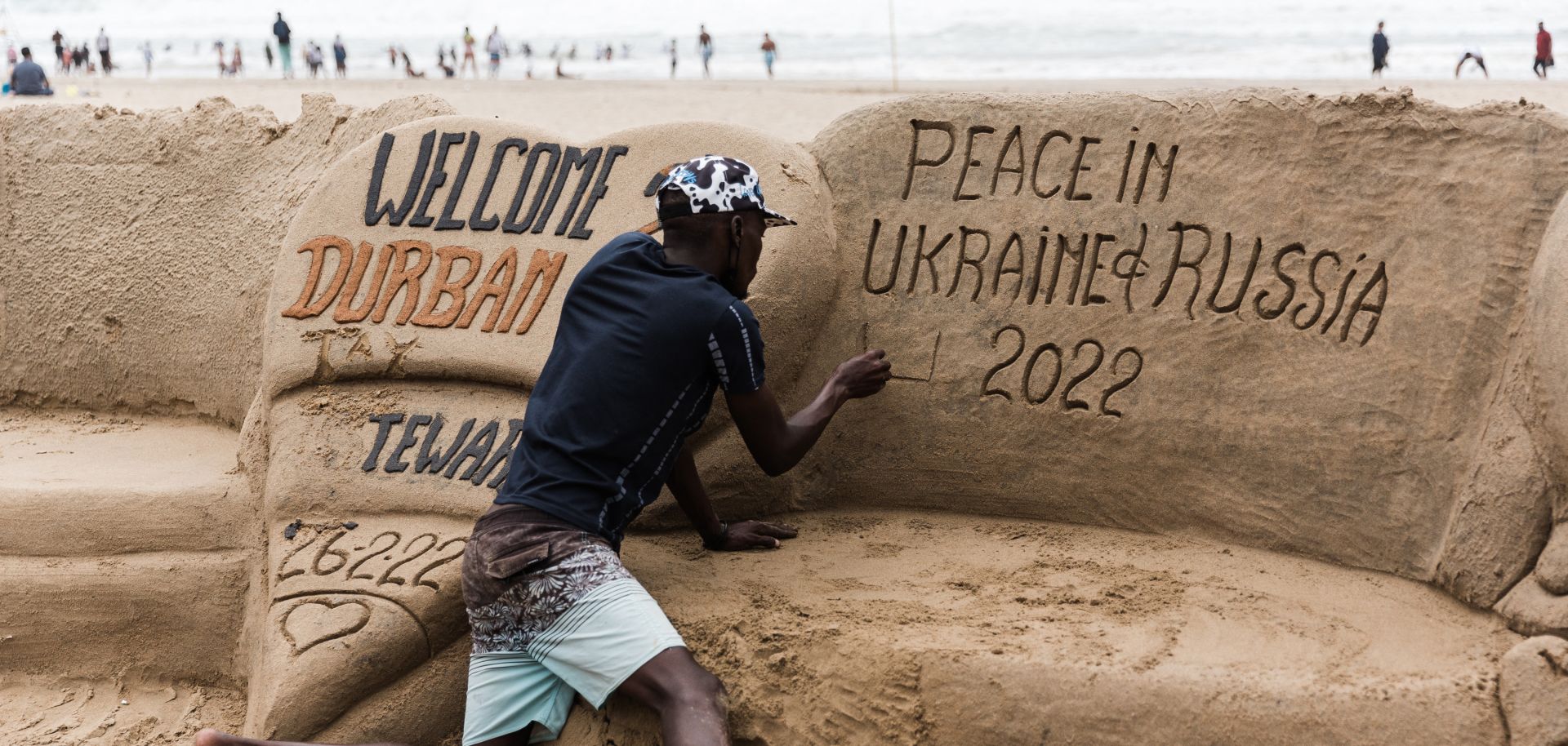
A sand sculptor writes a message calling for peace between Ukraine and Russia on a beach in Durban, South Africa, on Feb. 27, 2022.
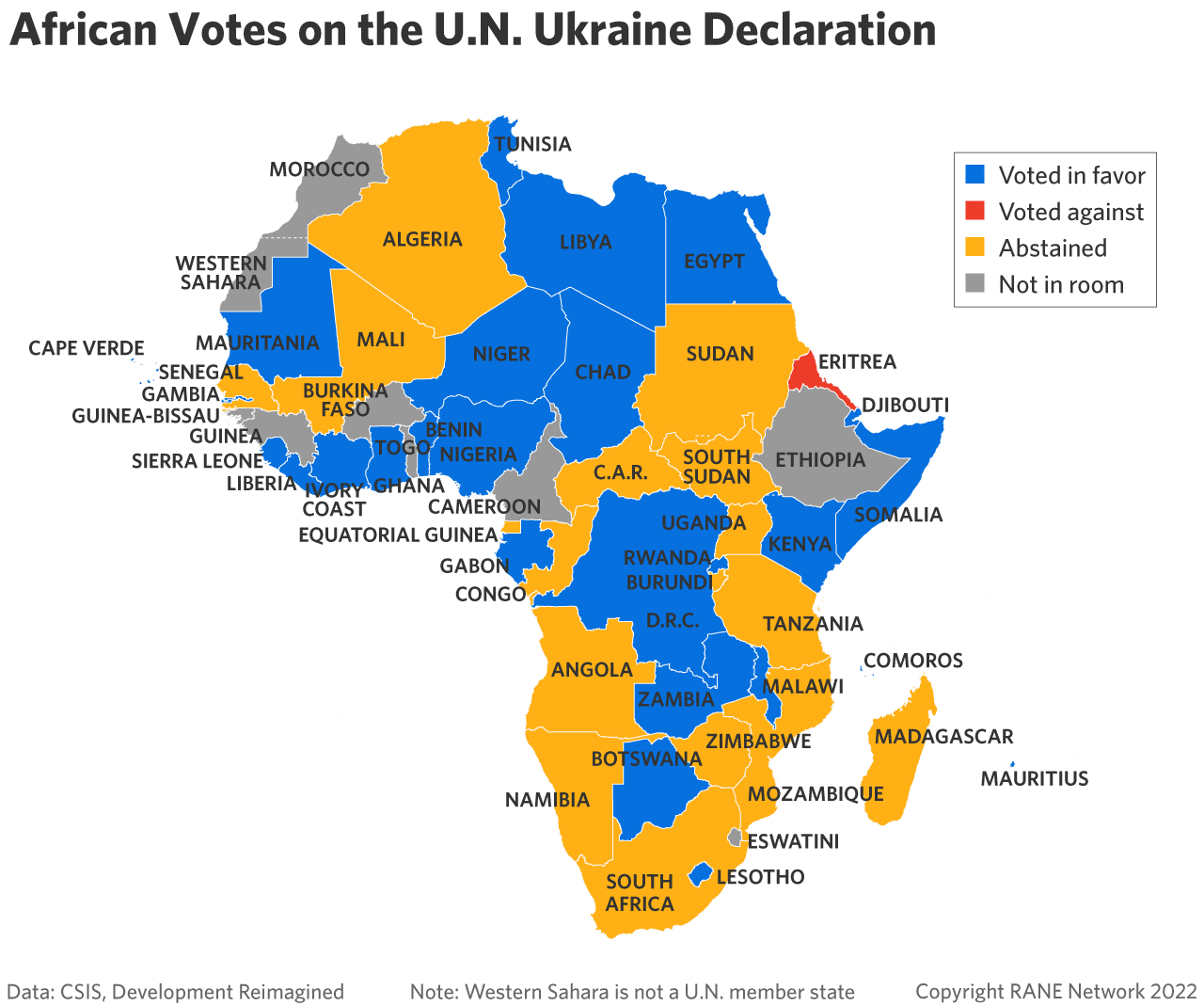
The increasingly multipolar world order is empowering some African countries to maintain a neutral stance on the war in Ukraine, despite pressure from the United States and its allies to condemn Russia. And with limited repercussions from the West, these nations will likely be free to continue prioritizing pragmatism over ideological alliances in their response to the ongoing conflict. 28 African countries supported the U.N. resolution on March 2 condemning Russia's invasion of Ukraine. 17 African states, however, abstained while eight other countries were absent from the vote. During a March 31 press conference, U.S. Ambassador to the African Union Jessica Lapenn said that the United States was looking for strong African responses to Russian aggression, and specifically welcomed the opportunity to work with Senegal, one of the African countries that voted in favor of the U.N. resolution. Lapenn's remarks align with the U.S. and Western European position that African states should condemn the Russian invasion, and that neutrality or abstention implies complicity with Moscow's actions in Ukraine.
- Eritrea is the only African country that voted against the March 2 resolution, likely due to Eritrean President Isaias Afwerki's close relationship with Russian President Vladimir Putin and animosity toward the West, which was recently punctuated by new U.S. sanctions imposed on Eritrea in November over its role in the war in neighboring Ethiopia.
- Some African leaders have criticized the United States' insistence that Africa should condemn Russia's Ukraine invasion, saying it implies their countries need Western guidance for their foreign policy and are not free to choose their own diplomatic path.
For many African countries, neutrality is in itself a position on the war, influenced in part by an increasingly multipolar world order. For decades, anti-Western imperialism has motivated resistance in sub-Saharan Africa to U.S. and European global dominance. However, the growing shift from a U.S.-led unipolar world to a more ''multipolar world'' — with China, Russia and India forming some of those poles — is further motivating some African leaders to reject the idea they must choose between the East and the West. From the perspective of the developing world, with increased multipolarity comes more choices, leading to more flexible — and more volatile — alignments. This trend is visible in Africa's diverse political, economic, security, social and ideological partnerships with their U.S., European, Chinese and Russian counterparts. Africa's largest economies, including Nigeria, Kenya and South Africa, each pursue loans, arms deals and infrastructure projects with disparate partners, sometimes pitting global powers against one another in order to capitalize on the most advantageous deal. Western pressure to condemn the Russian invasion of Ukraine flies in the face of the reality that the United States and its allies' dominance over the global order is weakening, thus reducing African countries' incentive for developing exclusive political or economic alliances with Western governments. Against this backdrop, neutral African states — many of which have had their own wars in the recent past — are focused on their own survival, growth and independence in an increasingly uncertain world.
- The African countries that voted in favor of the U.N. resolution to condemn Russia's invasion largely cited what Kenya's U.N. ambassador referred to as a duty to safeguard Ukraine's territorial integrity. Those that abstained from the vote, however, cited equally principled reasons for their decision; Ugandan President Yoweri Museveni, for example, alluded to Western ''double standards'' in justifying his country's neutral position on the conflict, and said that he prefers maintaining diplomatic ties with China over the United States because Beijing does not advocate for interfering in the domestic affairs of other countries.
- The United States has repeatedly criticized South Africa, in particular, for remaining neutral on the war in Ukraine, to which President Cyril Ramaphosa responded by lambasting what he calls NATO's encroachment in Ukraine. During a debate in the U.N. General Assembly on March 2, South Africa's ambassador Mathu Joyini suggested Western countries had committed their own violations of the U.N. Charter throughout history and were using the resolution condemning Russia's actions to increase their own geopolitical advantage over Moscow.
Multipolarity is visible in sub-Saharan African countries' diverse — and sometimes conflicting — global partnerships on issues like economic development, territorial sovereignty and political stability. As the saying goes, all politics is local. Undoubtedly, leaders across Africa are considering how the myriad possible outcomes of the war in Ukraine will impact their international partnerships and ability to maintain governance. Arms deals, loans, infrastructure agreements, foreign aid, trade agreements, treaties and tariffs with disparate partners (some of whom are on opposite sides of the Ukrainian conflict) factor into the equation. For some of the African states that either abstained or weren't present for the vote on the U.N. Ukraine declaration (like Ethiopia, Uganda, Mali, Sudan and the Democratic Republic of the Congo), condemning Russia would risk setting a precedent for international intervention that could later see foreign powers investigate security, political and humanitarian issues within their own borders. Separately, Western sanctions against Russia are driving food crises and price surges across Africa, which make leaders more vulnerable to internal threats of political and social instability. Maintaining a neutral diplomatic stance on the war in Ukraine does not alleviate these challenges; it does, however, grant African leaders flexibility as they attempt to leverage the situation to support negotiations with the United States, China and other international partners.
- Russia's bilateral trade with sub-Saharan Africa amounted to about $7 billion dollars in 2021 (the United States and Europe's combined trade totaled roughly $44 billion by comparison). Russia also remains the largest arms exporter to Africa and weapons frequently cross political borders. Russian arms are being used in ongoing conflicts in Burkina Faso, Cameroon, Central African Republic, Chad, Congo, Ethiopia, Mali, Mozambique, Niger, Nigeria, Sudan, South Sudan and Somalia, among others.
- China has strong financial ties with many African nations and has also begun expanding its role in maintaining the Continent's peace and security. Beijing has announced several diplomatic initiatives focused on promoting the stability of Ethiopia and Somalia, both of which have ongoing civil wars within their borders.
- In a region plagued by conflict and military coups, rising food insecurity brought on in part by price hikes resulting from Western sanctions against Russia makes African countries even more vulnerable to insurgencies, political instability and overall unrest. West Africa is currently facing its worst food crisis on record, with a 40% increase in hunger from 2021.
Despite its rhetorical condemnation, the West is ultimately unlikely to sanction African countries for retaining a neutral stance on the Russia-Ukraine conflict, reducing the risk of direct economic consequences for states that chose to do so. While states like South Africa and Uganda may not currently curry favor with the United States, Washington is unlikely to punish African neutrality given its preoccupation with the war and other urgent issues. As such, neutral African states are pursuing what they likely view as a low-cost method of maintaining distinct partnerships through the conclusion of the Ukrainian war. It is in the interest of most (if not all) African states to maintain political, economic and security ties with a diverse array of global partners, particularly if the cost of doing so is minimal to nonexistent. Although the West appears to view African support as crucial to the global response to Russian aggression, African leaders will likely continue to pursue pragmatism as the war rages on.
